A Mississauga landlord lost $1,800 in a single month—not because their tenant stopped paying rent, but because they used the wrong lease form. Under Ontario law, the tenant was legally entitled to withhold that money permanently. This isn't an edge case. It happens constantly to landlords who don't understand the rules around Ontario's mandatory Standard Lease.
Many Ontario landlords still use outdated templates, OREA Form 400 alone, or DIY Word documents—unaware that since April 30, 2018, the government-mandated Standard Lease is required for most residential tenancies. Using the wrong form or including illegal clauses can cost thousands in withheld rent, dismissed LTB applications, and unenforceable terms.
This guide covers everything landlords need to know about the Ontario Standard Lease in 2026: what's required and what's changed, how Bill 60 affects your lease strategy, which clauses are enforceable (and which will get thrown out), step-by-step completion instructions, and copy-paste additional terms that protect you at the LTB.
Ontario Standard Lease Compliance Checklist 2026
Don't risk losing thousands in withheld rent or dismissed LTB applications. This free checklist ensures your Ontario lease is legally compliant with Bill 60 changes—download now and protect your investment.
Get Free PDF →What Is the Ontario Standard Lease?
The Ontario Standard Lease is the government-mandated form every private residential landlord must use when renting out their property. Governed by the Residential Tenancies Act, 2006 (RTA), this standardized lease became mandatory on April 30, 2018, with an updated version required since March 1, 2021. The official form number is Form 047-2229.
The purpose of standardization is straightforward: prevent landlords from including illegal or unenforceable clauses that violate tenant rights under the RTA. Before the Standard Lease, landlords could (and often did) include terms that contradicted provincial law—terms tenants unknowingly signed but couldn't legally be held to.
Who Must Use the Standard Lease
The Standard Lease applies to all private residential tenancies in Ontario: apartments, condos, houses, basement units, and any other living space rented for residential purposes. This applies regardless of rent amount or lease length. Whether you're renting a $1,500 basement apartment or a $5,000 downtown condo, you need the Standard Lease.
Exemptions
A small number of housing types are exempt from the Standard Lease requirement: care homes and long-term care facilities, mobile home parks and land lease communities, social housing and co-operatives, and commercial properties. If your rental doesn't fall into these categories, you must use the Standard Lease.
The 15 Mandatory Sections
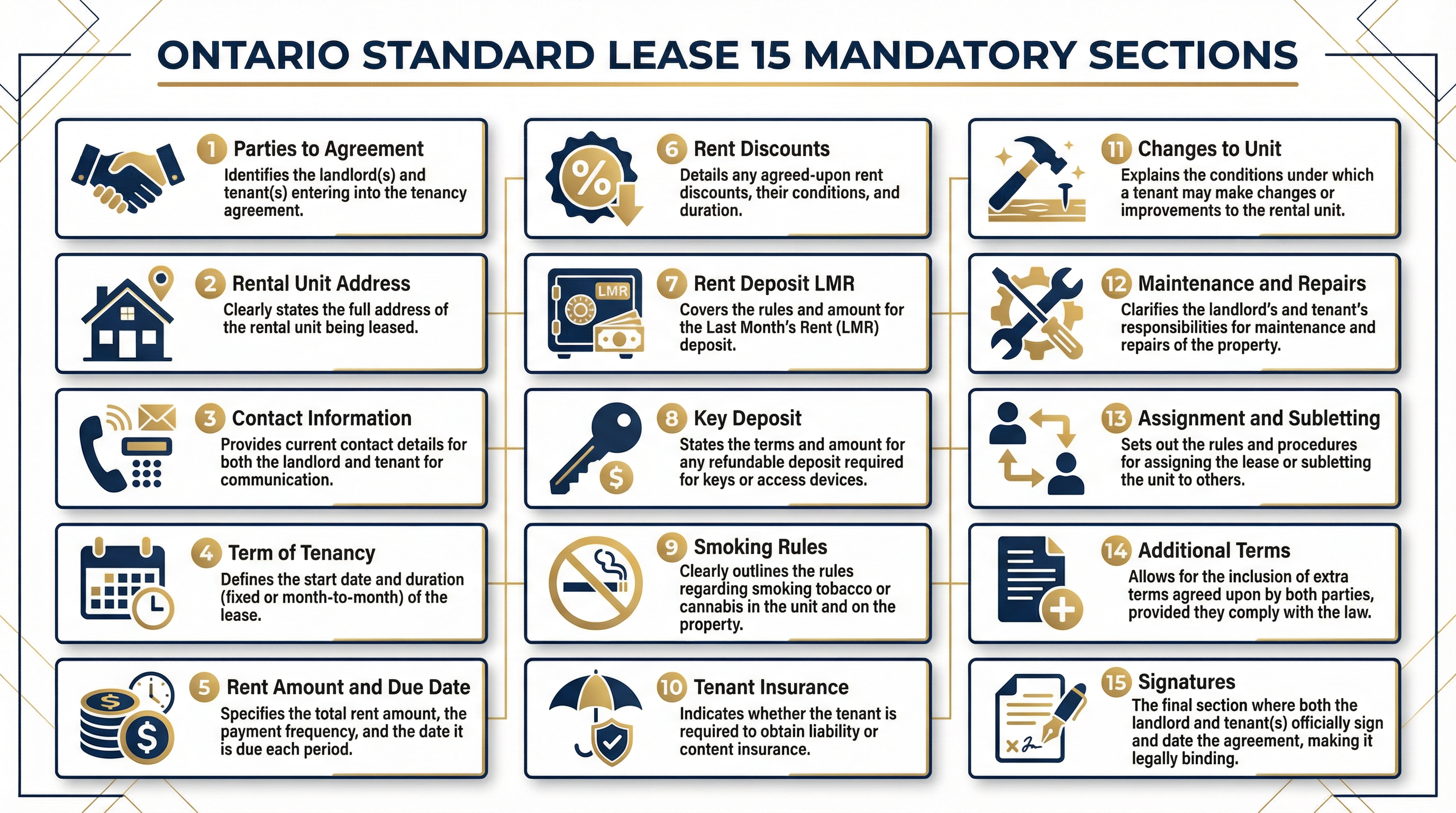
The Standard Lease contains 15 sections that cannot be altered or removed. These cover: parties to the agreement, rental unit address, contact information, term of tenancy, rent details, rent discounts, rent deposit, key deposit, smoking rules, tenant insurance, changes to the rental unit, maintenance and repairs, assignment and subletting, additional terms, and signatures. Each section serves a specific legal purpose, and leaving any blank creates ambiguity that typically works against the landlord at the LTB.
2026 Updates: What's Changed and Why It Matters
If you're an Ontario landlord, 2026 brings significant changes to how you manage your rental properties. Bill 60 (the Fighting Delays, Building Faster Act, 2025), passed November 24, 2025, has fundamentally altered eviction timelines and LTB procedures. Understanding these changes is critical to your lease strategy.
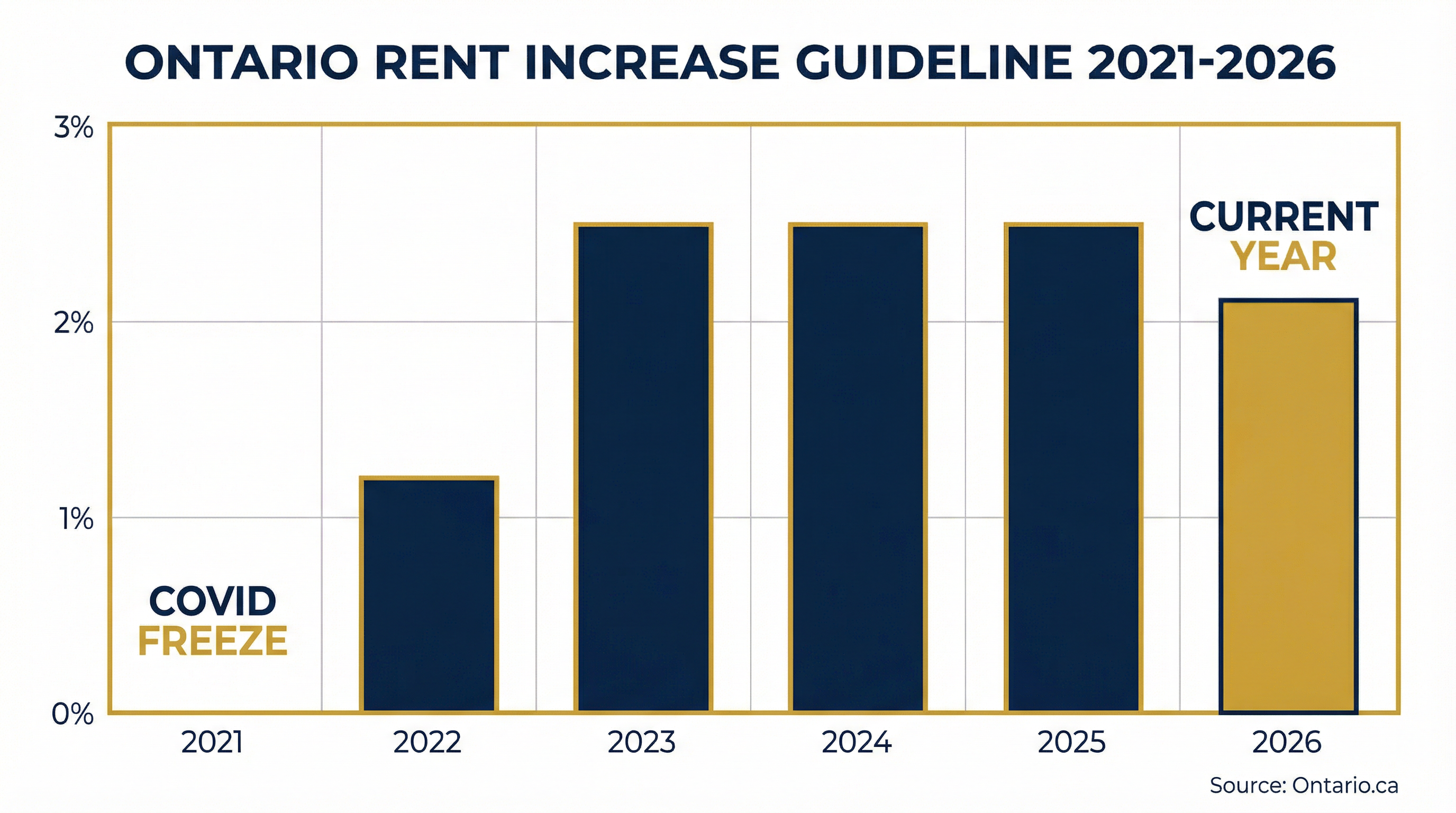
2026 Rent Increase Guideline: 2.1%
The 2026 rent increase guideline is 2.1%—the lowest cap in four years, down from 2.5% in 2025. This applies to units first occupied on or before November 15, 2018. Units occupied after that date remain exempt from rent control, meaning landlords of newer buildings can increase rent by any amount with proper notice. The maximum Above Guideline Increase (AGI) remains 3% above the guideline, allowing a total increase of up to 5.1% for 2026 if approved.
Bill 60: The Biggest Changes in 20 Years
Bill 60 represents the most significant changes to Ontario's rental landscape in two decades. The key provisions now in effect include:
N4 Notice Period Shortened: The termination date on N4 notices (non-payment of rent) has been reduced from 14 days to 7 days. This means landlords can file an L1 application at the LTB one week faster than before.
Appeal Window Reduced: The window to appeal LTB decisions has been cut from 30 days to 15 days. Both landlords and tenants need to act faster if they disagree with a ruling.
50% Arrears Rule: Tenants must now pay 50% of their rent arrears before they can raise maintenance issues at an LTB hearing. This addresses a common delay tactic where tenants would cite unrelated maintenance problems to postpone eviction proceedings.
Standardized Forms: The government may now prescribe exact form contents, potentially affecting how additional terms are structured in future lease versions.
How Bill 60 Affects Your Lease
Faster eviction timelines mean lease compliance is more critical than ever. Clear additional terms reduce disputes before they reach the LTB. Documentation requirements are stricter—your lease is evidence. Payment terms and late rent procedures should be crystal clear. The landlords who will navigate 2026 successfully are those with airtight leases that leave no room for interpretation.
Market Context
Understanding the rental market context helps frame your lease decisions. Ontario's 1-bedroom average rent currently sits at $1,939 per month. The GTA vacancy rate has risen to 3.0%—the first time it's been at this level since the pandemic. Approximately 75% of new buildings are offering move-in incentives like one to two months of free rent. The average eviction cost exceeds $11,500 when you factor in lost rent, legal fees, and vacancy. LTB hearings currently take between 3 and 17.9 months for 80% of cases.
As CMHC Deputy Chief Economist Tania Bourassa-Ochoa noted: "The tight conditions that defined rental markets in the past few years in Canada's largest cities loosened in 2025."
Common Mistakes That Void Your Lease Terms
Understanding what makes a lease term invalid is just as important as knowing what to include. The most expensive mistakes landlords make aren't tenant problems—they're self-inflicted wounds from using the wrong forms or including unenforceable clauses.
Mistake #1: Using the Wrong Form
OREA Form 400 alone is NOT valid—it can only supplement the Standard Lease, not replace it. Generic templates downloaded from the internet likely contain illegal terms. Outdated lease versions from before March 2021 may cause problems at the LTB. Always use the official Ontario Standard Lease form (Form 047-2229, 2020 version).
Consider this real case: A first-time landlord in Mississauga used a generic lease template downloaded from the internet. The tenant requested the official standard lease in writing. The landlord ignored the request. After 21 days, the tenant withheld $1,800 in rent. After 30 more days without receiving the lease, the tenant kept the money permanently—all legal under the RTA.
Mistake #2: Including Illegal Clauses
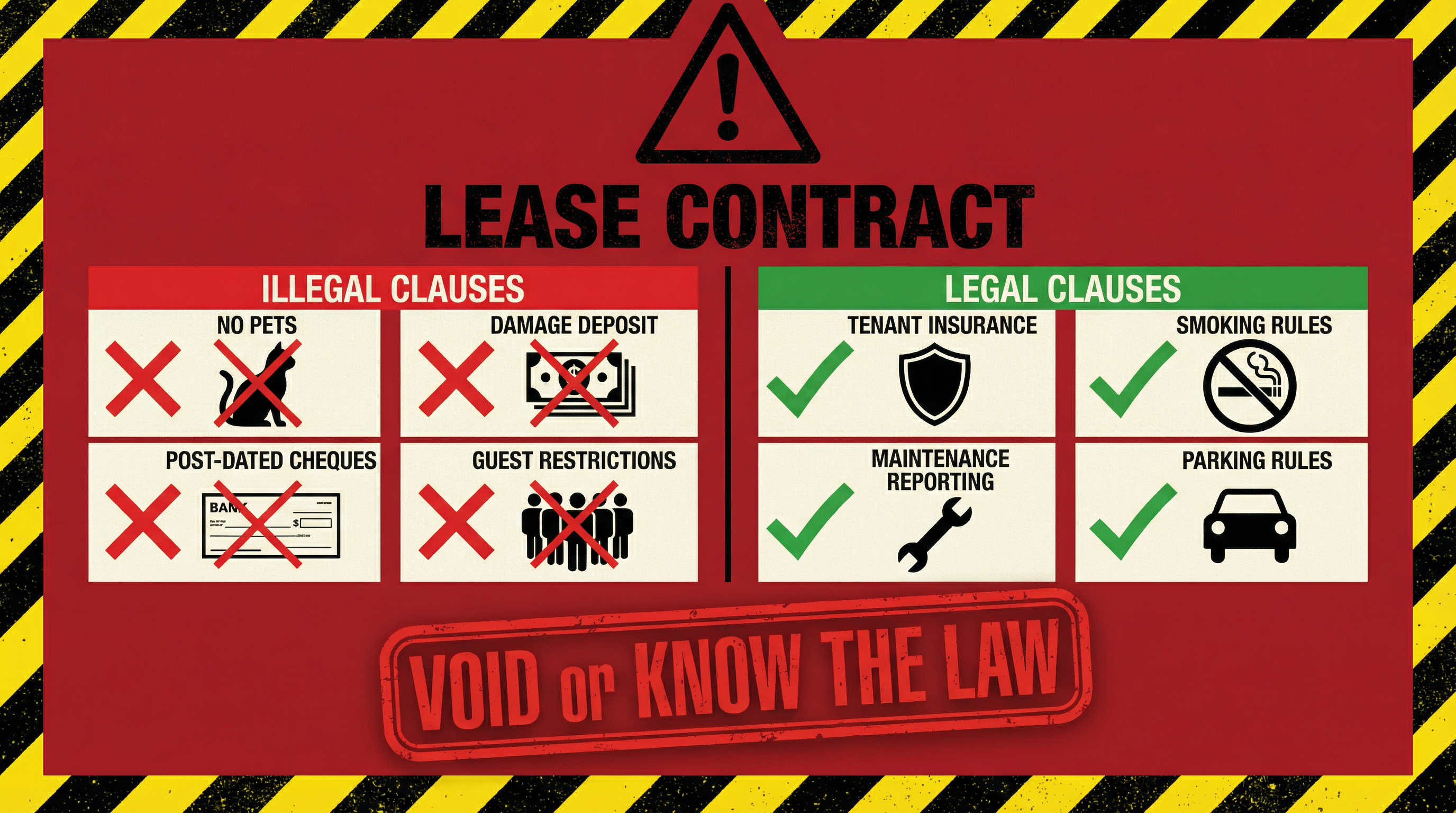
These clauses are void and unenforceable even if the tenant signs them:
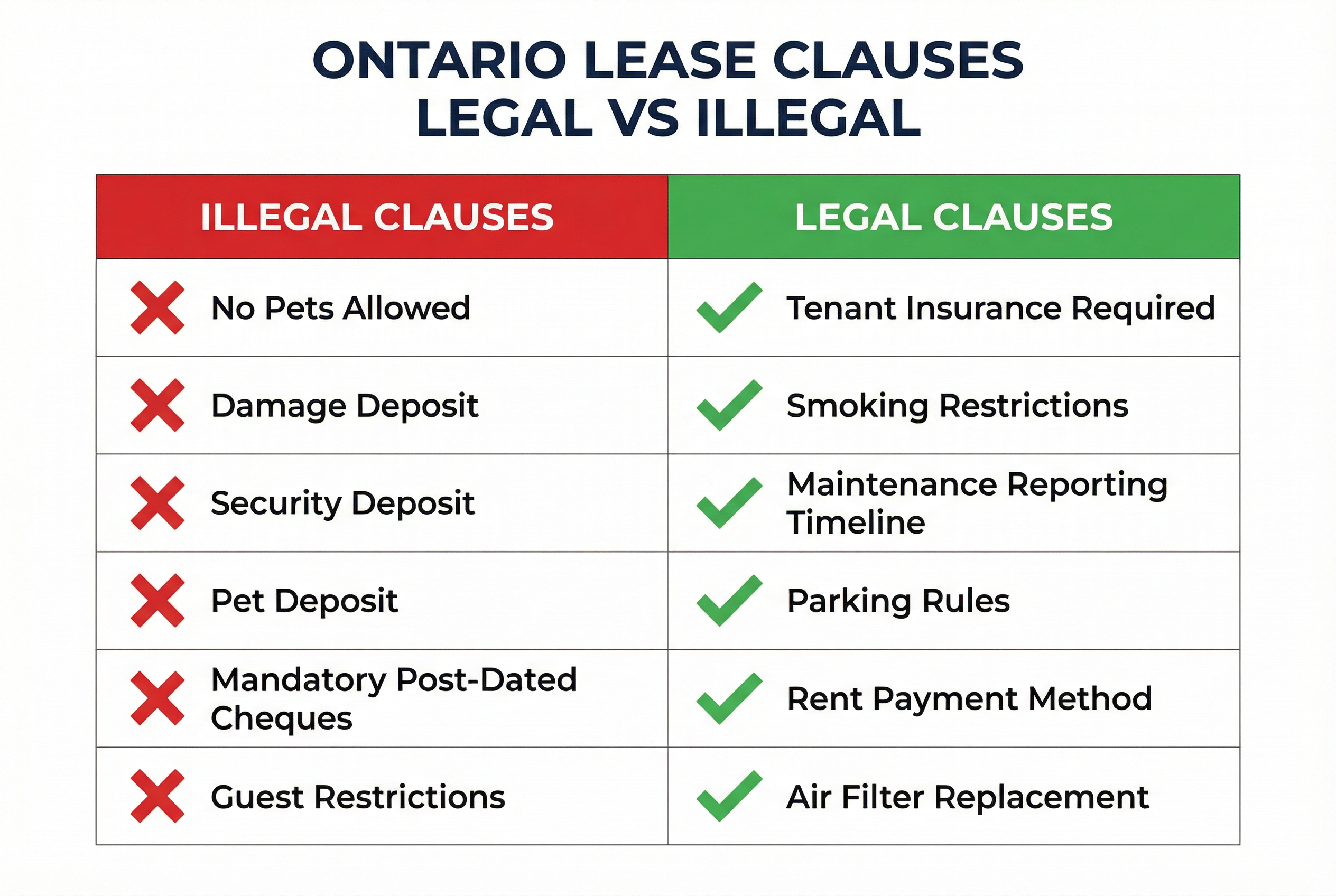
"No pets allowed" clauses violate RTA Section 14. You cannot evict for pet ownership, and the clause is unenforceable. The only exception is if your condo corporation has specific pet restrictions in its bylaws.
Damage or security deposits are illegal. Only last month's rent (LMR) and a refundable key deposit are permitted. Any "damage deposit," "pet deposit," or "security deposit" gives the tenant grounds to file a T1 application for refund.
Mandatory post-dated cheques cannot be required. You can offer the option and accept if the tenant agrees, but you cannot demand them as a condition of tenancy.
Guest restrictions that limit who can visit or stay with the tenant violate tenant rights and are unenforceable.
Interest on late rent is not permitted under the RTA. You cannot charge interest on rent arrears.
Tenant-paid landlord repairs clauses that shift maintenance responsibility to the tenant are void. Landlords have a legal obligation to maintain the property.
As Marda Management puts it: "The biggest mistake landlords make is including terms that violate the RTA. Any term in a lease that contradicts the RTA is void and unenforceable, even if the tenant signs the document."
Case Study: The Pet Clause Trap
A Toronto landlord included "No pets allowed" in their lease. The tenant signed but later adopted a cat. The landlord issued an N5 for lease violation. At the LTB hearing, the adjudicator dismissed the application—pet bans are unenforceable under the RTA. The landlord lost months of time and $200 in filing fees, and the tenant kept the cat.
Mistake #3: Failing to Provide the Lease
If a tenant requests the Standard Lease in writing and you don't provide it within 21 days, the tenant can legally withhold one month's rent. If you still haven't provided it after 30 more days, the tenant keeps that withheld rent permanently. Additionally, the tenant can terminate a fixed-term lease early without penalty. Always provide the Standard Lease proactively—don't wait for a request.
Mistake #4: Incomplete Sections
All 15 sections must be filled out. Leaving sections blank creates ambiguity that the LTB may interpret against the landlord. Even if a section doesn't apply to your situation, write "N/A" rather than leaving it empty.
Penalty Ranges for Violations
The consequences of lease violations can be severe. Individuals face fines up to $50,000, while corporations can be fined up to $250,000. New administrative penalties under Bill 60 range from $500 to $10,000.
Unsure if your current lease is compliant? Use Tenon10's free Lease Builder to generate a fully compliant Ontario Standard Lease in minutes. Try the Lease Builder →
How to Create a Bulletproof Ontario Lease
Now that you understand what NOT to do, here's exactly how to create a lease that protects you at the LTB and withstands legal scrutiny.
Step 1: Use the Official Form
Download the Standard Lease from Ontario.ca or use Tenon10's Lease Builder. The current required version is Form 047-2229 (2020 version, required since March 1, 2021). Never modify the pre-printed portions of the form—any alterations can invalidate terms or create grounds for dispute.
Step 2: Complete All 15 Sections
Walk through each section carefully:
Section 4: Term of Tenancy — Specify whether the lease is fixed-term or month-to-month. Note that under the RTA, fixed-term leases automatically convert to month-to-month at their end unless properly terminated.
Section 5: Rent — Include the exact amount, due date, and payment method. Be specific: "Rent of $2,000 is due on the 1st of each month via e-transfer to [email protected]." Ambiguous payment terms create problems when you need to prove non-payment.
Section 7: Rent Deposit (Last Month's Rent) — You can only collect LMR, not a damage deposit. You must pay interest annually (2026 rate: 2.1%), and this deposit can only be applied to the last month of tenancy—not used as a damage offset.
Section 8: Key Deposit — The maximum you can charge is the actual replacement cost of keys. This deposit must be fully refundable when keys are returned.
Step 3: Add Legal Additional Terms (Section 15)
Section 15 is where smart landlords differentiate themselves. These additional terms ARE enforceable when properly written:
Tenant Insurance Requirement: "Tenant agrees to obtain and maintain tenant insurance (contents and liability coverage of at least $1,000,000) throughout the tenancy and provide proof upon request."
Smoking Restrictions: "Smoking of any substance, including cannabis, is prohibited inside the rental unit and within 9 metres of any entrance, window, or ventilation intake."
Maintenance Reporting: "Tenant agrees to report any maintenance issues, water leaks, or pest sightings to the landlord in writing within 48 hours of discovery."
Air Conditioning/HVAC: "Tenant is responsible for replacing HVAC filters every 90 days and ensuring vents remain unobstructed."
Parking Rules: "One designated parking space (#___) is included. Guest parking in visitor spots only. No vehicle repairs, storage of inoperable vehicles, or commercial vehicles."
Rent Payment Method: "Rent shall be paid by e-transfer to [email protected]. NSF fees of $25 (or actual bank charge, whichever is less) apply to returned payments."
Step 4: Get Signatures Before Move-In
Both the landlord and all tenants listed on the lease must sign before the tenant takes possession. Each tenant should receive a signed copy. Keep the original for your records in a secure, accessible location.
Step 5: Provide Copy Within 21 Days
After signing, provide the tenant with their copy within 21 days. Keep proof of delivery—email receipt, courier tracking, or a signed acknowledgment. This protects you if the tenant later claims they never received the lease.
What Happens If Things Go Wrong
Your lease isn't just paperwork—it's your primary evidence at the LTB. Understanding how your lease terms translate to legal disputes helps you structure them for maximum protection.
When Your Lease Becomes Evidence
Every LTB application references the lease. Clear terms equal a stronger case. Ambiguous terms give the adjudicator discretion—which often favors the tenant in borderline situations.
Common LTB Scenarios Where Lease Terms Matter
Non-Payment (L1 Application): Your lease proves the rent amount and due date. Clear payment terms support your N4 notice. Under Bill 60, you only have 7 days before you can file an L1—there's no time to clarify ambiguous lease terms.
Damage/Disturbance (N5/L2): Your additional terms define what's prohibited. Without clear smoking rules, it's harder to prove a violation. The winning combination at the LTB is photos plus clearly documented lease terms.
Rent Increases (N1): Your lease start date determines when you can increase rent. You must wait 12 months from move-in or the last increase. The 2026 guideline is 2.1% for rent-controlled units—your lease documentation proves whether your unit qualifies for rent control.
Case Study: The Successful Additional Terms
An experienced Ottawa landlord used the Standard Lease with detailed additional terms: tenant insurance requirement, specific parking rules, maintenance reporting timeline, and clear smoking restrictions. When a dispute arose about property damage, the landlord had clear documentation showing what was expected. The LTB ruled in their favor because the terms were properly disclosed and didn't violate the RTA.
Cost-Benefit Analysis
Consider the true cost of different lease approaches. A DIY Word document is free but carries high risk—it likely contains illegal clauses. A downloaded PDF is free but medium risk—it's missing custom protections. Lawyer review costs $200-500 and offers low risk, but gets expensive if you have multiple properties. Tenon10's Lease Builder is free and low risk—it's built specifically for Ontario compliance.
Now consider the cost of getting it wrong: a tenant withholding rent costs $2,000 or more. An LTB application dismissed for invalid lease terms costs $200 in fees plus months of lost rent. A bad faith eviction penalty can reach $35,000. Legal fees for lease disputes typically run $1,000 to $10,000+.
Ontario Standard Lease Compliance Checklist 2026
Don't risk losing thousands in withheld rent or dismissed LTB applications. This free checklist ensures your Ontario lease is legally compliant with Bill 60 changes—download now and protect your investment.
Get Free PDF →Practical Takeaways
Standard Lease Compliance Checklist
Before Signing:
Using official Ontario Standard Lease form (2020 version). All 15 sections completed accurately. Names of all tenants listed. Full property address included. Rent amount and due date specified. Utilities responsibilities clearly defined. Lease term (start and end date) documented. Rent deposit amount recorded (LMR only). Key deposit amount recorded (replacement cost only). Smoking rules specified. Additional terms added in Section 15 only. No illegal clauses included.
After Signing:
Provide signed copy to tenant within 21 days. Keep proof of delivery. Store original lease securely. Note lease end date for renewal planning. Calculate rent increase date (12 months from start).
Quick Wins vs. Long-Term Strategies
Quick Wins (Do Today): Download the official Standard Lease form. Review your current lease for illegal clauses. Add tenant insurance requirement to additional terms.
Long-Term Strategies: Build a lease template library for different property types. Document all tenant communications in writing. Set calendar reminders for rent increase dates (90 days notice required).
Resource Links
Official Ontario Standard Lease: ontario.ca/page/guide-ontarios-standard-lease
Tenon10 Lease Builder: tenon10.com/forms/ca/on/standard-lease
LTB Forms: tribunalsontario.ca/ltb/forms/
Conclusion
The Ontario Standard Lease isn't just paperwork—it's your first line of defense as a landlord. With Bill 60 now in effect, the stakes are higher than ever. Faster eviction timelines (7 days vs. 14), stricter LTB procedures, and reduced appeal windows mean your lease needs to be airtight from day one.
Use the official government form—no exceptions. Complete all 15 sections thoroughly. Add legal additional terms that protect you. Avoid the illegal clauses that get thrown out at the LTB. Provide the signed lease within 21 days.
Stop Using Outdated Templates That Put Your Investment at Risk
Tenon10's free Lease Builder generates a fully compliant Ontario Standard Lease in minutes—complete with legal additional terms and e-signature capability.
Free • No signup required • Updated for the Bill 60 changes in force 21 Sep 2026
Frequently Asked Questions
Can I use a "no pets" clause in my Ontario lease?
No. Under the Residential Tenancies Act, blanket pet bans are unenforceable in Ontario. Even if your tenant signs a lease with a "no pets" clause, you cannot evict them for getting a pet. The only exception is if your condo corporation has specific pet restrictions in its bylaws—then you can require tenants to comply with those rules. Instead of a pet ban, consider adding terms about pet damage responsibility and cleaning requirements.
What happens if I don't provide the Standard Lease within 21 days?
If a tenant requests the Standard Lease in writing and you don't provide it within 21 days, the tenant can legally withhold one month's rent. If you still haven't provided it after 30 more days, the tenant keeps that withheld rent permanently. Additionally, the tenant can terminate a fixed-term lease early without penalty. Always provide the Standard Lease proactively—don't wait for a request.
Can I collect a damage deposit or security deposit in Ontario?
No. Ontario landlords can only collect two deposits: a rent deposit (last month's rent) and a refundable key deposit equal to the actual replacement cost of keys. Damage deposits, security deposits, pet deposits, and cleaning deposits are all illegal. If you've collected an illegal deposit, the tenant can apply to the LTB to recover it—plus potentially additional compensation.
Is my lease still valid if it contains illegal clauses?
Yes and no. Your lease remains valid, but any clause that violates the Residential Tenancies Act is automatically void and unenforceable—even if the tenant signed it. The legal portions of your lease still apply. However, relying on illegal clauses can backfire: the LTB may dismiss applications based on unenforceable terms, and you could face penalties up to $50,000 for individuals or $250,000 for corporations.
Do new buildings (post-November 2018) still need to use the Standard Lease?
Yes. This is a common misconception. Buildings first occupied after November 15, 2018 are exempt from rent control (meaning landlords can increase rent by any amount with proper notice), but they still must use the Ontario Standard Lease form. The Standard Lease requirement and rent control exemption are two separate rules. Every residential tenancy in Ontario—regardless of when the building was built—requires the Standard Lease.
Related Resources
New landlord? Start with our First-Time Landlord Checklist.
Need to send a rent increase? Learn about the N1 Notice for 2026.
Tenant not paying? Understand the New 7-Day N4 Process Under Bill 60.
Want to add legal protection? See our guide to 15 Additional Clauses Smart Landlords Include.