

In a tight Toronto rental market where the gap between a long-tenured tenant's rent and current market rent can exceed $700/month, both parties often have a strong financial incentive to negotiate a clean end to the tenancy rather than fight it out for 9-12 months at the LTB. The N11 — Ontario's "Agreement to End the Tenancy" — is the form that makes that cooperative path possible. It's the only LTB form that requires both signatures, has no statutory notice period, and requires no specific grounds. Used well, it ends tenancies quickly, fairly, and without administrative friction. Used badly, it becomes a vehicle for coercion that exposes landlords to substantial liability.
Most existing content treats the N11 as a one-page form to fill out. The reality is that an N11 is a negotiation between two parties with legitimate interests on both sides — and getting the negotiation right matters more than getting the form right. A landlord who pressures a tenant into signing can lose tens of thousands of dollars in a later T2 challenge. A tenant who signs without considering their leverage can leave significant money on the table.
This guide treats the N11 as a genuine negotiation, covering what each party typically wants, how cash-for-keys economics actually work in Ontario in 2026, when the cooperative path serves both sides, and what crosses the line into coercion. Five sections cover what an N11 actually is, when it makes sense for each party, the cash-for-keys negotiation framework, what voids an N11, and how different scenarios play out for landlords, tenants, and property managers.
The N11 Negotiation Guide for Ontario Landlords, Tenants, and Property Managers
Approaching an N11 from any side? This free guide walks landlords, tenants, and PMs through the cash-for-keys negotiation, what voids an N11, and how to document a fair agreement that protects both parties.
Get Free PDF →What an N11 actually is
The N11 — formally, "Agreement to End the Tenancy" — is the only LTB form that requires both the landlord's and the tenant's signatures. Once both parties sign, the tenancy ends on the agreed termination date. No further notice, no hearing, no LTB application required.
Four characteristics distinguish N11 from every other end-of-tenancy path:
- Voluntary on both sides. Neither party can be compelled to sign.
- No statutory notice period. The termination date is whatever both parties agree to — could be next week, could be six months out.
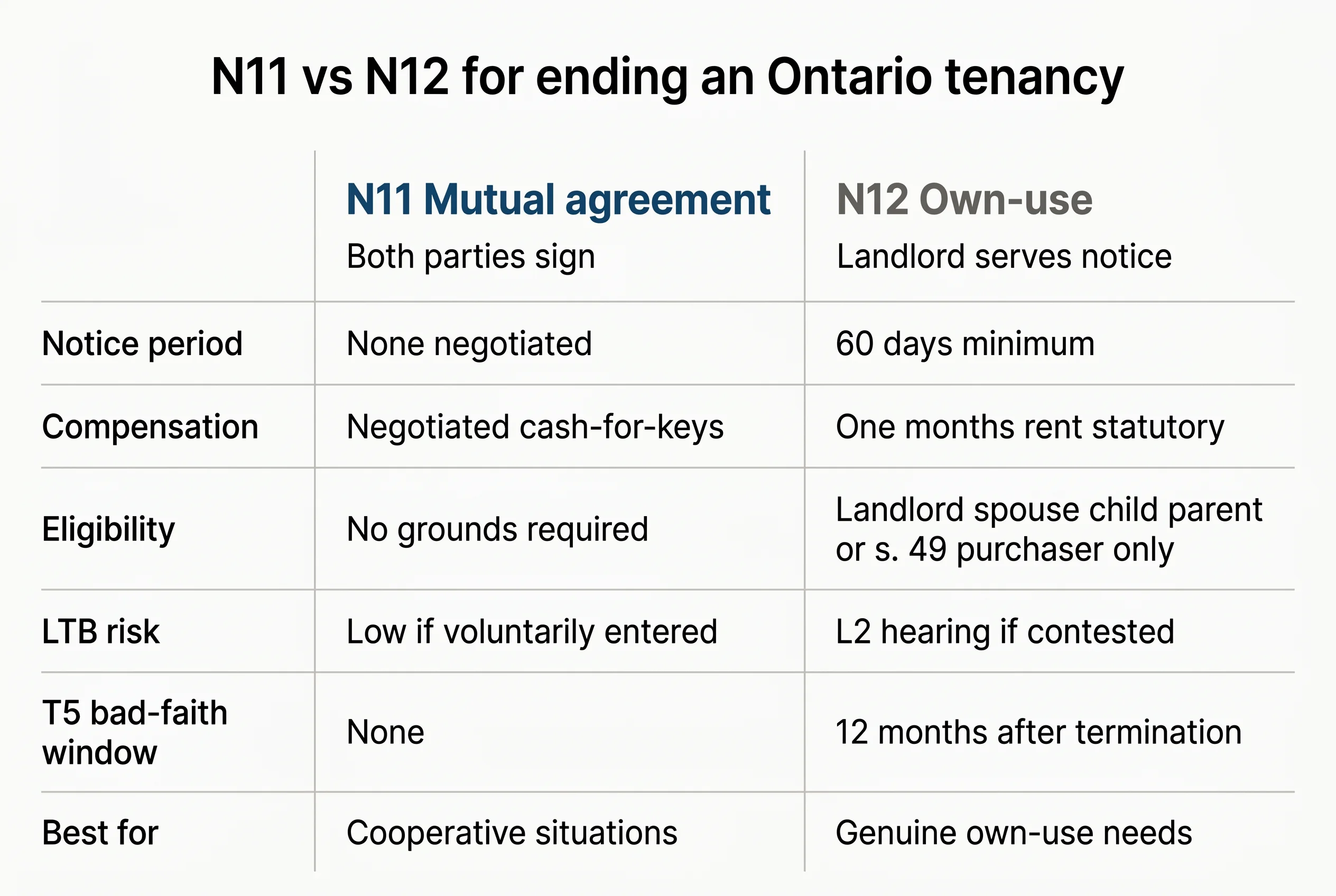
- No grounds requirement. Unlike N4, N5, N12, or N13, the N11 doesn't require any specific reason. Both parties simply agree.
- Final on the agreed date. Once the date passes, the tenancy is over. No challenge, no appeal.
How N11 differs from other paths
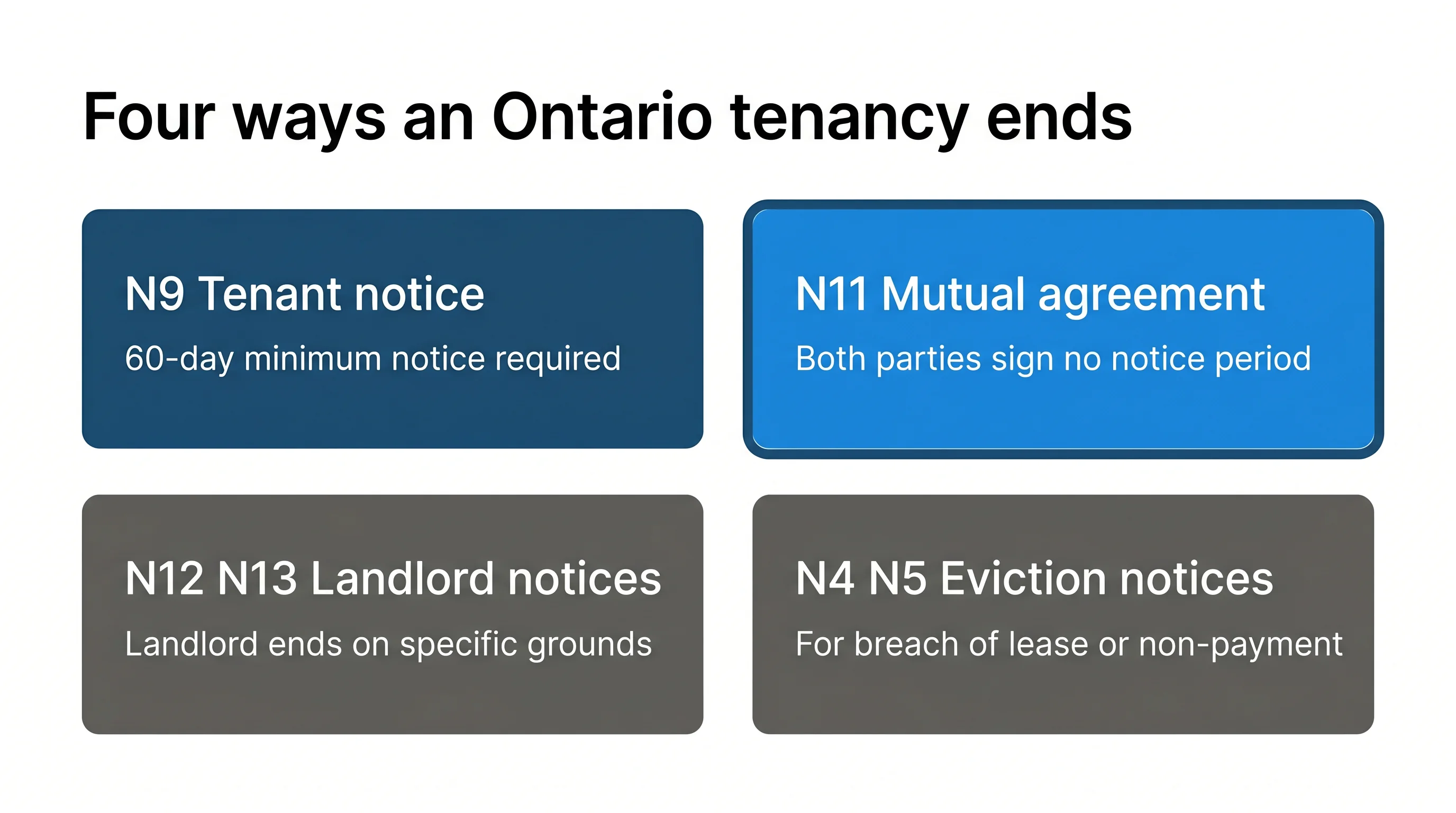
It's worth understanding where N11 sits among the alternatives. Ontario tenancies end through one of four paths:
- N9 (tenant's notice): The tenant ends the tenancy alone but must give statutory minimum notice — typically 60 days for a monthly tenancy ending on the last day of a rental period. No landlord agreement required.
- N11 (mutual agreement): Both parties sign. No notice period, no grounds. Fully cooperative.
- N12, N13, N5, etc. (landlord notices): Landlord ends unilaterally on specific grounds. Tenant has rights to challenge at the LTB.
- L3 application: If a tenant signs an N11 (or gives an N9) but doesn't vacate by the agreed date, the landlord files an L3 to enforce. L3 hearings are typically faster than L1 or L2 because the agreement is documented.
Why N11 has become more common in 2026
Three trends are driving N11 adoption right now. LTB wait times have stretched to 6-9 months for L1 hearings and 7-12 months for L2 hearings — both parties benefit from settling quickly rather than queuing for nearly a year. Tight rental markets create pressure too: Toronto's 1.8% vacancy rate produces wide rent gaps between long-tenured tenancies and current market rents, which gives landlords strong financial incentive to offer cash-for-keys. And Bill 60 caution on N12 has tightened T5 bad-faith evidence standards, making some landlords more cautious about N12 misuse and pushing legitimate own-use scenarios toward N11 negotiation instead. For a deeper look at how Bill 60 reshaped Ontario tenancy law, see How Bill 60 Affects Ontario Landlords.
When N11 makes sense for each party
When N11 makes sense for landlords
The N11 is the right tool when the landlord wants vacant possession but either lacks clean grounds for unilateral termination or wants to avoid the time and risk of LTB proceedings. Common scenarios:
- Selling the property with vacant possession. Buyer wants the unit empty on closing. N11 avoids the 12-month T5 risk that comes with N12.
- Family member who isn't N12-eligible. Wants nephew, sibling, or in-law to move in — none of whom qualify under N12. N11 can achieve the same outcome legitimately.
- Tenancy "fit issues." Communication has broken down, neighbour complaints accumulating, the relationship isn't recoverable but no clear grounds for N5 or N6 exist.
- Rent gap economics. Long-tenured tenant paying well below market — a one-time cash payment often costs less than years of foregone market rent.
When N11 makes sense for tenants
Tenants sometimes assume an N11 offer is bad for them by default. Often it isn't:
- Relocating anyway. If the tenant is moving for a job, school, or family — N11 lets them set the date freely instead of being bound by N9's 60-day notice rule.
- Receiving a meaningful payment. A $5,000-$10,000 cash-for-keys payment is sometimes more than the tenant could save in a year. For tenants planning a move anyway, the payment is essentially found money.
- Avoiding a contested eviction record. A clean N11 looks better on future rental applications than a contested N4, N5, or N12 record.
- Getting flexibility on timing. N11 termination dates are negotiable; statutory notices are not.

When N11 makes sense for property managers
PMs use N11 strategically because it keeps both parties out of the LTB queue — the biggest operational headache in 2026. The N11 path lets the PM resolve fit issues without 9-12 months of waiting, document cooperative outcomes that reflect well on the firm's track record, maintain working relationships with tenants who may rent again from other clients, and avoid the documentation-heavy evidentiary process of L2 hearings.
When N11 isn't the right path
Not every situation fits N11. The cooperative path doesn't make sense when the tenant has serious arrears and cannot afford a payment plan — N4/L1 may be the only realistic path. It doesn't make sense when the landlord has clean grounds and the tenant won't negotiate — formal notice may be faster. It doesn't make sense when the tenant has substantial rights worth defending and the landlord's offer doesn't reflect that. And it definitely doesn't make sense when either party is acting in bad faith — in which case the N11 itself becomes a liability.
The cash-for-keys negotiation framework
In Ontario's tight markets, the most common N11 scenario involves a payment from landlord to tenant. There's no statutory framework for this — it's pure negotiation. But the economics are predictable enough that both sides usually arrive at similar ranges.
Typical cash-for-keys ranges in 2026
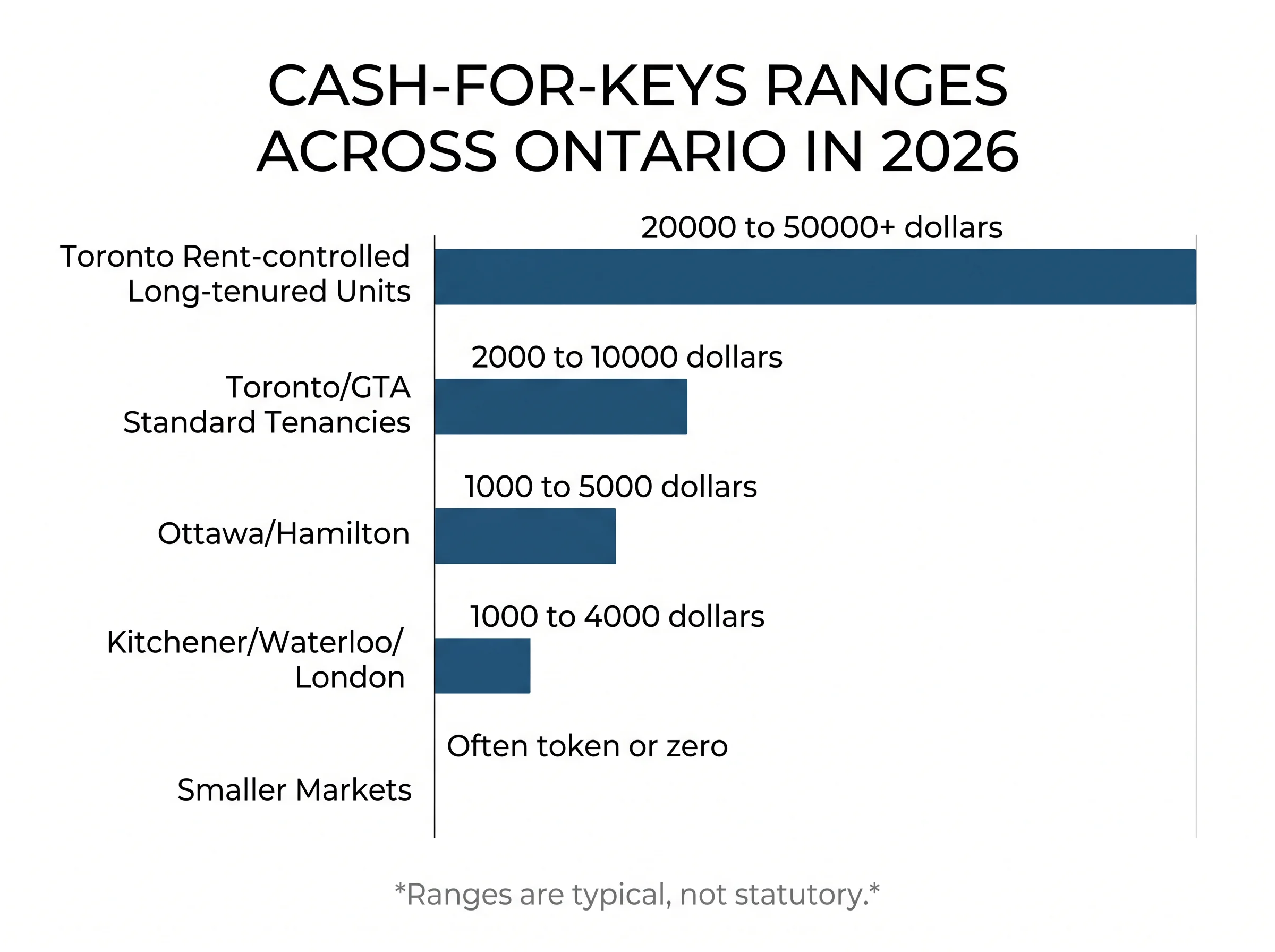
These ranges are not statutory and vary widely by specific circumstance, but they reflect common Ontario practice:
- Toronto/GTA, standard tenancies: $2,000-$10,000
- Toronto/GTA, long-tenured rent-controlled units with significant rent gap: $20,000-$50,000 or more
- Ottawa, Hamilton, Kitchener: $1,000-$5,000 typical
- Smaller markets: often token amounts or no money at all (cooperative timing alone is the value)
The math from the landlord's side
A landlord considering a cash-for-keys offer is comparing two paths. Path A is to negotiate via N11 — say, $5,000 payment plus 60 days to vacancy, then re-rent at market rate. Path B is to wait for organic turnover or pursue formal grounds: months or years of carrying the below-market tenancy, or 7-12 months of LTB process if there are grounds.
For a Toronto unit currently at $1,800 with $2,500 market rent, recovering a $5,000 payment takes about 7 months at the new rate. Most landlords find the math compelling. The same logic applies even more strongly when the rent gap is wider — long-tenured rent-controlled units sometimes carry $700-$1,500/month gaps where a $20,000+ cash-for-keys payment is recovered within 1-2 years of new market-rate occupancy.
The math from the tenant's side
A tenant evaluating an N11 offer should consider four factors:
- Moving costs: $1,500-$4,000 typical (movers, deposit on new unit, utility transfers, lost productivity)
- Rent differential: if their current rent is below market, finding a comparable unit at the new rent costs more monthly
- Time and disruption: searching for a new unit takes weeks; settling in takes longer
- Reference value: a clean cooperative ending preserves the relationship for future references
A reasonable starting position for tenants in long-tenured rent-controlled units is at least 4-6 months of the rent differential, plus moving costs. A tenant paying $1,800 in a unit where market rent is $2,500 has a $700/month gap — at 6 months, that's $4,200 in rent differential plus $2,500 in moving costs, suggesting an $7,000 starting position. Whether that's the right number depends on the specific unit and market, but the framework is the right starting point.
How to actually negotiate
Three principles apply to both sides:
- Don't negotiate on the spot. Whoever opens the conversation, the other party should take 24-48 hours to consider. Ideally with legal advice.
- Document everything. Verbal offers create disputes about what was promised. Written offers create clarity.
- Separate the N11 form from the deal terms. The N11 itself doesn't mention payment. Put cash-for-keys in a separate written addendum that specifies amount, payment schedule, and any contingencies.
What voids an N11
Under the RTA, an N11 must be entered into freely. Coerced or pressured agreements are unenforceable, and a tenant who signed under coercion can challenge the agreement through a T2 application — sometimes resulting in tenancy reinstatement and damages awarded against the landlord.
What coercion looks like
The line between "negotiating firmly" and "coercing" matters. Examples that have been found to constitute coercion in LTB decisions:
- Threatening fabricated eviction grounds. "Sign this or I'll file an N12 for my sister" — when the sister doesn't qualify under N12.
- Misrepresenting tenant rights. "You have to leave anyway" — when the tenant has full RTA protections.
- Harassment or interference. Allowing the unit to deteriorate, withholding services, repeated unannounced entries to pressure signature.
- Pressure on vulnerable tenants. Language barriers, disability, recent immigration status, or lack of time to seek advice — all factors that increase scrutiny if challenged.
- Demanding signature on the spot. A landlord who gives a tenant 10 minutes to decide is creating a record that supports a coercion challenge later.
A real coercion case
A Mississauga landlord served a fake N12 on a 4-year tenant, claiming her sister would move in (sisters are not eligible occupants). She then pressured the tenant to "just sign an N11 — it's easier." The tenant signed and vacated.
The tenant later filed a T2 application alleging coercion and bad-faith conduct. The LTB found in the tenant's favour, awarding damages of approximately one year's rent equivalent — even though tenancy reinstatement was no longer possible. The landlord's "shortcut" became substantially more expensive than the legal path would have been. For more on the proper N12 framework, see Ontario N12 Notices: A Complete Guide to Own-Use Tenancy Endings.
Other things that void or weaken an N11
- Missing signatures. Both landlord and tenant must sign personally (or via authorized agent with documented authority).
- Misrepresentation of material facts. If either party lied about a key fact and the other relied on it, the agreement may be challenged.
- Conditional terms not met. If the N11 was contingent on a payment or a sale closing that doesn't happen, the agreement may collapse.
- Verbal-only agreements. The N11 must be on the official Tribunals Ontario form and signed.
What protects an N11 from challenge
For landlords and PMs who want a defensible N11: written offer with reasonable consideration time (48+ hours), documented suggestion that the tenant seek legal advice (Tenant Duty Counsel, community legal clinic), plain-language summary of what the tenant is signing, separate written agreement covering payment terms and any conditions, and no threats, no misrepresentations, no pressure tactics in the documented record. The same documentation that protects the landlord from a coercion challenge also gives the tenant confidence the offer is genuine.
How different situations play out
Scenario A: Standard cash-for-keys negotiation
Toronto condo, current rent $1,800/month, market rent ~$2,500/month, tenant of 6 years. Landlord wants vacancy. Initial offer: $3,000 plus 60 days. Tenant counter: $6,000 plus 90 days. Settlement: $4,500 plus 75 days. Both parties sign N11 with separate addendum specifying $2,250 paid on signing, $2,250 paid on key handover. Landlord recovers payment within ~7 months at new market rate.
Scenario B: Tenant relocating for work
Ottawa apartment, $1,700/month, tenant accepting a job in Calgary and wanting to leave in 30 days. The tenant could give N9 (60-day notice) but wants flexibility. Landlord agrees to end the tenancy in 30 days via N11 — gets to re-list earlier; tenant gets the timing they need. No money exchanges hands. Both sides save time and the relationship remains good for future references.
Scenario C: Borderline own-use handled cooperatively
Hamilton townhouse, $2,000/month, landlord's nephew wants to move in. Nephews are not eligible occupants under N12. Landlord could not legally serve N12, but can negotiate an N11 with the existing tenant. Offer: $5,000 plus 90 days. Tenant accepts after consulting a community legal clinic. The arrangement is legitimate because the tenant freely agreed; no T5 risk because no N12 was served.
Scenario D: Property sale with vacant possession
Toronto condo, $1,900/month, owner selling. Buyer wants vacant possession on closing. Owner has two paths: serve N12 on the buyer's behalf under section 49, or negotiate an N11. Owner chooses N11 to avoid the 12-month T5 risk window. Settlement: $7,500 plus 90 days, contingent on closing. N11 signed with separate written addendum specifying payment and contingency. All parties achieve their goals on schedule.
Scenario E: Coerced N11 successfully challenged
Mississauga condo, tenant of 4 years, $1,500/month. Landlord serves a fake N12 (sister not eligible) and pressures the tenant to "just sign an N11." Tenant signs under pressure with no legal advice and vacates. Tenant later files T2 alleging coercion. LTB awards approximately one year's rent equivalent in damages. The "shortcut" cost the landlord more than the proper path would have.
Practical takeaways
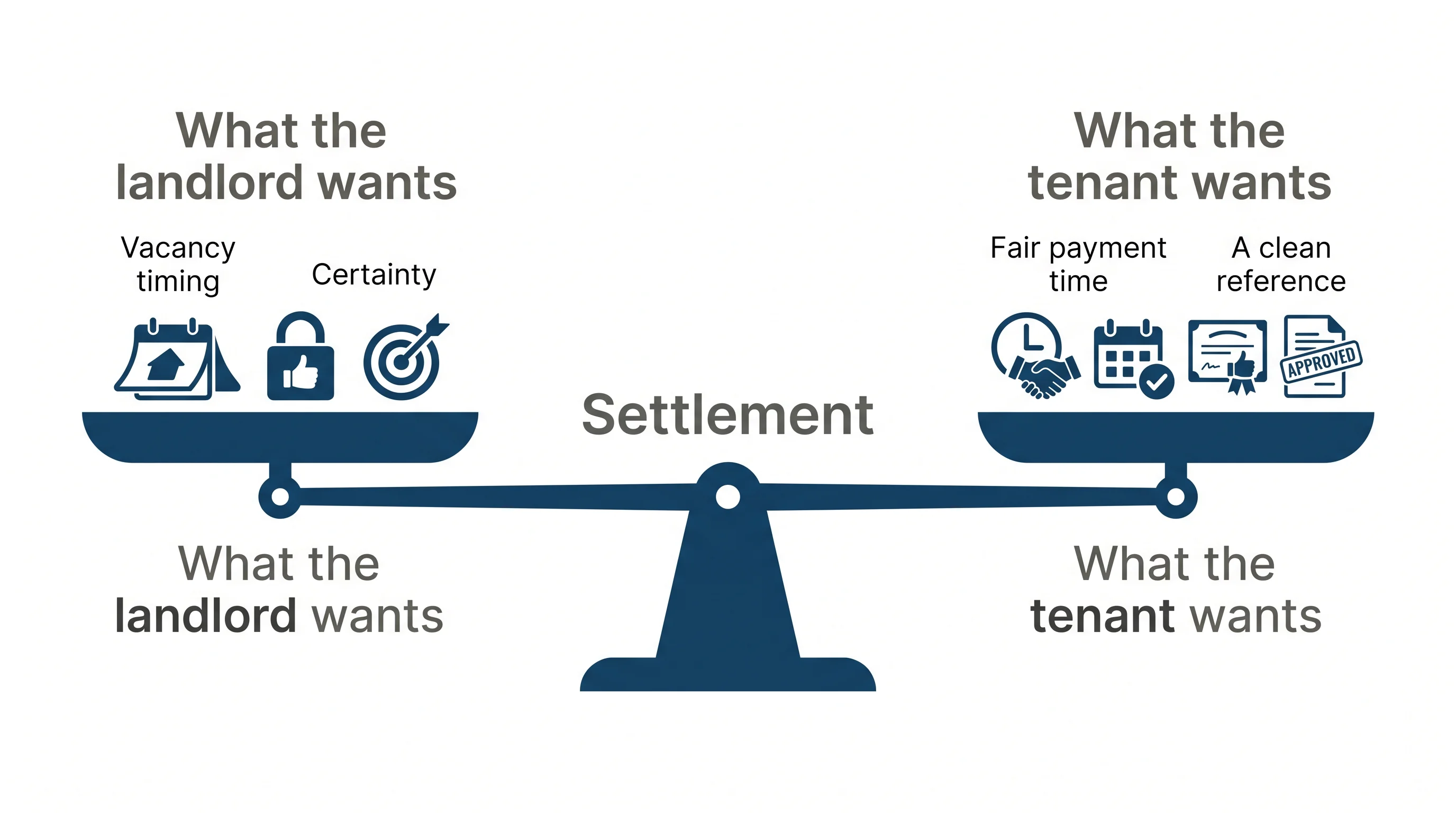
Before the conversation, identify what you genuinely need (vacancy by a specific date, certainty, money, flexibility), research typical cash-for-keys ranges for your market and tenancy type, prepare a written offer or counter-offer, and give the other party reasonable time (48+ hours) to consider.
During the negotiation, negotiate in writing wherever possible. For landlords: avoid any threats, misrepresentations, or pressure tactics. For tenants: seek advice from Tenant Duty Counsel or a community legal clinic. Document payment terms and conditions separately from the N11 form itself.
At signing, both parties sign the official Tribunals Ontario N11 form, the termination date is clearly stated and realistic, cash-for-keys terms (if any) are in a separate written addendum, and each party keeps a signed copy.
After signing, the landlord honours payment terms on schedule, the tenant vacates by the agreed date, keys are returned and condition documented. If the tenant doesn't vacate, the landlord can file an L3 to enforce the agreement — typically faster than L1 or L2 because the agreement is documented.
Calculate notice termination dates accurately: Even though N11 termination dates are negotiated, the Ontario Termination Date Calculator can help model alternative paths (N9, N12, etc.) so you understand what the formal alternatives would look like before negotiating an N11.
The N11 Negotiation Guide for Ontario Landlords, Tenants, and Property Managers
Approaching an N11 from any side? This free guide walks landlords, tenants, and PMs through the cash-for-keys negotiation, what voids an N11, and how to document a fair agreement that protects both parties.
Get Free PDF →Conclusion
The N11 is one of the few places in Ontario tenancy law where the system explicitly allows two parties to make their own deal. Used well, it serves both sides — landlords get vacancy on a predictable timeline, tenants get flexibility and often financial assistance, and everyone avoids the 9-12 month LTB queue. Used badly, it becomes coercion, and the landlord ends up with worse outcomes than if they'd just followed the formal eviction process.
The skill in N11 negotiation isn't legal — it's practical. Reasonable offers, written documentation, time for both parties to consider, and respect for the voluntary nature of the agreement. The math usually favours cooperation; the LTB usually enforces honest agreements quickly; and tenants who freely choose an N11 usually leave with goodwill and a useful reference.
If you're approaching an N11 conversation from either side, start with the proper Tribunals Ontario N11 form and a separate written addendum for any cash-for-keys terms. For deeper context on the contested alternatives, see L1 vs L2 LTB Applications: Understanding the Difference — knowing what the formal eviction paths look like is the best preparation for a successful N11 negotiation.
Generate a compliant N11 with addendum templates
Create the official Tribunals Ontario N11 form with separate cash-for-keys addendum templates — designed to hold up to scrutiny if challenged.
Free • No signup required • Updated for the Bill 60 changes in force 21 Sep 2026
Frequently asked questions
Can my landlord force me to sign an N11?
No. An N11 must be voluntary. If a landlord pressures or threatens you, or misrepresents your rights to get you to sign, the agreement can be challenged at the LTB and the landlord may face damages. Always take at least 24-48 hours to consider any N11 offer and ideally consult Tenant Duty Counsel or a community legal clinic before signing.
How much cash-for-keys is a fair offer in Ontario?
There's no statutory minimum or maximum — it's pure negotiation. Typical Toronto/GTA ranges run $2,000-$10,000 for standard tenancies. For long-tenured tenants in rent-controlled units with a significant rent gap, payments of $20,000-$50,000+ are common. Smaller markets see $1,000-$5,000 ranges. The right offer depends on tenancy length, rent gap, moving costs, and market conditions.
What's the difference between an N11 and an N9?
N9 is the tenant's unilateral notice — the tenant decides to leave and gives statutory minimum notice (60 days for monthly tenancies, ending on the last day of a rental period). N11 is a mutual agreement signed by both parties — no notice period required, just an agreed termination date.
Can I back out of an N11 after signing?
Generally no. Once both parties sign, the agreement is binding. Limited exceptions exist for clear coercion, fraud, or material misrepresentation — but these require evidence and a formal LTB challenge. Don't sign an N11 you're not sure about.
Are cash-for-keys payments taxable?
For tenants, the payment may be taxable as compensation — talk to a tax professional. For landlords, it's typically deductible as a rental property expense. Tax treatment varies by circumstance, so don't rely on assumptions; get advice specific to your situation.


