

Among Ontario's eviction notices, the N5 is unique: it gives the tenant 7 days to fix the problem and keep the tenancy. That single feature explains why most N5s never reach the LTB — by some industry estimates, 60-75% of first N5s are voided through behaviour change or repair within the seven-day window. But the N5 also has a less-known second feature that's the most consequential procedural rule in Ontario tenancy law: a second N5 served within 6 months of the first cannot be voided. Once that second notice arrives, the tenancy clock is running and the tenant has to defend at the LTB or move out.
The N5 is one of the most commonly served — and most commonly misused — Ontario notices. Landlords reach for it when they should be using N4 or N7. Tenants don't realize they have 7 days to remedy. Both sides routinely miss the 6-month escalation rule that turns a routine first warning into a no-going-back second notice.
This guide explains the two-N5 rule clearly, the three distinct grounds (interference, damage, overcrowding), what each side should document, and how the path connects to L2 if behaviour doesn't change. Five sections cover what an N5 actually is, the two-N5 escalation rule, the three grounds with their evidence requirements, what voids or invalidates an N5, and how different scenarios play out.
Got an N5 Notice? A Tenant's 7-Day Response Guide for Ontario
Received an N5 notice in Ontario? You may have just 7 days to keep your tenancy. This free guide walks tenants through what an N5 means, how the void window works, and how to respond fast and protect your rights.
Get Free PDF →What an N5 actually is
The N5 — formally, "Notice to End your Tenancy For Interfering with Others, Damage or Overcrowding" — is the official Tribunals Ontario form used when a tenant has caused a problem that isn't about money but does affect the unit, the building, or other tenants. It's distinct from N4 (non-payment), N7 (serious breaches), N8 (end of term and persistent lateness), and N12 (own-use).
Three distinct grounds fall under N5:
- Substantial interference with the reasonable enjoyment of others (landlord, neighbours, other tenants)
- Wilful or negligent damage to the unit or residential complex
- Overcrowding beyond health, safety, or housing standards
Each ground has different evidence requirements at the LTB — covered in detail in the third section of this guide.
Where N5 sits in the notice ecosystem
It helps to position N5 against the other Ontario notices that get confused with it:
- N4 — for non-payment of rent
- N5 — for interference, damage, or overcrowding (this notice)
- N7 — for serious breaches: serious safety impairment, illegal use, serious damage
- N8 — for end of term, including persistent late payment
- N12 — for landlord, family, or purchaser own-use
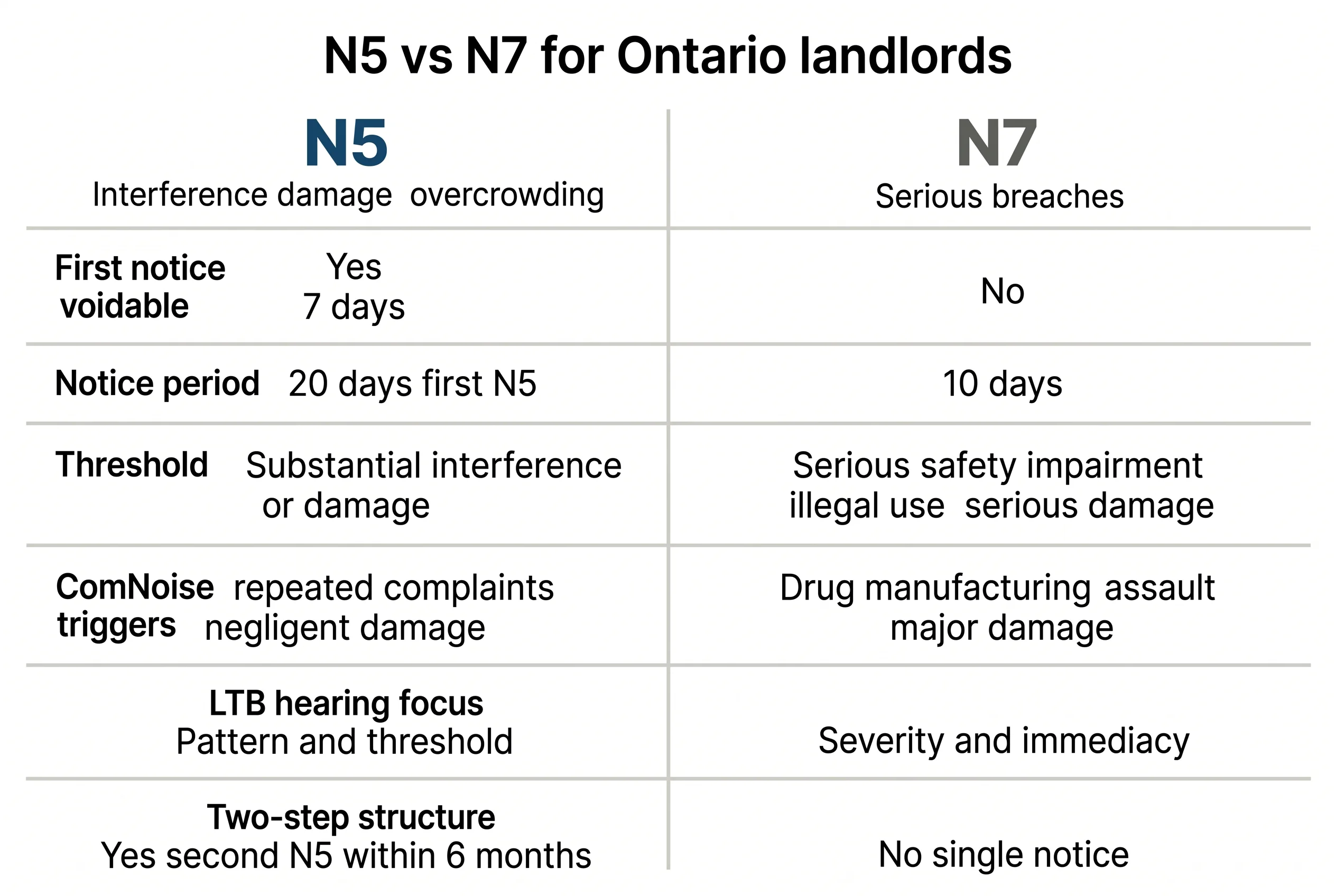
The most common mix-up is between N5 and N7. The threshold question is severity: ordinary damage and disturbance fall under N5; serious safety threats, illegal acts (e.g., drug manufacturing), and severe damage fall under N7. A landlord who reaches for N7 when N5 is the right tool — or vice versa — risks dismissal at the LTB.
Why N5 has built-in escalation
The N5 is designed to encourage behaviour change without litigation. The first N5 is voidable — the tenant has 7 days to fix the problem and keep the tenancy. Most tenants do exactly that, which is why the vast majority of N5s never reach the LTB. But if the conduct recurs within 6 months, the second N5 cannot be voided — and that escalation provides the procedural foundation for an L2 application.
This two-step structure is unique among Ontario notices. N4 doesn't work this way (one notice, one void window per cycle). N12 doesn't work this way (no void window at all). The two-N5 rule is the article's central concept and gets full treatment in the next section.

The two-N5 rule: the most important thing to understand
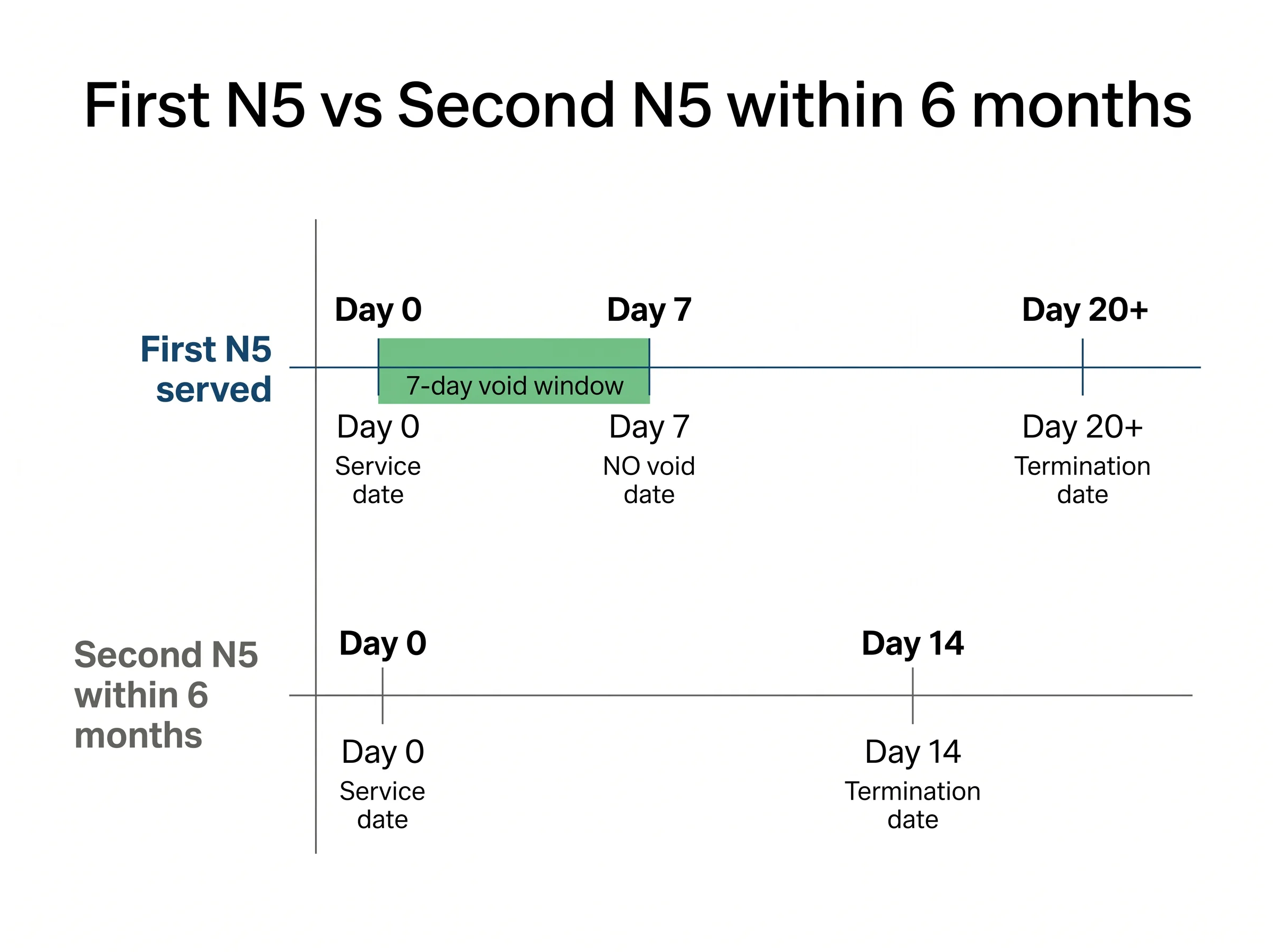
First N5: voidable in 7 days
When a landlord serves a first N5, the tenant has 7 days from the date of service to remedy the conduct and void the notice. What "remedy" means depends on the ground:
- Interference: stop the conduct (no more loud parties, no more harassment, no more unauthorized occupants in common areas)
- Damage: repair the damage or pay the landlord's reasonable cost of repair
- Overcrowding: reduce the number of occupants to within standards
If the tenant remedies within 7 days, the notice is void by operation of law. The tenancy continues. No further action required.
If the tenant doesn't remedy, the notice remains valid through its termination date (at least 20 days from service). At that point, the landlord can file an L2 application within 30 days of the termination date.
Second N5 within 6 months: cannot be voided
The 6-month escalation rule is what makes N5 procedurally powerful. If the same or similar conduct recurs within 6 months of the first N5, the landlord can serve a second N5 that cannot be voided. The tenant has no remedy window. The termination date is 14 days from service. After termination, the landlord can file L2.
This isn't a punishment for the tenant — it's procedural recognition that the first N5 was a warning, and the warning didn't work. The tenant can still defend at the L2 hearing on the merits (whether the conduct actually occurred, whether it met the substantial-interference threshold, whether accommodation duty was met). But there's no longer a 7-day quick-fix path.
Why this matters for both sides
For landlords, the two-N5 rule means the first incident matters more than they might realize. Documentation should start with the first incident, not when the landlord finally decides to serve a notice. If the conduct recurs within 6 months and a second N5 is needed, well-documented evidence from both periods makes the L2 case.
For tenants, the two-N5 rule means a first N5 is genuinely an opportunity to fix the problem and preserve the tenancy. A second N5 within 6 months is not an opportunity — it's a procedural step toward eviction. The defence happens at the L2 hearing, not by remedying the conduct.
The 6-month clock starts at the service date, not the termination date
A common confusion: the 6-month period is measured from when the first N5 was served, not from its termination date or the date the landlord identified the conduct. A first N5 served on January 15 starts a clock that runs until July 15. If a second incident happens on July 16, the second N5 served on that date is too far out — it's effectively another "first" N5, voidable by the tenant.
This timing matters strategically. If a landlord notices a recurring pattern toward the end of the 6-month window, getting the second N5 served quickly can preserve the no-void escalation.
The three grounds and what each requires
Substantial interference: the highest-volume, hardest-to-prove ground
Substantial interference covers conduct that meaningfully disrupts another person's reasonable use of the property. Examples:
- Repeated loud parties or persistent late-night noise
- Harassment of neighbours or building staff
- Persistent smoking that affects others (in non-smoking buildings)
- Aggressive or threatening behaviour
- Interference with shared common areas
The "substantial" threshold is the key word. A single noisy night doesn't qualify. A neighbour who finds the tenant's normal music annoying doesn't qualify. The conduct must rise to the level of meaningful interference with reasonable enjoyment — and the landlord must be able to prove it at the LTB.
Documentation that holds up at L2 includes a dated written log of incidents (date, time, exact nature of disturbance, who observed it), signed and dated witness statements from affected neighbours, police reports if applicable, audio or video evidence where lawful to capture, prior written warnings or correspondence with the tenant, and building management or condo board reports.
Damage: easiest to prove with proper evidence
Damage covers wilful (intentional) or negligent (careless) damage to the unit or residential complex. Normal wear and tear is excluded.
Common damage scenarios that trigger N5: broken fixtures, holes in walls, damaged flooring; broken appliances beyond normal wear; damage to common areas (broken doors, smashed windows, equipment); damage from unauthorized renovations or modifications.
Documentation that holds up at L2: photographs of damage with date stamps, repair estimates or paid invoices, the move-in inspection report (if available) showing prior condition, written communication with the tenant about the damage, and witness statements where applicable.
Damage cases tend to have higher landlord success rates at L2 because the evidence is physical and documentable. A photo with a date and a repair invoice is hard to argue with.
Overcrowding: rare and standards-based
Overcrowding is the least-used N5 ground. It applies when the number of occupants exceeds limits set by health, safety, or housing standards — typically tied to municipal property standards or the National Building Code.
Documentation that holds up at L2: the lease showing authorized occupants, documented observations of additional occupants (with dates), reference to the specific municipal occupancy standard being violated, and photos or witness statements supporting the observed occupancy.
Match the ground to the conduct
Each ground requires different evidence and runs into different defences. Trying to fit the wrong ground to the wrong conduct is a common failure mode. A few decision rules:
- Noise + disturbance → interference
- Physical damage to property → damage
- Too many people in the unit → overcrowding
- Late or unpaid rent → N4 (NOT N5) — see How to Use the N4 Notice in Ontario
- Persistent lateness pattern → N8 (NOT N5)
- Serious safety threat or illegal activity → N7 (NOT N5)
What voids an N5 — and the T2 risk for landlords
What voids an N5
Several things can void or invalidate an N5:
- Tenant remedies within 7 days (first N5 only) — the most common path to void
- Defective notice form — wrong form version, missing required details, wrong termination date
- Wrong grounds cited — N5 used for issues that should be N4, N7, or N8
- Insufficient evidence at L2 — adjudicator dismisses the application
- Improper service — N5 not served according to RTA rules (no Certificate of Service, etc.)
- Retaliatory or bad-faith service — tenant successfully challenges via T2
The first item — tenant remedy — is by design. The remaining items are procedural failures that landlords need to avoid.

The T2 counter-application risk
If a landlord serves an N5 that is fabricated, retaliatory, or otherwise abusive, the tenant can file a T2 application — formally, "Application About Tenant Rights." T2 outcomes can include an order requiring the landlord to stop the conduct, rent abatement (often 5-25% of rent for a defined period), damages, and an award of costs.
The most common T2 trigger in N5 contexts: a landlord who serves an N5 alleging vague "interference" shortly after a tenant raised legitimate repair concerns or filed a maintenance complaint. Adjudicators look at the timing — if an N5 follows a tenant complaint within days or weeks, the retaliation inference is strong.
The accommodation duty for tenants with disabilities
Under the Ontario Human Rights Code, landlords have a duty to accommodate tenants with disabilities up to the point of undue hardship. This duty intersects with N5 procedure when the conduct underlying the N5 is connected to a disability — for example, mental health episodes, neurological conditions, or addiction.
The accommodation duty doesn't immunize the tenant from N5 entirely. But it does require the landlord to engage in a meaningful accommodation process — exploring support arrangements, building staff coordination, or external services — before pursuing eviction. LTB adjudicators scrutinize whether reasonable accommodations were considered when the conduct relates to a disability.
For landlords, the practical takeaway: if you become aware of a disability connection during the N5 process, document the accommodation discussions you've had. Going to L2 without engaging in accommodation almost always weakens the case. For tenants, raise the disability connection in writing as early as possible — and seek advice from a community legal clinic experienced in human rights cases.
What protects an N5 from challenge
For landlords who want a defensible N5: clear documentation of the specific conduct (dated, witnessed); use of the current Tribunals Ontario N5 form; specific description on the notice itself of what conduct must stop or be remedied; proper service with Certificate of Service; no retaliation pattern (no N5 issued shortly after a tenant complaint); and engagement with accommodation duty if disability is in play.
How different situations play out
Scenario A: First N5 voided successfully
Toronto condo, $2,200/month. Tenant has been hosting late-night gatherings; multiple neighbour complaints over a 3-week period. Landlord serves first N5 for substantial interference on March 1, with termination date March 21. Within the 7-day void window, the tenant ceases the gatherings. The N5 is void; the tenancy continues. No L2, no further procedural action.
Scenario B: Second N5 within 6 months → L2 succeeds
Hamilton low-rise apartment, $1,800/month. First N5 served February 1 for damage to a common-area door; tenant pays for repair within 7 days; first N5 voided. April 15 — different damage incident (broken window in common area). Landlord serves second N5 within 6 months on April 16; not voidable. Termination date April 30. Landlord files L2 within 30 days. December 2026 hearing — landlord presents both N5s, dated photos, and repair invoices. Adjudicator orders eviction with damages. For more on the L2 application path that follows, see L1 vs L2 LTB Applications: Understanding the Difference.
Scenario C: Vague N5 dismissed at L2
Ottawa apartment, $1,700/month. Landlord serves N5 alleging "noise complaints from neighbours" without specific dates, witness names, or detailed incidents. Tenant disputes the allegations and doesn't remedy. Landlord files L2. At hearing, adjudicator finds the substantial-interference threshold isn't met — complaints are vague and unsupported. L2 dismissed. Landlord wasted $186 in filing fees and 9 months of LTB queue.
Scenario D: Retaliatory N5 → tenant wins T2
Mississauga condo, $1,600/month. Tenant has been requesting repairs for 6 months; landlord has been slow to respond. After tenant escalates a written repair request, landlord serves N5 alleging "interference." Tenant files T2 application alleging retaliatory N5. LTB hearing finds in tenant's favour — N5 is retaliatory and the underlying interference allegations are unsupported. Tenant awarded rent abatement and damages. Landlord ordered to stop the conduct.
Scenario E: Mental health accommodation prevents L2
Toronto townhouse, $2,000/month, tenant of 8 years. Tenant develops a mental health condition causing periodic loud distress episodes. Neighbours complain. Landlord serves first N5. Tenant's family contacts landlord with medical documentation and requests accommodation. Landlord works with the family on a structured support plan, engages building staff for coordination. The accommodation process is documented; behaviour stabilizes. N5 is not pursued to L2; tenancy continues with the support plan in place.
Practical takeaways
Before serving (landlord) — the documentation checklist:
- Have I documented the specific incident(s) with date, time, and witness information?
- Does the conduct meet the "substantial" threshold (interference) or "wilful or negligent" threshold (damage)?
- Am I using the correct, current N5 form?
- Is the termination date at least 20 days from service (for first N5) or 14 days (for second N5)?
- Have I described the conduct specifically enough that the tenant knows what to remedy?
- If I expect to file L2 later, is my documentation strong enough to survive scrutiny?
- Have I considered whether accommodation duty applies?
After receiving (tenant) — the response checklist:
- Which N5 ground is being cited (interference, damage, or overcrowding)?
- Is this a first N5 (with 7-day void window) or second N5 within 6 months (no void)?
- If first N5: what specifically would remedy the issue, and can I do it within 7 days?
- If second N5: I cannot void — am I preparing my defence for the L2 hearing?
- Have I contacted Tenant Duty Counsel or a community legal clinic?
- Could a T2 challenge apply (was the N5 retaliatory or fabricated)?
- If accommodation duty applies, have I raised it with the landlord?
Quick wins: Use the current Tribunals Ontario N5 form, never an outdated version. File Certificate of Service immediately after serving. Document the specific conduct, dates, and witnesses.
Longer term: For landlords, build template incident logs to ensure consistent documentation. For tenants, know that the 7-day void window is a real opportunity, not a trap. For PMs, track the 6-month escalation window for every N5 served.
Calculate the right termination date: Use the Ontario Termination Date Calculator to compute the correct termination date for any N5 — preventing the most common defective-notice mistakes.
Got an N5 Notice? A Tenant's 7-Day Response Guide for Ontario
Received an N5 notice in Ontario? You may have just 7 days to keep your tenancy. This free guide walks tenants through what an N5 means, how the void window works, and how to respond fast and protect your rights.
Get Free PDF →Conclusion
The N5 is the workhorse notice for tenancy issues that aren't about money. Used well, it's a behaviour-modification tool first and an eviction tool only as a last resort — most N5s end with the tenant remedying within 7 days and the tenancy continuing. The two-N5 rule provides a clear escalation path when conduct genuinely doesn't change: the second notice within 6 months removes the void window and supports a fast-tracked L2 application.
For landlords, the work of a successful N5 happens in the documentation. Specific dated incidents, named witnesses, and proper service make the difference between a notice that holds up at L2 and one that gets dismissed for vagueness. For tenants, the work happens in the response. Knowing the void window exists, knowing the difference between first and second N5, and knowing when to seek legal advice can preserve the tenancy or build the defence.
If you're approaching an N5 from either side, also see N11 Mutual Agreements as the cooperative alternative when the N5 path doesn't fit, and 5 Things Your Landlord CAN'T Do in Ontario for tenant context on retaliation.
Generate a compliant N5 notice with documentation templates
Create the official Tribunals Ontario N5 form, calculate termination dates automatically, and build the documentation file you'll need if the case ever reaches L2.
Free • No signup required • Updated for the Bill 60 changes in force 21 Sep 2026
Frequently asked questions
What's the difference between a first N5 and a second N5?
A first N5 has a 7-day void window — the tenant can remedy the conduct (stop the behaviour, repair the damage, reduce occupants) and keep the tenancy. A second N5 served within 6 months of the first cannot be voided. The tenant has no remedy window, the termination date is 14 days from service, and the landlord can file an L2 application after termination.
How long do I have to remedy a first N5?
7 days from the date of service. If you remedy the conduct within that window, the notice is void by operation of law and your tenancy continues. The remedy depends on the ground: stopping the conduct (interference), repairing or paying for the damage (damage), or reducing the number of occupants (overcrowding).
What counts as "substantial interference"?
Conduct that meaningfully disrupts another person's reasonable use of the property — repeated loud parties, harassment of neighbours, persistent disturbances, interference with common areas. Minor or one-time issues don't qualify. The threshold is "substantial," not "annoying."
Can my landlord serve me an N5 for one noisy night?
Generally no. The substantial-interference threshold means a single isolated incident usually doesn't qualify. Repeated, persistent, or escalating conduct is the typical N5 trigger. That said, a single severe incident — significant property damage, threatening behaviour — could justify either an N5 or, in extreme cases, an N7 (serious breach).
What happens if I receive an N5 but the allegations are false?
Don't remedy conduct you didn't engage in (that risks confirming the allegations). Document your version with dates, witnesses, and any evidence. If the N5 is retaliatory — for example, served shortly after you raised legitimate complaints about repairs — consider filing a T2 application alleging interference with reasonable enjoyment. Tenant Duty Counsel and community legal clinics can advise on T2 strategy.


