

In Ontario, a rent increase on a $2,100 apartment works out to about $44 more per month in 2026. That's the practical effect of the province's 2.1% guideline, which took effect on January 1. It's a small number that trips up thousands of landlords every year — because the rules around how and when to collect that $44 are strict, and getting them wrong voids the increase entirely.
Rent increases are among the most misunderstood parts of the Ontario rental relationship. Landlords miss the 90-day rule. Tenants don't always know the guideline is capped. Property managers tracking anniversary dates across dozens of units burn hours every quarter trying to keep it all straight. And a single defective N1 costs a full year of the increase — not days, not weeks, a full 12 months until the next window opens.
This guide is written for landlords, property managers, and tenants — because all three sides of a rent increase benefit from understanding the same rules. No advocacy, no spin. Just how Ontario rent increases work in 2026, what a valid N1 looks like, what voids one, and what the process looks like in practice for different situations.
The Ontario Rent Increase Checklist: Know If Your N1 Is Valid
Received a rent increase notice? Use this free Ontario tenant checklist to quickly verify whether your N1 notice is valid under the 2026 rules — and know exactly what to do if it isn't.
Get Free PDF →Ontario rent increases in 2026: the landscape
Ontario's 2026 rent increase guideline is 2.1%. It applies to most rent-controlled units — generally those first occupied as a residential rental before November 15, 2018. The guideline is set each summer by the Ontario government, based on the Ontario Consumer Price Index averaged over 12 months ending in May of the previous year, and capped at 2.5% maximum by law.
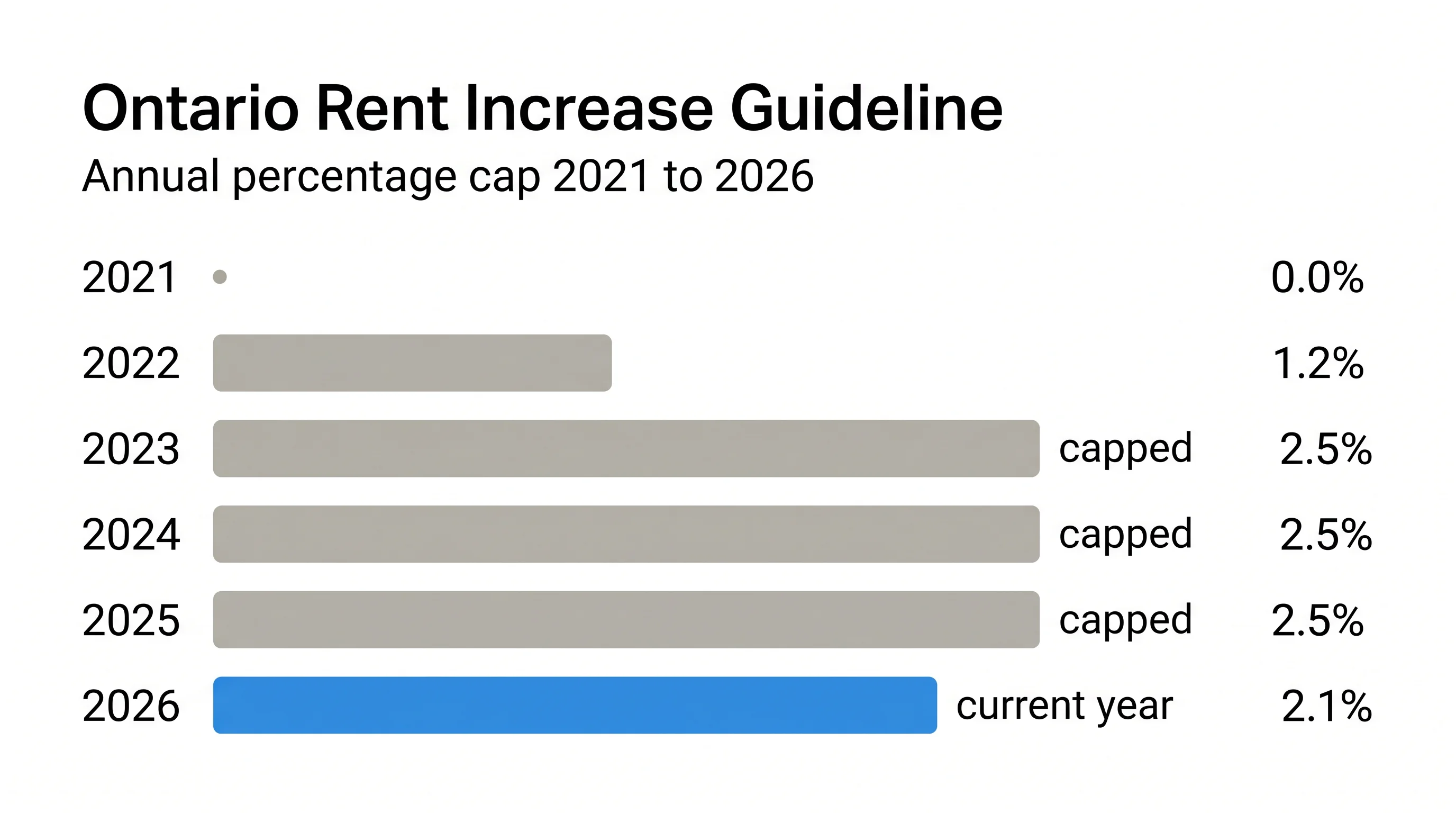
The history gives useful context for where 2026 sits. In 2021, the guideline was frozen at 0.0% during the pandemic. It moved to 1.2% in 2022, then hit the legal cap of 2.5% for three consecutive years in 2023, 2024, and 2025. This year's 2.1% reflects a moderating inflation environment — still meaningful, but the first time in three years the guideline hasn't been pinned at the legal ceiling.
Three rules govern every rent increase at a rent-controlled unit in Ontario:
The 12-month rule means rent can only be increased once every 12 months for the same tenancy at the same rental unit. This is counted from the effective date of the last increase, or from the date the tenant first moved in if there's been no prior increase. Buying a property mid-year doesn't reset the clock — the 12 months follows the tenant, not the ownership.
The 90-day rule requires at least 90 days of written notice before the increase can take effect. This is a minimum, not a target. Serving with 75 or 80 days is not a close call — it's a defect that voids the increase.
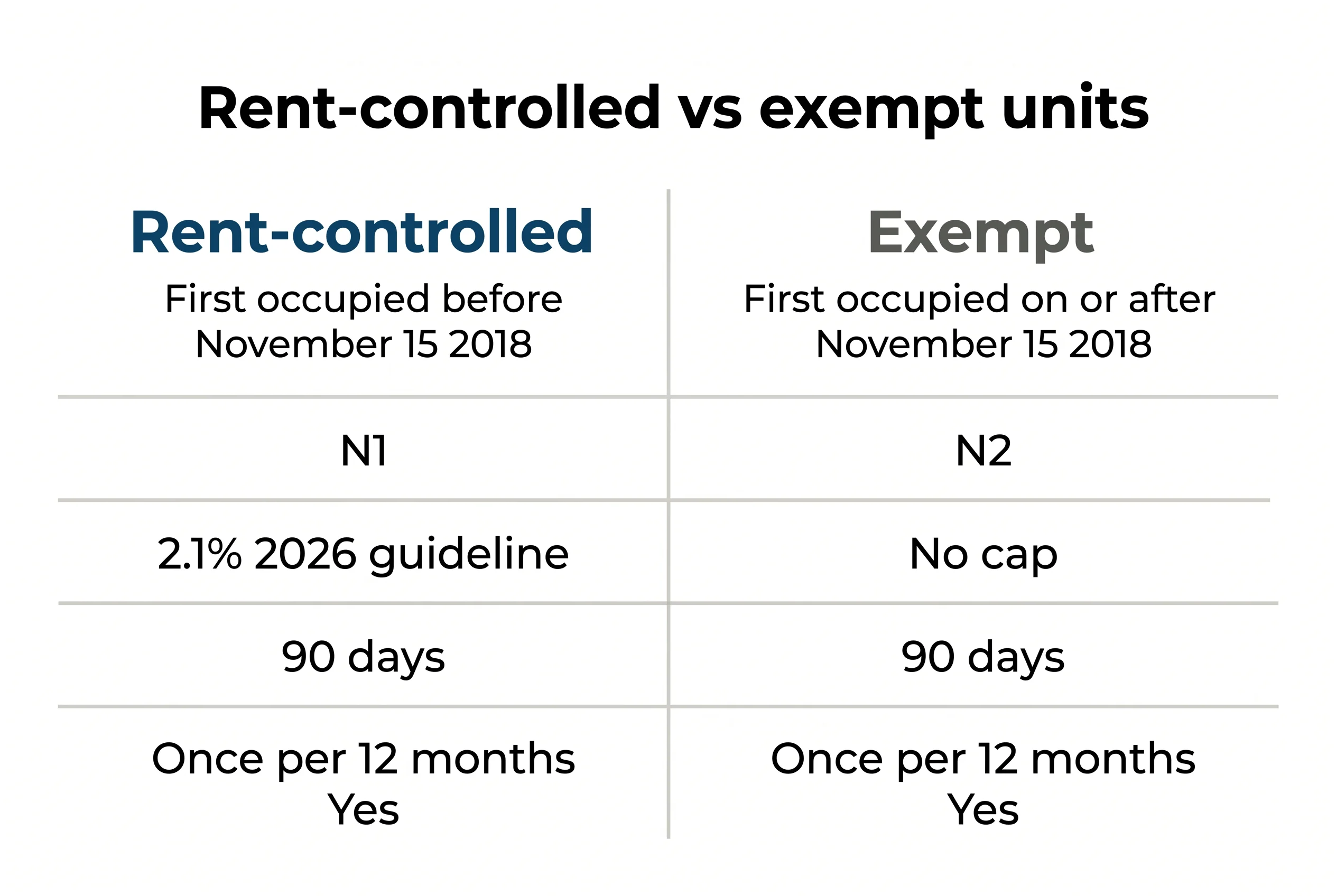
The rent control rule determines whether the guideline applies at all. Units first occupied before November 15, 2018 are rent-controlled: the guideline caps the annual increase. Units first occupied on or after that date are exempt — no provincial cap applies, though the 90-day notice requirement still does, and the form used is different (N2 instead of N1). Commercial tenancies, care homes, and units where the tenant shares a kitchen or bathroom with the owner are always exempt.
Why this matters for each party: landlords who miss the window lose a full year of the increase. Property managers running portfolios of 50 or more units need systems to track anniversary dates, because manual tracking breaks down. Tenants benefit from knowing what's legal, what isn't, and what to do if a notice doesn't look right when it arrives.
The rules are the same whether you own one unit or manage five hundred. Only the scale of the problem changes.
How the N1 notice actually works
Form N1 — "Notice of Rent Increase" — is the official Landlord and Tenant Board form used to increase rent in a rent-controlled unit by the annual guideline amount. For exempt units (post-November 2018), the equivalent form is Form N2, which has a different structure because there's no provincial cap on the amount.
The forms are the same concept, but they aren't interchangeable. Using an N1 on an exempt unit, or an N2 on a rent-controlled unit, is a form error that can void the notice. Before serving anything, the first question to answer is whether the unit is rent-controlled or exempt.
The five requirements for a valid N1
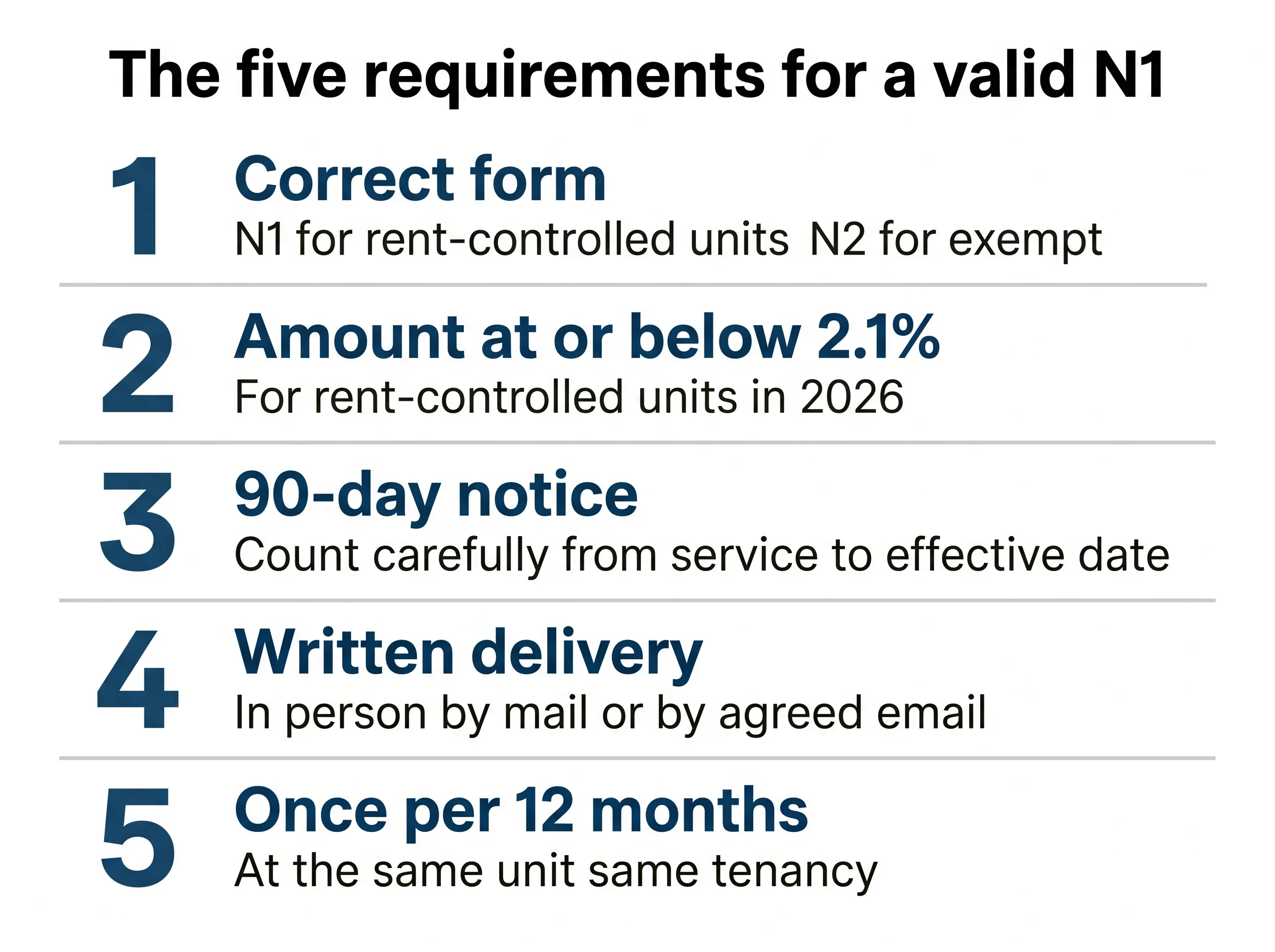
- Correct form. N1 for rent-controlled units, N2 for exempt units.
- Amount at or below the guideline. For 2026, that's 2.1% for rent-controlled units. Exempt units have no cap but still require the notice.
- 90-day minimum notice. The effective date must be at least 90 days after the notice date. Count carefully — one day short voids the notice.
- Written delivery through an acceptable method. In person to the tenant, in the tenant's mailbox or under the door, by regular mail (add 5 days for mail delivery), or by email only if the tenant has given written consent in advance to receive notices that way. Text messages, voicemails, and social media do not count.
- One N1 per 12 months. At the same unit for the same tenancy. Stacking two N1s in a shorter window voids the second one.
The notice itself must contain specific information: the landlord's name and the tenant's name, the rental unit address, the current rent amount, the proposed new rent amount, the effective date, the landlord's signature, and the date the notice was completed. Missing any of these can create a defect.
A concrete example
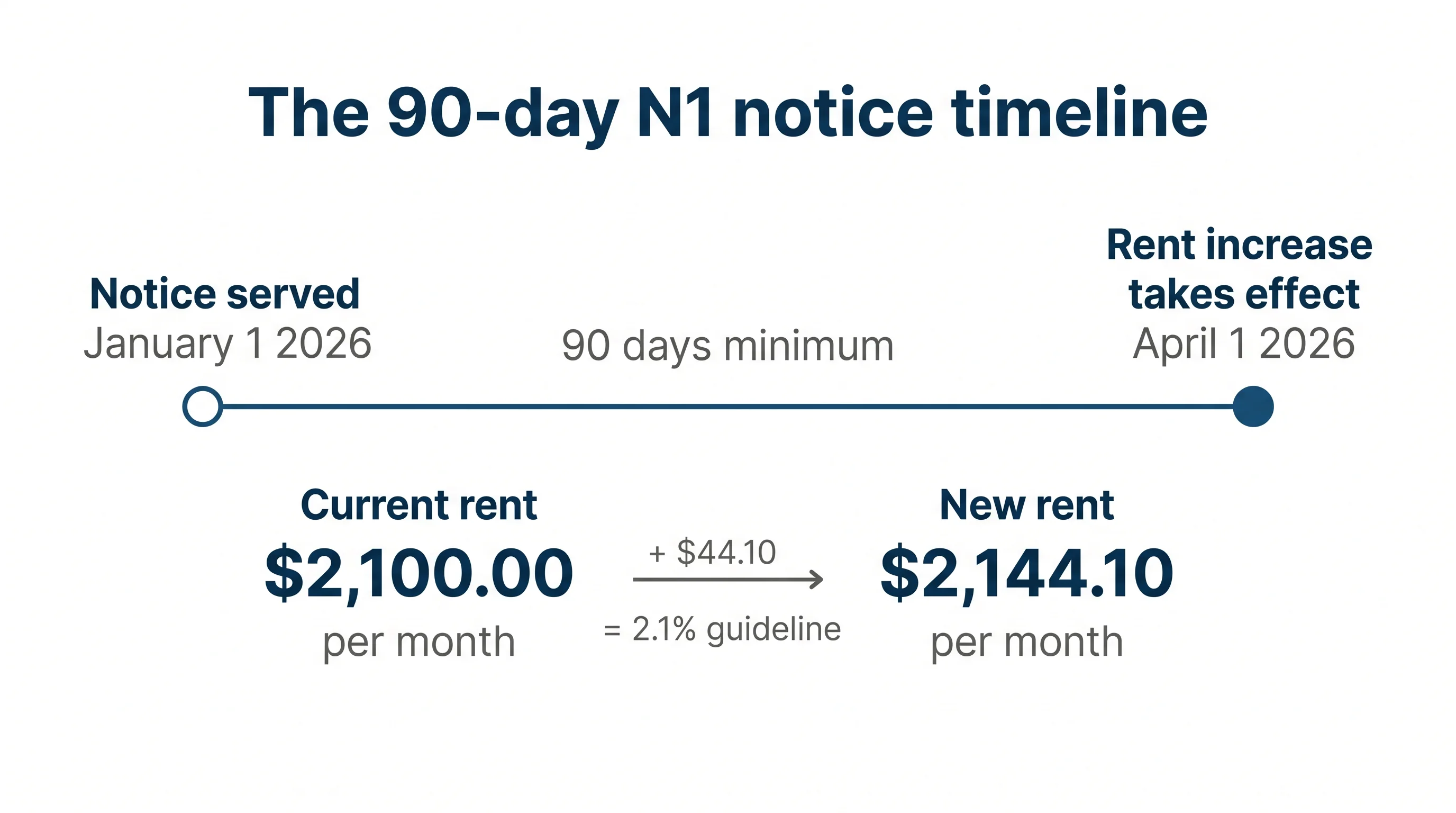
A Toronto apartment has a tenant who moved in March 2019. Current rent is $2,100 per month. The last increase was April 1, 2025, when rent went from $2,050 to $2,100. The next eligible increase date is April 1, 2026 — 12 months after the last increase.
To make the April 1, 2026 effective date, the landlord must serve the N1 by January 1, 2026 — at least 90 days before the effective date.
The maximum new rent is $2,100 × 1.021 = $2,144.10 per month. The monthly increase is $44.10.
If the landlord serves the N1 on January 5 instead of January 1, it's five days short — the increase is void. The landlord must either serve a new N1 with a later effective date, or wait until the next 12-month window. Either way, that month of $44.10 is gone.
Calculate yours in seconds: Use the Ontario Rent Increase Calculator to work out the maximum allowed rent based on your current amount and the 2026 guideline.
Above-guideline increases
In limited situations, a landlord can apply to the LTB for an above-guideline increase (AGI). The grounds are narrow: significant capital expenditures on the building, increases in operating costs like municipal taxes, or added security services. AGIs require a formal application with supporting evidence, can be contested by affected tenants, and add months to the timeline. They're not a shortcut around the guideline — they're a specific regulated process for cost recovery in specific situations.
What voids an N1 (and what happens then)
The stakes on a defective N1 are high. A voided notice means the increase is unenforceable — the tenant continues paying the old rent, and the landlord can't serve a new valid N1 until the next 12-month window opens. On a single unit at $2,100, that's about $530 in lost annual revenue. On a 10-unit portfolio at $2,000 average rent, it's $5,000+ per cycle. The cost compounds quickly for small landlords who manage by spreadsheet and property managers who serve dozens of N1s a year.
Common failure modes
- Wrong form. Using N1 on an exempt post-2018 unit, or N2 on a rent-controlled unit.
- Amount exceeds the guideline. Charging 2.3% on a rent-controlled unit without an approved AGI order.
- Insufficient notice. Less than 90 days between service and the effective date — often off by a week or two because the landlord counted from the "send date" rather than the date the tenant actually received it.
- Multiple N1s in 12 months. The second one is void.
- Missing required fields. No signature, wrong effective date, incorrect unit address.
- Verbal or informal notice. Text message, voicemail, or a conversation is not valid service.
- Attempting to stack years. Missing one year's increase doesn't let you catch up with two the next year. One N1 per 12-month period is the rule.
What happens when it goes wrong
If the landlord tries to collect a voided increase, the tenant continues to owe only the original rent. If the landlord collects the higher amount anyway, the tenant can file a T1 application with the Landlord and Tenant Board to recover the excess, typically with interest. T1 applications must be filed within one year of the illegal collection.
For the landlord, the practical consequences are:
- No increase collected on the effective date
- Full year of revenue forgone on that unit
- Next valid N1 can't be served until the next 12-month window
- If money was collected anyway, a T1 order requires repayment with interest
Three real-world scenarios
Scenario A — 75 days' notice by accident. A landlord serves an N1 on February 15, 2026 for a May 1, 2026 increase. That's 75 days, not 90. The notice is defective. The increase is void. The landlord's options are to serve a new N1 with a valid 90-day window (pushing the effective date to mid-May at the earliest) or wait until next year's window — noting that the 12-month rule will still constrain the timing.
Scenario B — Second N1 in six months. A landlord served an N1 effective June 1, 2025 and mistakenly serves another one effective December 1, 2025 — only six months later. The second N1 is void. If the landlord collects the second increase, the tenant can file a T1 to recover it.
Scenario C — Exempt unit treated as controlled. A condo first occupied in 2020 is exempt from the guideline. The landlord serves an N1 (the wrong form) rather than an N2. The tenant disputes; the form error alone may be enough to void the notice regardless of the amount.
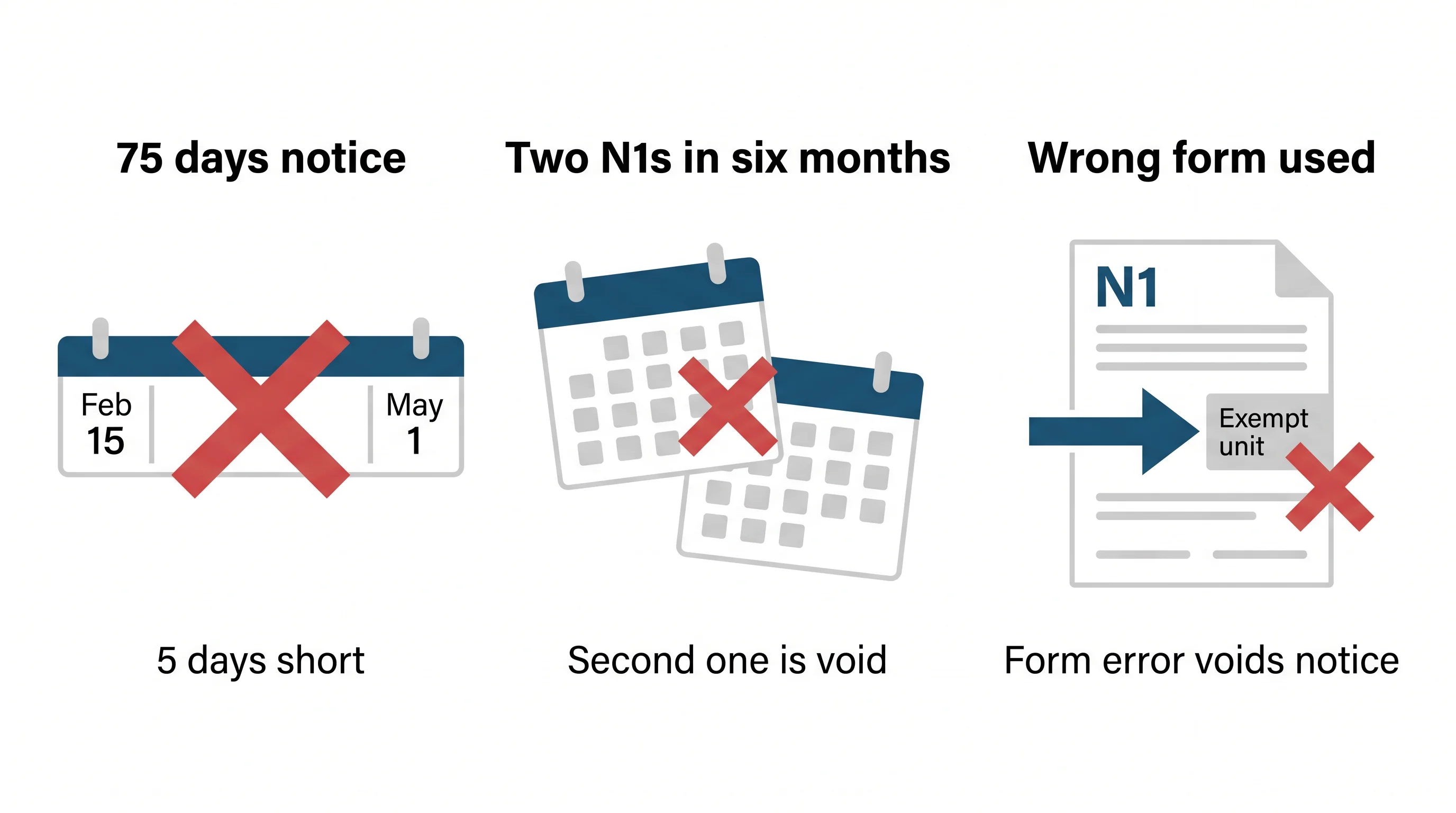
In all three, the pattern is the same: a single administrative mistake costs a full year of the increase. This is why the process rewards care over speed.
How this works for different situations
Rent increases work the same way under the law, but the operational reality varies based on who's running the process.
If you're self-managing a small portfolio
For one to five units, a spreadsheet and calendar reminders are usually enough. What works:
- Keep a simple file for each unit with move-in date, last increase date, last rent amount, and the date the last N1 was served
- Set a calendar reminder 120 days before each anniversary — this gives you a 30-day buffer to prepare and serve the N1 with time to spare
- Use the official LTB form every time — don't modify or recreate it
- Keep proof of service for at least a year in case of dispute
- When you buy a property, get the rent-increase history from the previous owner before the first anniversary; the 12-month rule follows the tenant, not the ownership
The biggest risk at this scale is forgetting. Setting calendar reminders well in advance is the cheapest way to avoid losing a year of revenue.
If you're a property manager handling multiple clients
Manual tracking breaks down past about 25 units. Each unit has its own anniversary date, its own rent-control status, and sometimes its own service method preferences from the landlord client. Missing an N1 window doesn't just cost the landlord client revenue — it costs you a difficult conversation about why the increase they were expecting isn't happening this year.
A defective N1 is harder to explain than a missed one. "I missed the window" is straightforward; "I sent it late" invites questions about process. Running a quarterly review of upcoming anniversaries and serving N1s 90–120 days ahead in batches is standard practice for firms at scale.
Software that tracks anniversary dates, validates the guideline amount for the current year, and generates a correctly formatted N1 pays for itself on a single recovered increase. The math isn't close.
If you're a tenant receiving an N1
When an N1 arrives, walk through the checklist:
- Is the unit rent-controlled (first occupied before November 15, 2018) or exempt?
- For rent-controlled units, is the amount at or below 2.1% for 2026?
- Is the effective date at least 90 days after you received the notice?
- Is this the only N1 you've received in the past 12 months?
- Is the form actually an N1, with all fields completed and signed?
If any of these checks fail, the notice may be void. Continue paying the old rent amount; document what you received, including when and how. If the landlord tries to collect the higher amount anyway, a T1 application at the LTB can recover what was paid above the old rent, within one year of the illegal collection.
If everything checks out and the increase is at or below 2.1% on a rent-controlled unit, the notice is likely valid. Disputing a correctly served guideline increase without grounds rarely succeeds and isn't usually productive.
How Tenon10 handles this
For landlords and property managers, Tenon10 tracks anniversary dates automatically, validates the proposed increase amount against the current Ontario guideline, and generates a correctly formatted N1 with the effective date built in. The 12-month rule, the 90-day rule, and the form requirements are handled before you send anything — so the common failure modes above don't show up in your workflow.
For tenants receiving an N1 generated through the platform, the numbers are already verified against the 2026 cap before the notice reaches you. Everyone starts from the same facts, which usually means fewer disputes and faster resolution when questions do come up.
The Ontario Rent Increase Checklist: Know If Your N1 Is Valid
Received a rent increase notice? Use this free Ontario tenant checklist to quickly verify whether your N1 notice is valid under the 2026 rules — and know exactly what to do if it isn't.
Get Free PDF →Practical takeaways
If you're serving an N1:
- Has it been at least 12 months since the tenant moved in or since the last increase took effect?
- Is the unit rent-controlled or exempt?
- Is the increase at or below 2.1% (for rent-controlled units)?
- Are you using the correct form — N1 for controlled, N2 for exempt?
- Is the effective date at least 90 days after the notice date?
- Are you serving in writing using an RTA-acceptable method?
- Are you keeping proof of service?
- Is this the only N1 you've served in the past 12 months?
If you're receiving an N1:
- Does the form match your unit type?
- Is the amount at or below 2.1% for a rent-controlled unit?
- Is the effective date at least 90 days from the date you received it?
- Is this the only N1 you've received in the past 12 months?
Quick wins: Set calendar reminders 120 days before each tenancy anniversary. Keep a simple log of current rent, last increase date, and last N1 served.
Longer term: If you pass 10–15 units, move rent-increase tracking out of spreadsheets into software that validates the guideline each year and flags upcoming anniversaries.
Conclusion
The 2.1% Ontario rent increase guideline for 2026 is a small number with real consequences when the rules around it are misunderstood. For landlords, following the 12-month rule and the 90-day rule protects the increase and avoids a full year of lost revenue. For property managers, the challenge is less about the math and more about anniversary-date tracking at scale. For tenants, knowing what a valid N1 looks like — and what happens when it isn't valid — means fewer surprises when a notice arrives.
None of this is complicated once the framework is clear: rent-controlled versus exempt, one increase per 12 months, 90 days of written notice, correct form. The mistakes come from edge cases, missed dates, and confusion about which unit type applies.
Generate a valid Ontario N1 in minutes
Anniversary tracking, guideline validation, and correctly formatted N1 — built-in for every Ontario rental you manage.
Free • 2026 guideline built-in • RTA-compliant
Frequently asked questions
What is the 2026 Ontario rent increase guideline?
2.1%, effective January 1, 2026. It applies to most rent-controlled units — generally those first occupied as a residential rental before November 15, 2018.
How do I know if my unit is rent-controlled?
If the unit was first occupied as a residential rental before November 15, 2018, it's almost certainly covered by the annual guideline. Units first occupied on or after that date are exempt from the guideline but still subject to the 90-day notice requirement using Form N2 instead of N1.
Can rent be increased more than once a year?
No. Rent can only be increased once every 12 months at the same rental unit for the same tenancy, regardless of how much notice is given or how small the increase is.
What happens if an N1 is served with less than 90 days' notice?
The notice is void. The increase cannot be collected on the original effective date. The landlord must serve a new N1 with a valid 90-day window, which pushes the effective date later. Depending on how the 12-month rule applies, it may push the increase to the following year.
What should a tenant do if an N1 looks wrong?
Check the four basics: correct form, amount at or below 2.1% for rent-controlled units, at least 90 days' notice, and only one N1 in the past 12 months. If any of these are off, the notice may be void — continue paying the old rent and document what you received. If the landlord collects the disputed increase anyway, a T1 application at the LTB can recover it within one year of the illegal collection.


