

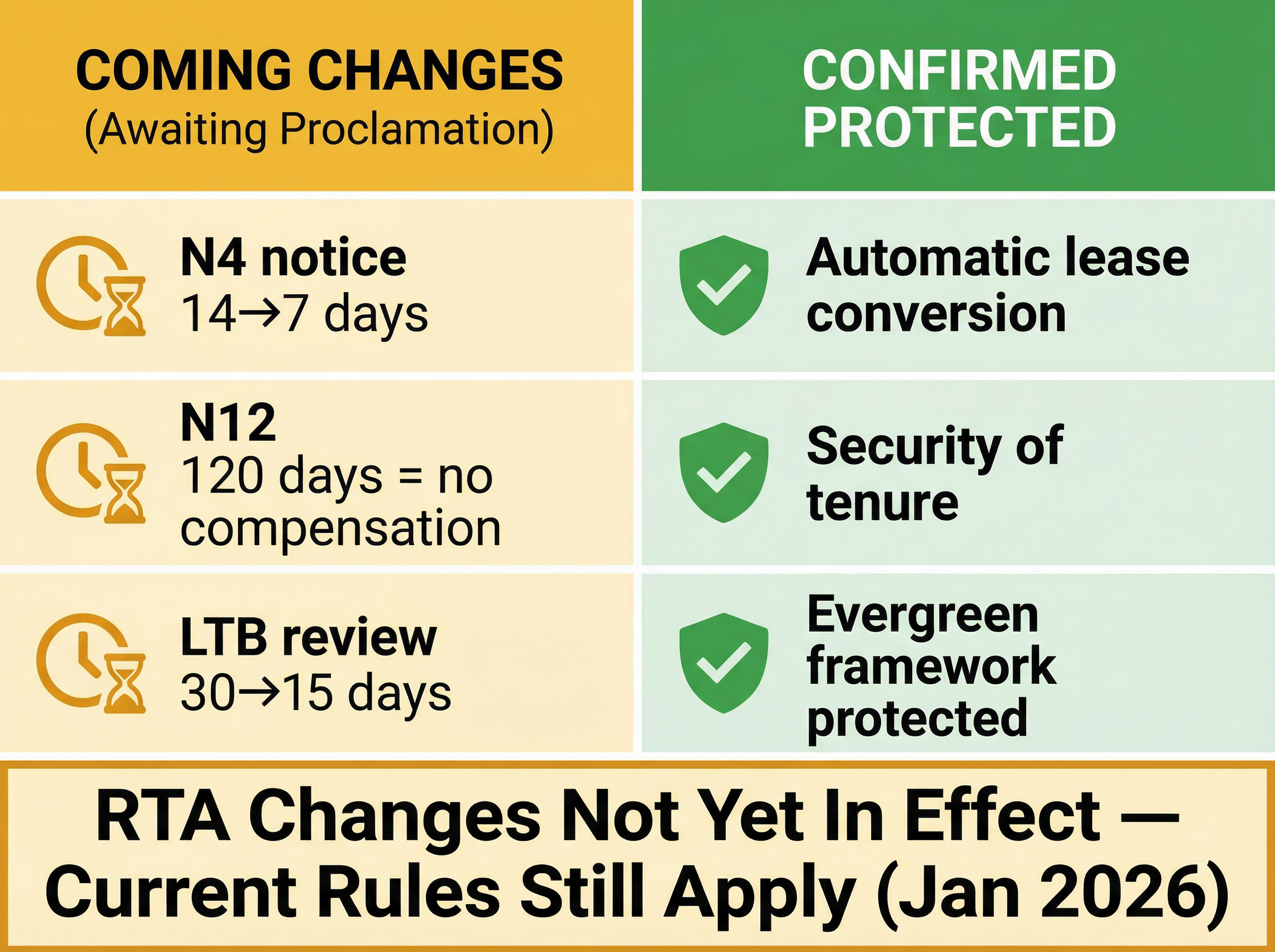
Update, 26 Sep 2026: The Bill 60 amendments to the Residential Tenancies Act that this article describes as awaiting proclamation began coming into force in stages on July 1 and September 21, 2026. None of them changes the rule this article explains: fixed-term leases still convert to month-to-month. The one change that touches the N12 section below: a landlord's-own-use N12 served on or after September 21, 2026 with at least 120 days' notice owes no compensation (a purchaser's N12 still does). Source: the LTB operational update of September 21, 2026.
Your Ontario lease doesn't "expire" — it transforms. And understanding this single fact could save you from making a $50,000 mistake.
Every year, thousands of Ontario landlords and tenants clash over the same misunderstanding: what happens when a one-year lease reaches its end date. Landlords believe they can simply "not renew" and reclaim their unit. Tenants panic, thinking they'll be forced out or pressured into signing new agreements. Both are operating on misconceptions that don't reflect Ontario law.
This guide cuts through the confusion with a definitive explanation of Ontario's "evergreen" lease framework — including the January 2026 Bill 60 updates. Whether you're a landlord planning your next move or a tenant wondering about your rights, you'll learn exactly what the law says, what you can and cannot do, and how to protect yourself.
Landlord's Lease-End Checklist: 15 Steps to Stay Legal When Your Fixed Term Expires
Don't risk a $50,000 fine or bad faith claim. This step-by-step checklist ensures you handle your tenant's lease expiration the right way under Ontario law.
Get Free PDF →The Law Behind "Evergreen" Leases — Section 38(1) RTA
What the Law Actually Says
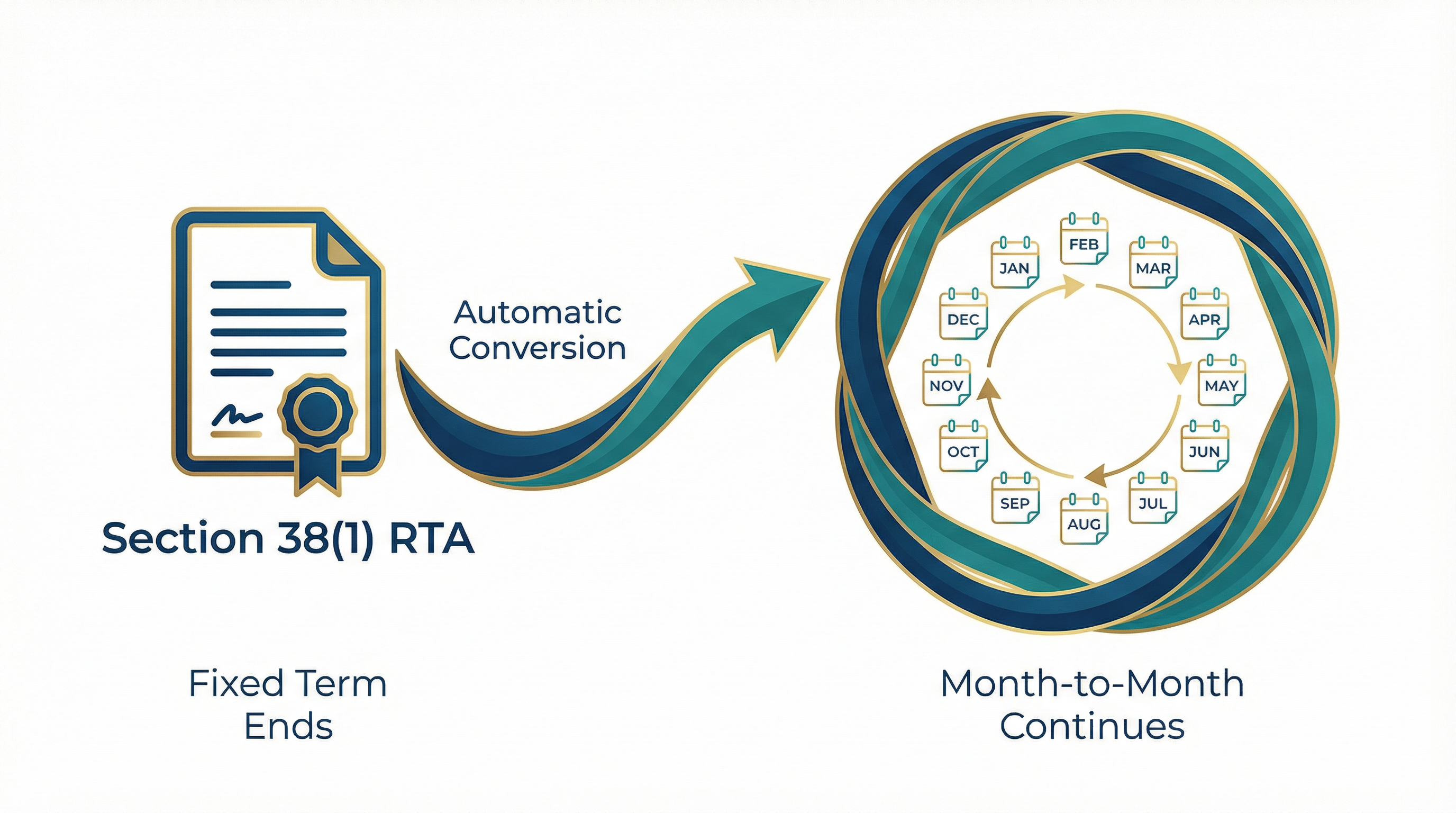
The foundation of Ontario's automatic lease conversion is Section 38(1) of the Residential Tenancies Act, 2006. Here's what it states:
"If a tenancy agreement for a fixed term ends and has not been renewed or terminated, the landlord and tenant shall be deemed to have renewed it as a monthly tenancy agreement containing the same terms and conditions that are in the expired tenancy agreement and subject to any increases in rent charged in accordance with this Act."
In plain language: when your fixed-term lease ends without anyone taking action to renew or terminate it, the law automatically converts it to a month-to-month tenancy. Every term in your original lease — the rent amount, the rules, the responsibilities — stays exactly the same.
Why Ontario Has This System
Ontario's evergreen lease framework exists to protect security of tenure — the principle that tenants have the right to remain in their homes as long as they follow the rules. When the RTA 2006 replaced the Tenant Protection Act, it strengthened these protections significantly.
Ontario is unique among many North American jurisdictions in this approach. The nickname "evergreen" comes from the fact that these leases never truly die — they simply transform and continue indefinitely.
Bill 60 Update: What's NOT Changing
In October 2025, the Ontario government initially proposed ending evergreen leases as part of Bill 60. The backlash was immediate and massive. Tenant advocacy groups mobilized, and within just three days — from October 23 to October 26, 2025 — the government reversed course.
Housing Minister Rob Flack announced: "Residents expect stability and predictability in Ontario's rental market, and now is not the time to consider changes to this system."
Bill 60 passed on November 27, 2025 without any changes to security of tenure or the evergreen lease framework. Your lease still automatically converts to month-to-month, and this protection remains firmly intact.
What Actually Happens When Your Lease Ends — The Step-by-Step Reality
The Automatic Conversion Process
Here's exactly what happens, day by day:
- Day of lease end date: Your fixed term concludes
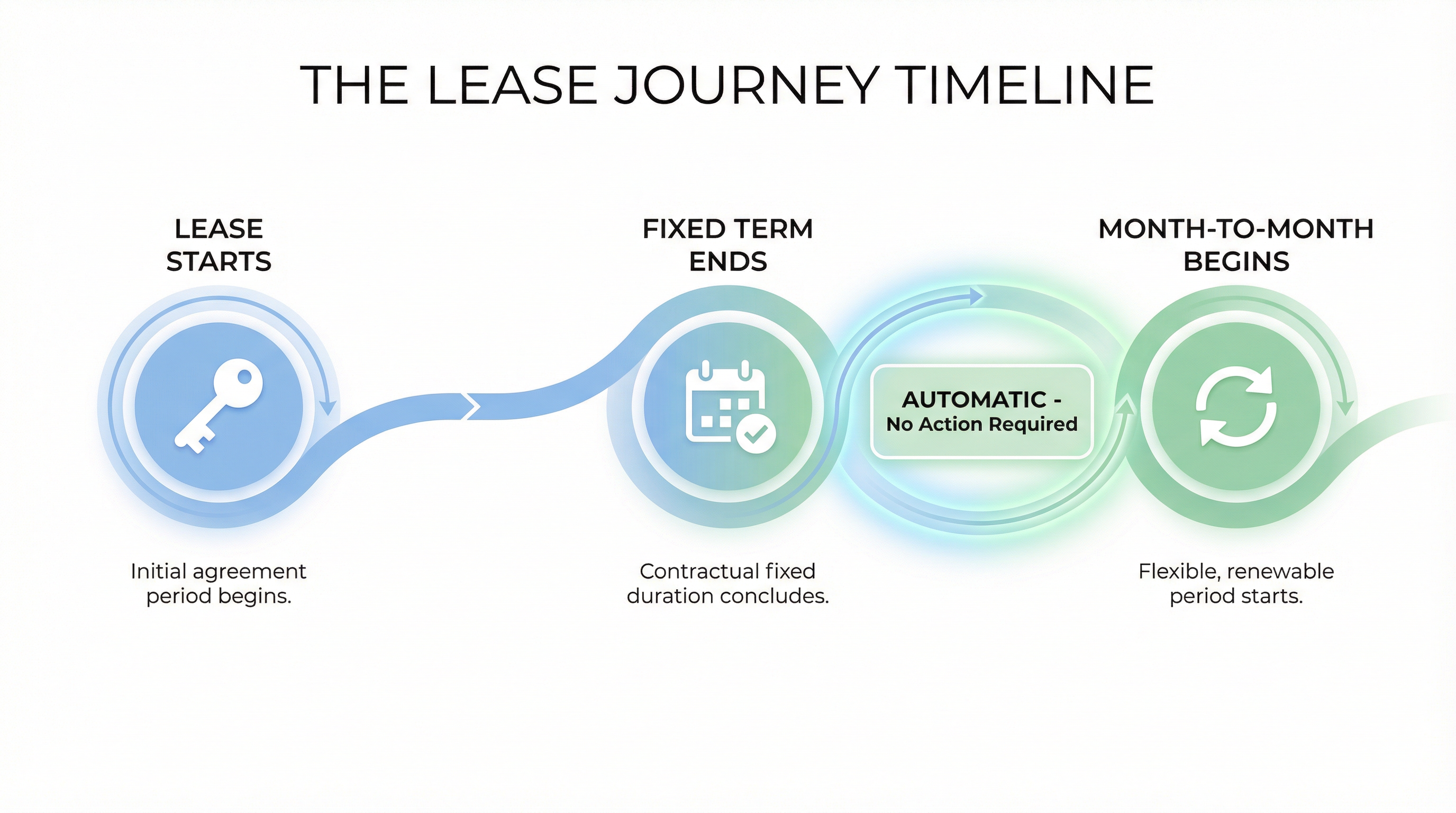
- Day after: Your tenancy automatically converts to month-to-month
- No paperwork required: The conversion happens by operation of law — neither party needs to do anything
- All terms preserved: Rent amount, rules, responsibilities — everything stays exactly the same
What Stays the Same
After your lease converts to month-to-month, these elements remain unchanged:
- Rent amount (subject only to guideline increases with proper notice)
- All lease terms and conditions
- Landlord's maintenance obligations
- Tenant's responsibilities
- Entry rules (24-hour notice still required)
- Pet permissions
- Parking, storage, included utilities
What Changes
The key differences after conversion to month-to-month:
- Either party can now end the tenancy with proper notice (60 days for tenants using Form N9, varies for landlords based on reason)
- Rent increases can occur annually with 90 days notice using Form N1 (limited to 2.5% guideline for 2025, 2.1% for 2026)
- Flexibility increases for tenants who may need to relocate
Need to calculate a termination date? Use our Ontario Termination Date Calculator to get the correct dates for any notice type.
The Rights You Keep
For Tenants:
- Right to stay indefinitely (as long as you follow the rules)
- Protection from eviction without valid cause
- Right to refuse signing a new lease
- Right to refuse rent increases above the guideline
For Landlords:
- Right to propose rent increases (within guideline)
- Right to pursue valid evictions with proper process
- Right to propose (but not require) a new fixed-term lease
- Right to sell the property (but tenancy transfers to new owner)
For Landlords — What You CAN and CANNOT Do
What You CANNOT Do
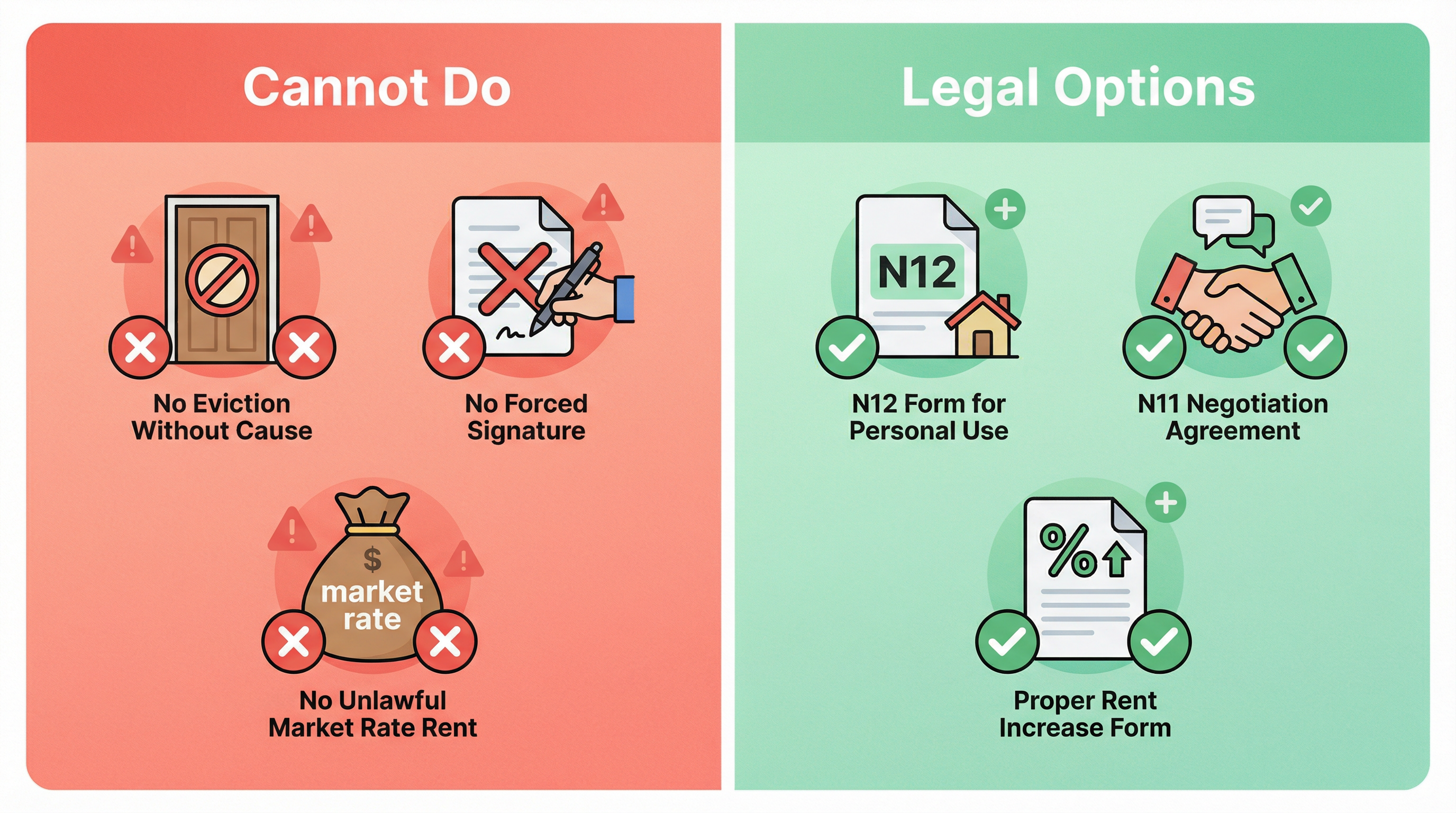
❌ Evict because the lease "ended"
Lease expiration is NOT a valid reason for eviction under the RTA. No LTB form exists for "lease ended" eviction. Attempting this could result in bad faith claims and significant penalties — up to $50,000 for individuals or $250,000 for corporations.
❌ Require a new lease
Tenants have zero obligation to sign anything. Refusing to sign is not grounds for eviction. You cannot increase rent beyond the guideline just because they won't sign a new agreement.
❌ Require an N11 at lease signing
Pre-signed N11 agreements are unenforceable. This practice is explicitly illegal under the RTA. The LTB will not honour such agreements, and you could face penalties.
❌ Raise rent to "market rate"
Existing tenants are protected by rent control (for units first occupied before November 15, 2018). Maximum increase: 2.5% for 2025 or 2.1% for 2026. Post-2018 units are exempt from the guideline but still require 90 days notice.
What You CAN Do Legally
✅ Continue the month-to-month tenancy
This is often the simplest and best option. A reliable tenant means predictable income with no legal risk, no vacancy costs, and no turnover expenses.
✅ Propose a new fixed-term lease
You can offer a new lease, but the tenant can accept or decline. You cannot penalize them for declining. The new lease may include a lawful rent increase if 12+ months have passed since the last increase.
✅ Pursue valid "no-fault" evictions
N12 (Personal Use): You or an immediate family member genuinely need the unit for at least one year.
- 60 days notice minimum
- One month rent compensation required
- Sworn affidavit required
- Bad faith penalties: up to 12 months rent via T5 application
- Note: for landlord's-own-use N12s served on or after September 21, 2026, giving at least 120 days' notice means no compensation is required (a purchaser's N12 still requires it)
N13 (Renovations/Demolition): Major work requiring vacant possession.
- Building permit required FIRST
- 120 days notice
- Compensation required
- Right of first refusal for tenant to return
✅ Negotiate a mutual agreement (N11)
- Must be truly voluntary — never pressure or mislead
- Consider "cash for keys" compensation
- Get everything in writing with a clear move-out date
For Tenants — Your Rights and How to Protect Them
Your Core Rights After the Fixed Term
- Right to stay: You don't have to leave, period
- Right to refuse: No obligation to sign a new lease or N11
- Right to same terms: Your rent and conditions don't change automatically
- Right to proper process: Only the LTB can order an eviction
Recognizing Pressure Tactics
Here are common scenarios tenants face and how to respond:
"Your lease is ending, so you need to sign a new one or move out"
→ False. You automatically convert to month-to-month. No action required on your part.
"Sign this N11 now — it's just paperwork"
→ Red flag. An N11 is an agreement to END your tenancy. Never sign without understanding the consequences.
"I'm not renewing your lease"
→ Irrelevant. There's nothing to "renew." The law does it automatically. They cannot refuse.
"The new rent will be $X (significantly higher)"
→ Likely illegal. Increases are capped at the guideline for controlled units. They must use Form N1 with 90 days notice.
The N11 Warning — Think Before You Sign
What an N11 actually does:
- Ends your tenancy on the specified date
- Waives your right to T5 application (bad faith eviction claim)
- Waives compensation rights
- Is extremely difficult to cancel once signed
- Allows the landlord to get an eviction order WITHOUT a hearing
When an N11 might make sense:
- You genuinely want to leave
- You've negotiated substantial compensation ("cash for keys")
- You have everything in writing
- You've consulted legal advice
What To Do If You're Being Pressured
- Document everything: Save texts, emails, record dates of verbal conversations
- Don't sign anything under pressure
- Contact Tenant Duty Counsel: Free legal help at LTB hearings
- Reach out to ACTO (Advocacy Centre for Tenants Ontario)
- File T2 application if the landlord is harassing you
Common Myths Exposed — Landlord Edition
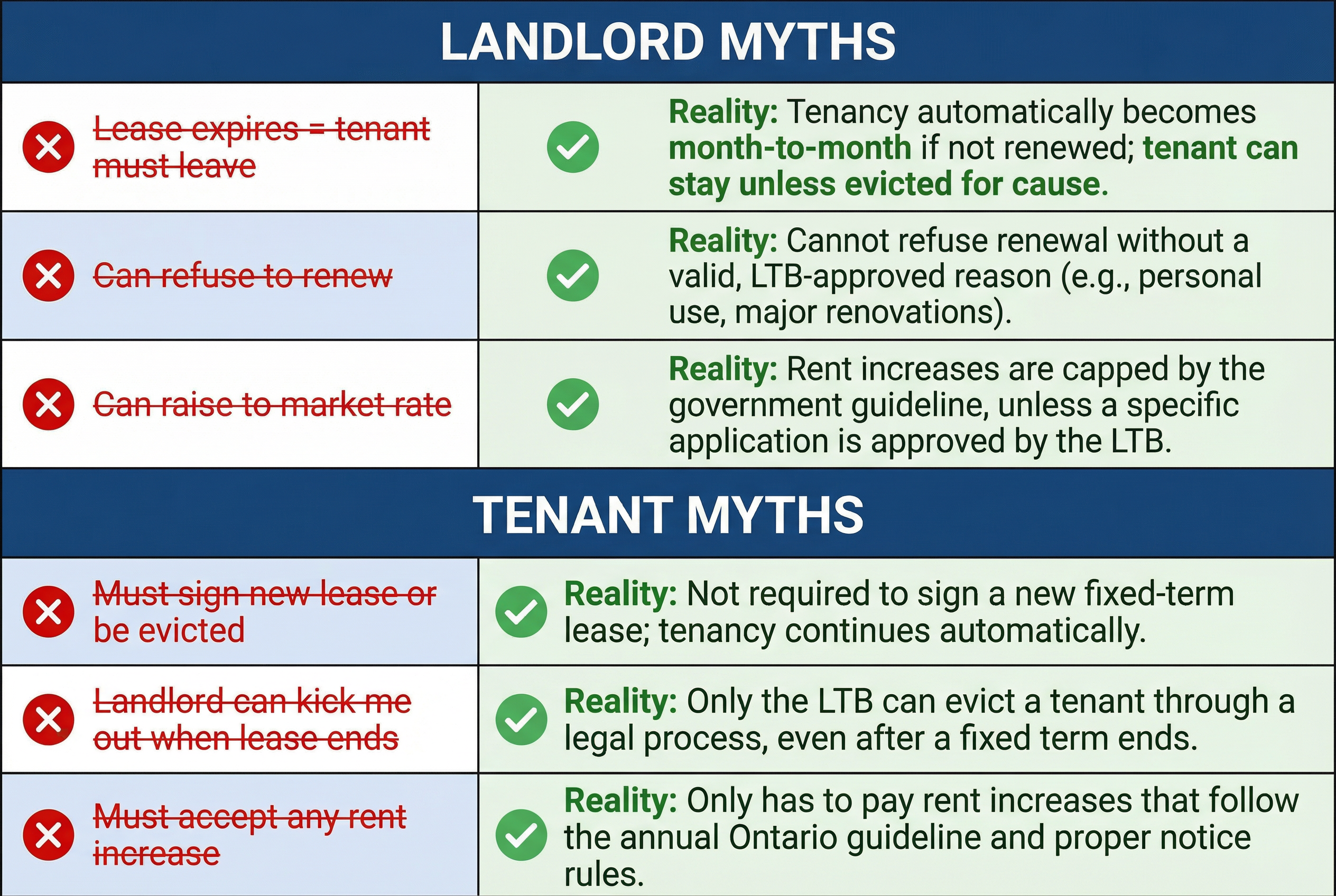
Myth #1: "The lease expires, so the tenant has to leave"
Reality: Leases don't "expire" in Ontario — they convert. No eviction right exists based on the lease end date alone.
Myth #2: "I can refuse to renew"
Reality: There's nothing to refuse. Conversion is automatic and mandatory under Section 38(1).
Myth #3: "I can raise rent to market rate when the term ends"
Reality: Rent increases are limited to the annual guideline (2.5% for 2025, 2.1% for 2026) for controlled units. Only between tenants (vacancy decontrol) can you reset to market rate.
Myth #4: "Bill 60 ended month-to-month leases"
Reality: The government proposed this but reversed course after just 3 days of backlash. Evergreen leases remain protected.
Myth #5: "I can require an N11 as part of the original lease"
Reality: This is explicitly illegal under the RTA. Such agreements are void and unenforceable.
Common Myths Exposed — Tenant Edition
Myth #1: "I have to sign a new lease or I'll be evicted"
Reality: You have the absolute right to stay month-to-month without signing anything.
Myth #2: "My landlord can kick me out because my lease is up"
Reality: They need a valid legal reason (personal use, renovations, non-payment, etc.) AND an LTB eviction order.
Myth #3: "I have no rights without a written lease"
Reality: The RTA protects all tenants, even those with verbal or implied agreements.
Myth #4: "I have to accept any rent increase when my lease ends"
Reality: Increases require proper form (N1), 90 days notice, and must comply with guideline limits.
Myth #5: "If I refuse to sign an N11, they'll just evict me anyway"
Reality: Refusing an N11 is your right. They would need a legitimate eviction reason and LTB approval.
Practical Takeaways
Actionable Checklist for Landlords
- ☐ Understand the law: Lease expiration ≠ eviction right
- ☐ Plan ahead: Decide your approach 90+ days before lease end
- ☐ Communicate clearly: Inform tenant of month-to-month conversion if continuing
- ☐ Follow proper process: Use correct LTB forms for any rent increase (N1) or termination
- ☐ Document everything: Keep records of all communications
- ☐ Consult professionals: LTB resources, paralegal, or lawyer for complex situations
- ☐ Never pressure: Avoid anything that could be seen as harassment or coercion
Actionable Checklist for Tenants
- ☐ Know your rights: You can stay without signing anything new
- ☐ Stay calm: Lease "ending" doesn't mean you're losing your home
- ☐ Document pressure: Save any communications suggesting you must leave or sign
- ☐ Don't rush: Never sign an N11 or new lease under pressure
- ☐ Verify increases: Check that any rent increase follows the guideline and proper notice
- ☐ Seek help early: Contact Tenant Duty Counsel or a legal clinic if concerned
- ☐ Give proper notice: If YOU want to leave, use Form N9 with 60+ days notice
Key Numbers to Remember
- 60 days: Minimum notice for tenants to end month-to-month tenancy (N9)
- 90 days: Notice required for rent increases (N1)
- 2.5%: 2025 rent increase guideline
- 2.1%: 2026 rent increase guideline
- $50,000: Maximum fine for illegal lockout (individuals)
Landlord's Lease-End Checklist: 15 Steps to Stay Legal When Your Fixed Term Expires
Don't risk a $50,000 fine or bad faith claim. This step-by-step checklist ensures you handle your tenant's lease expiration the right way under Ontario law.
Get Free PDF →Conclusion
Ontario's "evergreen" lease framework means your fixed-term lease never truly expires — it transforms into a month-to-month tenancy with all the same protections. Landlords cannot evict simply because the term ended, and tenants don't need to sign anything to stay.
Bill 60 (passed November 2025) changed many aspects of the Residential Tenancies Act, but automatic lease conversion and security of tenure remain firmly intact. The government's quick reversal on this issue demonstrates just how fundamental these protections are to Ontario's rental framework.
Whether you're a landlord navigating your options or a tenant standing firm on your rights, understanding Section 38(1) of the RTA is essential. The lease doesn't end — it evolves.

Ready to Create Your RTA-Compliant Lease?
Use Tenon10's Ontario Standard Lease builder to ensure your lease meets all legal requirements — and access our complete LTB forms library.
Free • No signup required • Updated for the Bill 60 changes in force 21 Sep 2026
Frequently Asked Questions
Can my landlord refuse to renew my lease in Ontario?
No. There's nothing to "refuse" — when your fixed-term lease ends, it automatically converts to a month-to-month tenancy under Section 38(1) of the RTA. Your landlord cannot prevent this conversion. You have the right to stay as long as you pay rent and follow the lease terms.
Do I have to sign a new lease when my one-year term ends?
No. You have no obligation to sign anything. Your tenancy continues month-to-month with all the same terms automatically. If your landlord presents a new lease, you can decline without consequences. Refusing to sign is not grounds for eviction.
Can my landlord increase my rent to market rate when my lease ends?
No. For rent-controlled units (first occupied before November 15, 2018), increases are limited to the annual guideline — 2.5% for 2025 and 2.1% for 2026. Your landlord must provide 90 days written notice using Form N1. Only when a unit becomes vacant can rent be reset to market rate.
What should I do if my landlord is pressuring me to sign an N11?
Don't sign anything under pressure. An N11 is an agreement to end your tenancy, not routine paperwork. Document all pressure tactics, consult with Tenant Duty Counsel (free at LTB) or a legal clinic, and remember that you cannot be required to sign an N11 as a condition of your tenancy. If harassment continues, you can file a T2 application with the LTB.
Did Bill 60 change anything about month-to-month leases?
No. The Ontario government initially proposed ending automatic month-to-month conversion, but reversed course within 3 days after significant public backlash. Bill 60 (passed November 27, 2025) does NOT change security of tenure or the evergreen lease framework. Your lease still automatically converts to month-to-month, and this protection remains intact. Important note: While Bill 60 passed, the RTA amendments are awaiting proclamation and are not yet in effect as of January 2026.


