A Toronto landlord collected a $6,400 "damage deposit" from his tenant in 2024. Both parties signed the agreement. The tenant paid willingly. But when the tenancy ended, the Landlord and Tenant Board ordered the full amount returned—plus interest and filing fees. The landlord's mistake? Including a clause that's automatically void under Ontario law, regardless of whether the tenant agreed to it.
Ontario's Standard Lease gives landlords exactly one place to customize their agreements: Section 15, Additional Terms. But this section is a legal minefield. Include the wrong clause, and it's not just unenforceable—it could expose you to LTB fines up to $35,000 per offence. Include the right clauses, and you can protect your property, clarify expectations, and avoid costly disputes.
This guide breaks down every clause you CAN and CAN'T add to your Ontario Standard Lease. You'll get 15+ illegal clauses to avoid (with RTA section references), 20+ legal clauses you SHOULD include (with copy-paste templates), grey area clauses that trip up even experienced landlords, and real LTB case outcomes showing what happens when illegal clauses are challenged.
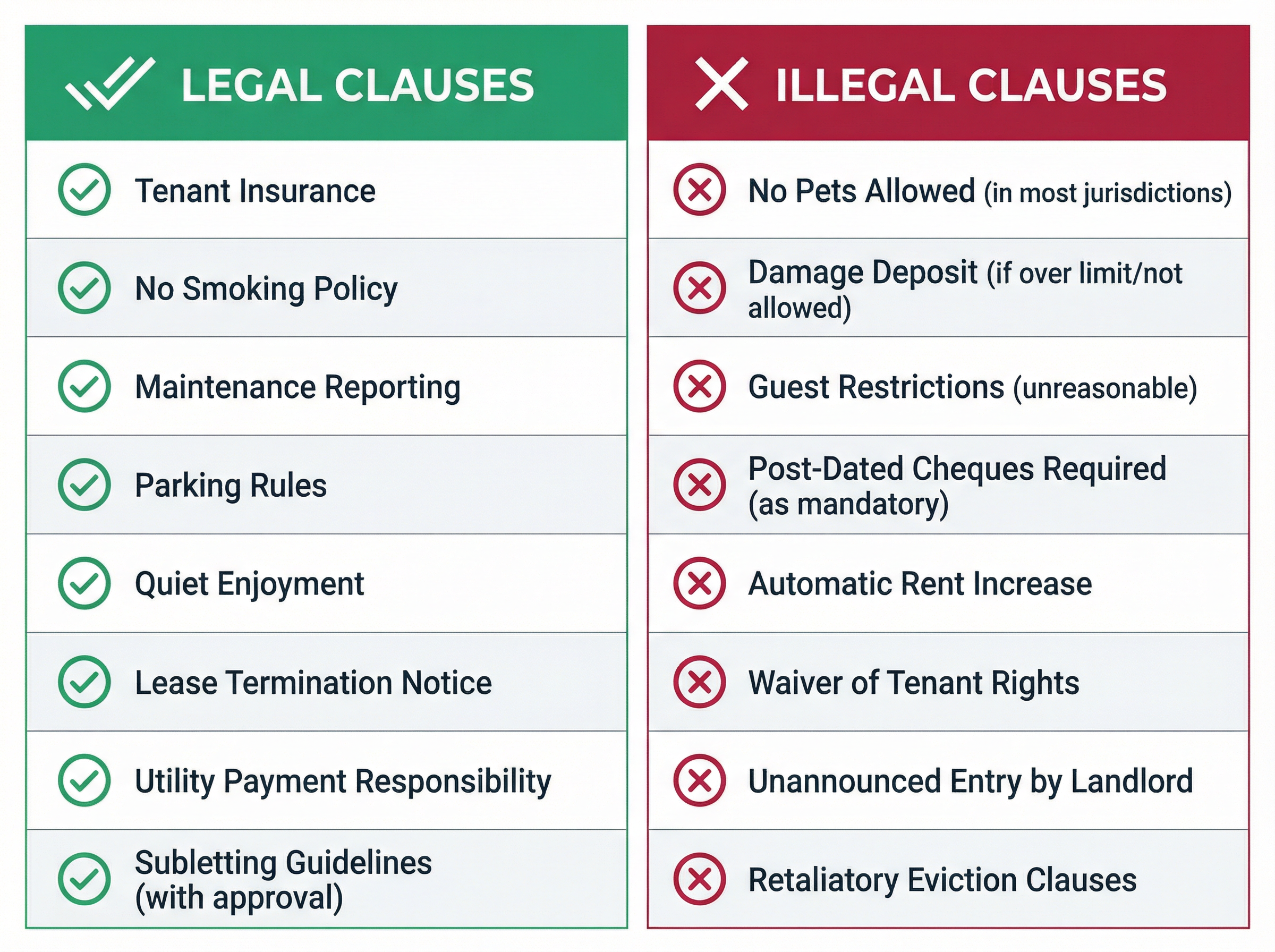
Section 15 Compliance Checklist: Legal vs Illegal Clauses
Pre-signing checklist to verify your Ontario Standard Lease is compliant. Includes 15+ illegal clauses to avoid and 10+ legal clauses to include.
Get Free PDF →Section 15 Explained: Your Only Customization Option
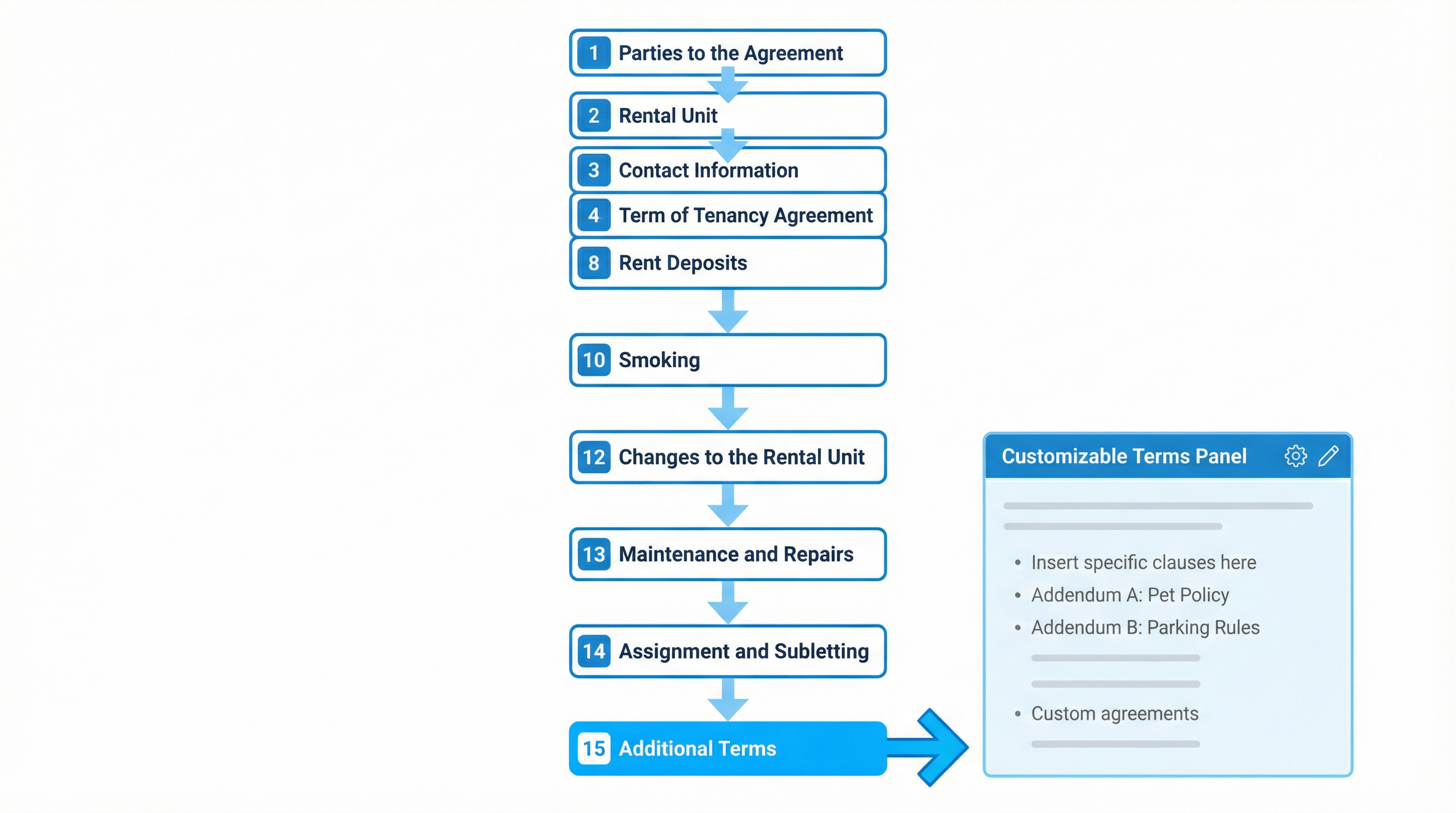
The Ontario Standard Lease has 15 mandatory sections that cannot be altered. Section 15—Additional Terms—is the only place landlords can add custom rules to their lease agreements. Understanding how this section works is essential for every Ontario landlord.
What Is Section 15?
Section 15 is the "Additional Terms" section of Ontario's Standard Lease. It's the only place landlords can add custom rules, and any terms you include require tenant consent and must be physically attached to the lease.
The Legal Framework
RTA Section 4 states clearly: any clause inconsistent with the Residential Tenancies Act is automatically void. The Standard Lease has 15 mandatory sections that cannot be altered. Section 15 allows additions, not modifications to existing sections.
Key Rules for Section 15 Terms
- Must be written in plain language
- Must clearly state what landlord/tenant must do
- Minimum 10-point font if typed
- Must be physically attached to the lease
- Requires tenant's written consent
"Any term in a lease that contradicts the RTA is void and unenforceable, even if the tenant signs the document." — Marda Management
Illegal Clauses: The Complete List
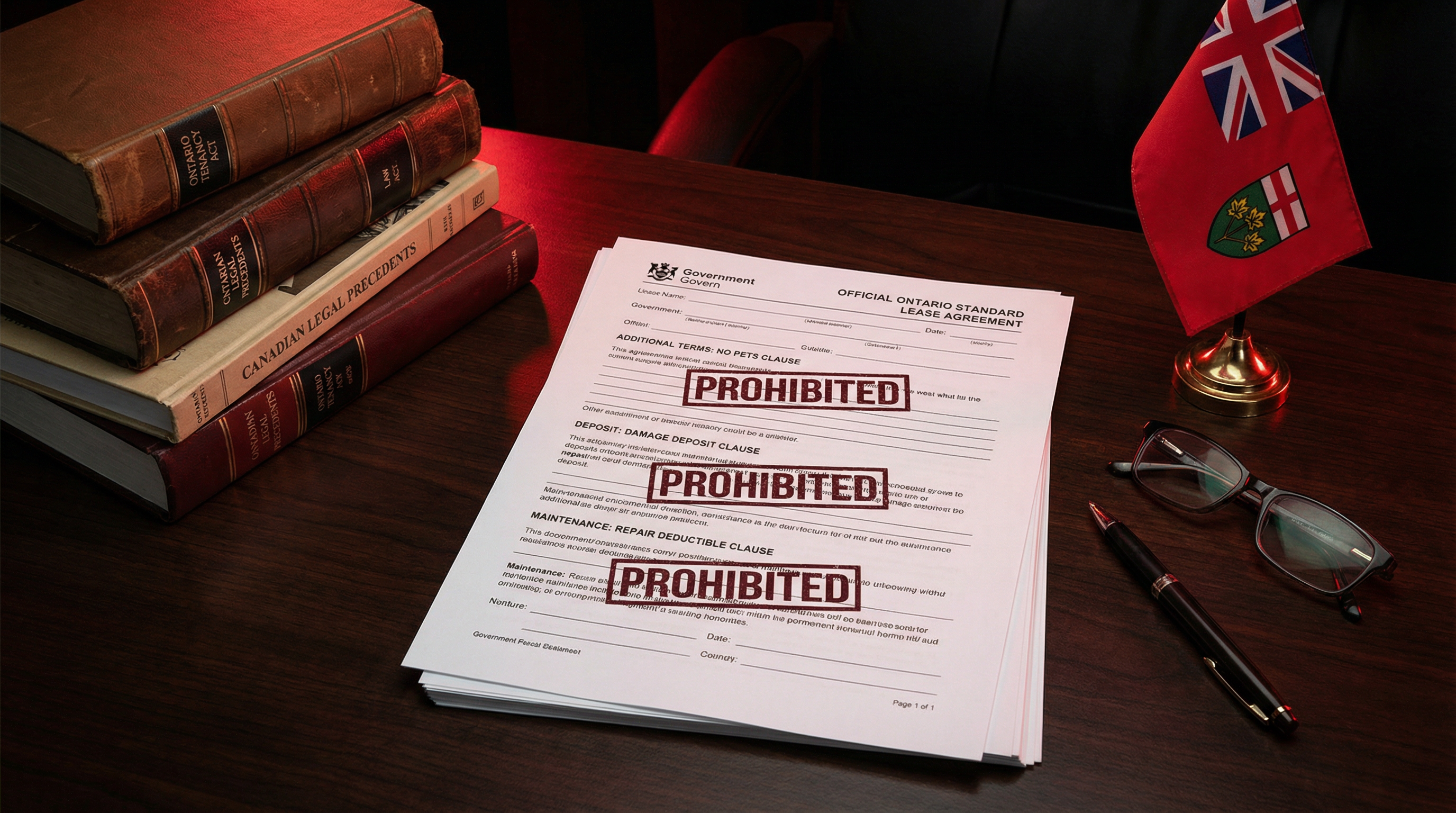
Per the Ontario Government: "Any extra term which attempts to take away a right or responsibility under the act is void (not valid or legally binding) and cannot be enforced." These clauses are VOID regardless of whether the tenant signs them.
Category 1: Pet Restrictions ❌
RTA Section 14: "A provision in a tenancy agreement prohibiting the presence of animals in or about the residential complex is void."
Illegal clauses include:
- "No pets allowed"
- "Pets prohibited"
- "Tenant agrees not to keep any animals"
- "Pet deposit of $500 required"
- Size/breed restrictions (in non-condo rentals)
The Exception: Condominium corporation rules CAN prohibit certain pets. But this is the condo's rule, not a lease clause. We'll cover condo-specific rules in detail below.
What You CAN Do Instead: Ask about pets on the rental application, deny an applicant based on pets (before signing), and include pet responsibility clauses covering damage liability and cleanup requirements.
Category 2: Occupancy Restrictions ❌
Illegal clauses include:
- "No guests overnight"
- "No roommates without landlord approval"
- "Maximum 2 occupants"
- "Additional occupants require landlord consent and fee"
- "No subletting under any circumstances"
Why They're Void: Tenants have the right to have guests for any length of time, have roommates/occupants without landlord consent, and sublet with landlord's permission (which cannot be unreasonably withheld).
The Exception: Municipal bylaws on overcrowding ARE enforceable.
"Tenants can have guests for any length of time. They can have occupants for any length of time." — Robert Di Lisi, Legal Expert (CRESI Podcast)
Category 3: Illegal Deposits ❌
Illegal deposit clauses include:
- "Security deposit: $2,000"
- "Damage deposit required"
- "Pet deposit: $500"
- "Cleaning deposit: $300"
- "Key deposit: $500" (if exceeds replacement cost)
What's LEGAL vs ILLEGAL:
| Deposit Type | Legal? | Maximum Amount |
|---|---|---|
| Last Month's Rent | ✅ Yes | 1 month's rent |
| Key Deposit | ✅ Yes | Actual replacement cost only |
| Damage Deposit | ❌ No | $0 — Prohibited |
| Pet Deposit | ❌ No | $0 — Prohibited |
| Security Deposit | ❌ No | $0 — Prohibited |
| Cleaning Deposit | ❌ No | $0 — Prohibited |
📋 Case Study: zhou-v-he-20240906
A landlord collected an illegal damage deposit of $6,400. The LTB ordered the full amount returned. Lesson: The size of the illegal deposit doesn't matter—ALL security deposits are prohibited in Ontario.
Category 4: Maintenance Transfer ❌
RTA Section 20: Landlord responsible for "good state of repair and fit for habitation"
Illegal clauses include:
- "Tenant responsible for all repairs under $100"
- "Tenant pays first $100 of any repair"
- "Tenant responsible for lawn maintenance"
- "Tenant must shovel snow and maintain exterior"
- "Tenant responsible for pest control"
- "Tenant agrees to maintain appliances"
Why They're Void: Exterior maintenance is the landlord's responsibility under RTA Section 20. These duties cannot be transferred via lease agreement.
The Workaround: You CAN have the tenant handle lawn care—but it requires a SEPARATE contract (not part of the lease). This makes it a severable agreement outside RTA jurisdiction.
Category 5: Financial Violations ❌
Illegal clauses include:
- "Post-dated cheques required"
- "Interest charged on late rent at X%"
- "Late payment fee: $50"
- "NSF fee: $100"
- "Rent increases automatically by 5% annually"
- "Rent increases above guideline accepted"
The Nuance: You CAN request post-dated cheques, but you CANNOT require them as a condition of the lease. NSF fees ARE allowed (for actual bank charges). Rent increases must follow the guideline (2.1% for 2026).
Category 6: Rights Waivers ❌
Illegal clauses include:
- "Tenant waives right to file with LTB"
- "Tenant agrees landlord may enter without notice"
- "Tenant agrees to vacate upon 30 days notice" (less than RTA requirements)
- Pre-signed N11 (Agreement to End Tenancy) at lease signing
Why They're Void: Tenants cannot waive their statutory rights under the RTA. Any attempt to do so is automatically void.
Legal Clauses: What You SHOULD Include
These clauses ARE enforceable and protect your property investment. Consider including them in every Section 15.
1. No-Smoking/Vaping Clause ✅
Why It's Enforceable: The RTA doesn't address smoking in individual units. Landlords can set these rules.
Copy-Paste Template:
Important: Must be in the original lease. Cannot be added mid-tenancy without tenant consent.
2. Tenant Insurance Requirement ✅
Why It's Enforceable: Standard Lease Section 11 specifically allows this.
Copy-Paste Template:
3. Maintenance Reporting Requirement ✅
Why It's Enforceable: Doesn't transfer maintenance responsibility—just requires communication.
Copy-Paste Template:
📋 Case Study: The Roof Leak Issue (AVS Hospitality)
A tenant didn't report a ceiling leak for 3 months. When the ceiling collapsed, the insurance claim was denied due to neglect. After adding a 48-hour reporting clause, the property manager prevented similar situations.
4. Pet Responsibility Clause ✅
Why It's Enforceable: You can't ban pets, but you CAN establish expectations.
Copy-Paste Template:
5. Parking Rules ✅
Copy-Paste Template:
6. Common Area Rules ✅
Copy-Paste Template:
7. Move-In/Move-Out Procedures ✅
Copy-Paste Template:
8. Rent Control Exemption Notice ✅ (If Applicable)
Copy-Paste Template:
Grey Area Clauses: The Tricky Ones
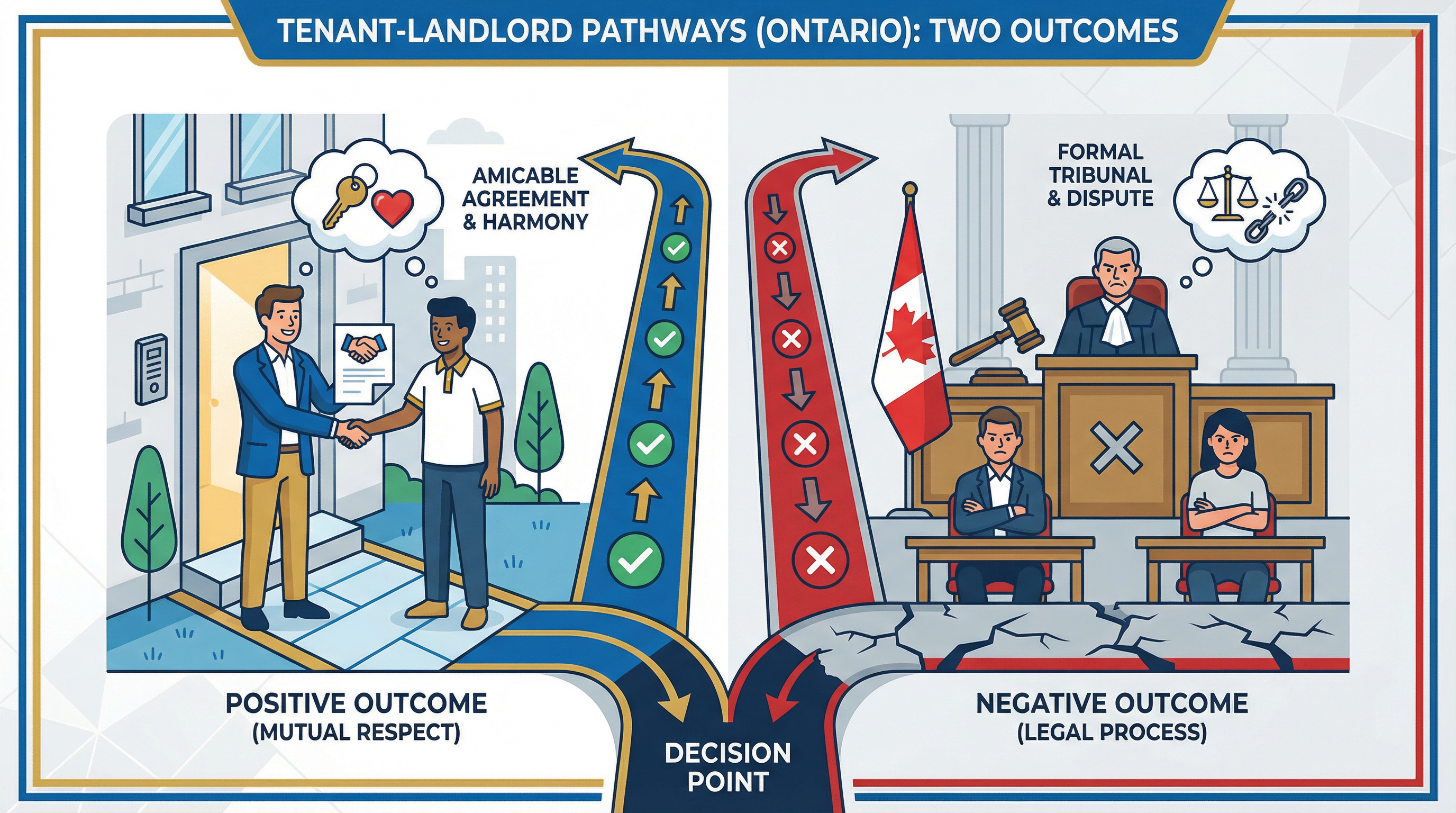
Some clauses aren't clearly legal or illegal—they depend on HOW you implement them.
1. Lawn Care / Snow Removal
The Rule: RTA Section 20 makes exterior maintenance the landlord's responsibility.
In the Lease: ❌ ILLEGAL
Separate Contract: ✅ LEGAL
If you want the tenant to handle yard work, create a SEPARATE agreement (not attached to the lease) that offers compensation or rent reduction in exchange. This makes it a severable contract outside RTA jurisdiction.
2. Post-Dated Cheques
Cannot Require: ❌
Can Request: ✅
3. Early Termination Provisions
Cannot Impose Penalties: ❌
Can Outline Process: ✅
4. Condo Pet Rules
In Regular Rentals: ❌ Pet bans are VOID
In Condos: ✅ Condo corporation rules ARE enforceable
Copy-Paste Template (Condo):
Condo vs. Non-Condo: Different Rules Apply
In a typical apartment building, a "no pets" lease clause is void under RTA Section 14. But in a condominium, the condo corporation's declaration, bylaws, and rules CAN restrict or prohibit pets—and these ARE enforceable against tenants.
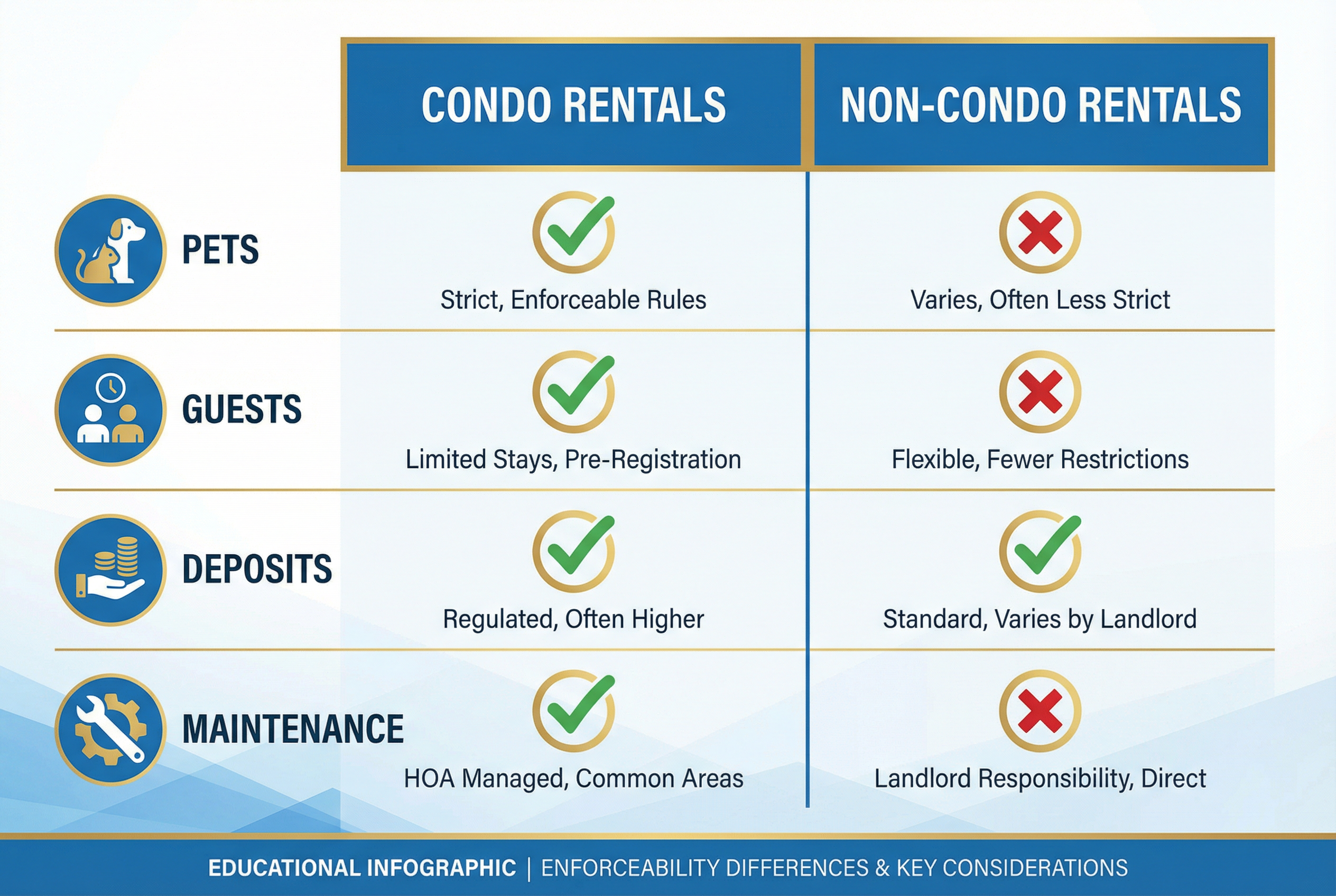
Key Distinction
| Scenario | Pet Ban Enforceable? |
|---|---|
| Lease clause says "no pets" (non-condo) | ❌ No |
| Lease clause says "no pets" (condo) | ❌ No |
| Condo declaration prohibits pets | ✅ Yes |
| Condo rules limit pet size/number | ✅ Yes |
The Enforcement Mechanism
- Condo rules are enforced through the Condominium Authority Tribunal (CAT)
- Tenants work through their landlord (the unit owner) for disputes
- Violation of condo rules CAN lead to N5 notice for substantial interference
Best Practice for Condo Landlords
- Provide tenants with a copy of relevant condo rules
- Include acknowledgment clause in Section 15
- Specify which rules relate to pets, noise, parking, etc.
- Keep condo rule documents as part of the lease file
What Happens If You Try to Enforce an Illegal Clause
If your lease contains an illegal clause, the illegal clause is unenforceable (as if it doesn't exist), the rest of the lease remains valid, and you cannot evict or penalize based on the void clause.
"An unenforceable clause doesn't void the entire lease agreement." — Soccio Marandola LLP
LTB Outcomes
When tenants challenge illegal clauses at the LTB:
Illegal Deposit Cases:
- Landlord ordered to return full deposit amount
- Interest added from date of collection
- Filing fees may be added
- No "partial enforcement"
Illegal Restriction Cases (pets, guests, etc.):
- Clause declared void
- Tenant's rights affirmed
- Landlord may face administrative fines for harassment if they attempted enforcement
Potential Penalties
| Violation | Consequence |
|---|---|
| Collecting illegal deposit | Full refund + interest ordered |
| Attempting to enforce void clause | Clause ignored by LTB |
| Harassment over void clause | Up to $35,000 administrative fine |
| Bad faith eviction | Up to 12 months rent + differential |
| Illegal eviction (individual) | Up to $50,000 fine |
| Illegal eviction (corporation) | Up to $250,000 fine |
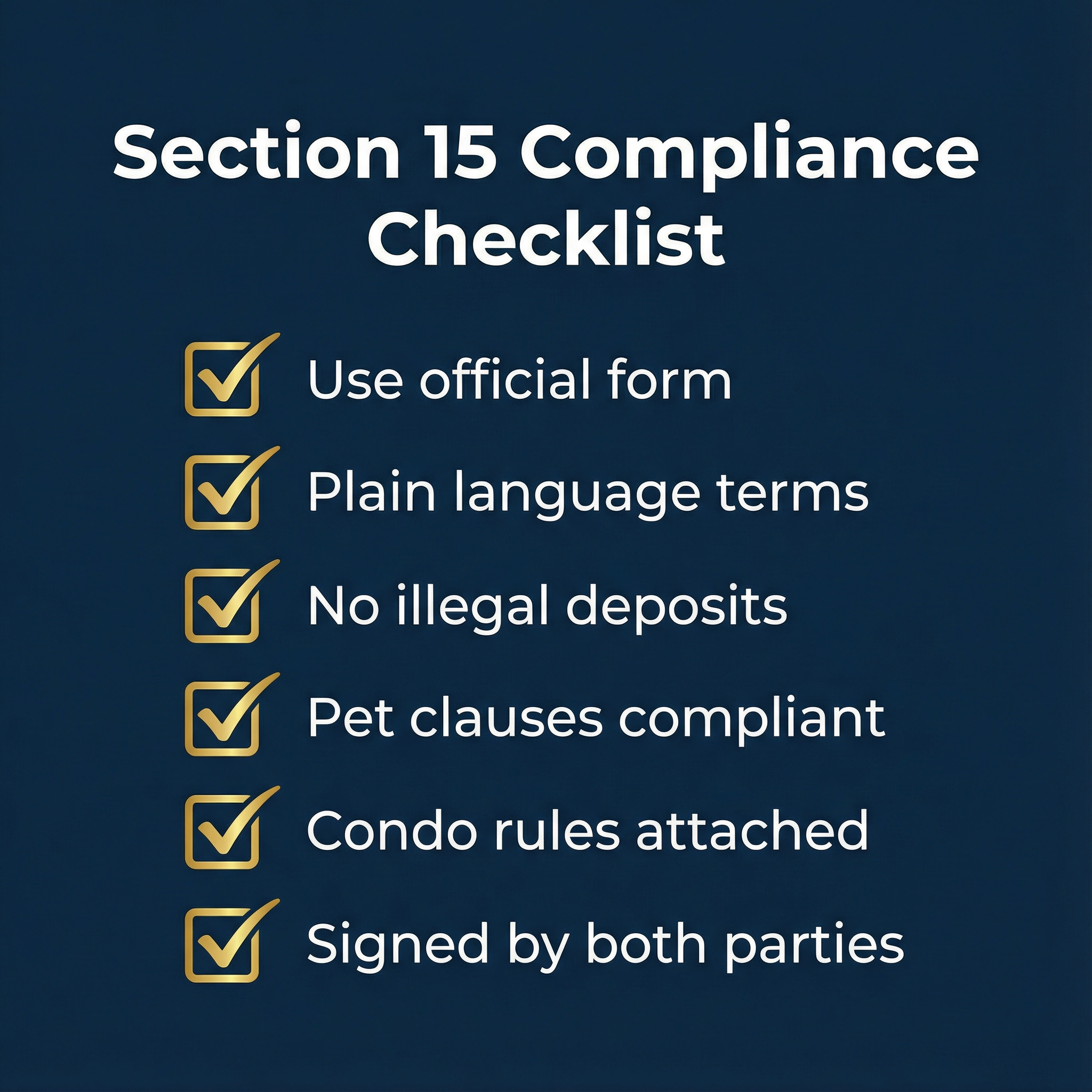
Pre-Signing Compliance Checklist
Before Every Lease Signing, Verify:
- ☐ Using official December 2020 Standard Lease form
- ☐ All 15 mandatory sections completed correctly
- ☐ No alterations to pre-printed sections
- ☐ Section 15 terms written in plain language (10+ point font)
- ☐ NO "no pets" clauses (unless condo with rules attached)
- ☐ NO damage/security/pet deposit clauses
- ☐ Key deposit = actual replacement cost only
- ☐ Last month rent deposit = max 1 month rent
- ☐ NO post-dated cheques required (request only)
- ☐ NO roommate/guest restrictions
- ☐ NO repair deductibles or maintenance transfers
- ☐ Rent control exemption documented (if applicable)
- ☐ Condo rules attached (if applicable)
Quick Wins (Implement Today)
- Add a no-smoking clause to every new lease
- Require tenant insurance with proof within 10 days
- Add maintenance reporting requirements (48-hour rule)
- Document move-in/out procedures to prevent disputes
- For condos: Always attach corporation rules
Long-Term Strategy
- Audit existing leases for illegal clauses
- Create a Section 15 template with your standard legal terms
- Build a separate lawn care contract if you want tenant to maintain exterior
- Review condo rules annually for changes affecting tenants
- Use Tenon10's Lease Builder to generate compliant leases automatically
Section 15 Compliance Checklist: Legal vs Illegal Clauses
Pre-signing checklist to verify your Ontario Standard Lease is compliant. Includes 15+ illegal clauses to avoid and 10+ legal clauses to include.
Get Free PDF →Key Takeaways
Ontario's Standard Lease limits your customization to Section 15—but that one section can make or break your landlord experience.
The key principles:
- Any clause that contradicts the RTA is automatically void, even if signed
- You CANNOT ban pets, restrict guests, or collect damage deposits
- You CAN require no-smoking, tenant insurance, and clear maintenance reporting
- Condo rules ARE enforceable—but only through the condo declaration, not your lease
The landlords who succeed in Ontario aren't those who try to sneak illegal clauses past tenants. They're the ones who maximize the legal protections available in Section 15 while building clear, professional tenant relationships.
Ready to Build Bulletproof Lease Agreements?
Tenon10's Lease Builder automatically generates Ontario-compliant Standard Leases with customizable Section 15 terms—no legal expertise required.
Free • No signup required • Bill 60 compliant
Frequently Asked Questions
Can a tenant break their lease if I included an illegal clause?
No. An illegal clause is simply void—it doesn't invalidate the entire lease. The tenant remains bound by all legal provisions. However, if the clause relates to deposits, the tenant can demand their money back and potentially file with the LTB for interest and costs.
What if my tenant agreed to a "no pets" clause and signed it?
The clause is still unenforceable. RTA Section 14 makes all pet prohibition clauses void "regardless of any agreement to the contrary." If the tenant later gets a pet, you cannot evict them solely for having it. You CAN take action if the pet causes damage or substantially interferes with other tenants.
Can I add new rules during an existing tenancy?
Not without the tenant's written consent. You cannot unilaterally add restrictions mid-tenancy. At lease renewal, you can offer a new lease with additional terms, but the tenant can refuse and continue on a month-to-month basis under the original terms.
Is there a limit to how many additional terms I can include in Section 15?
There's no legal limit, but practical wisdom suggests keeping it reasonable. A 30-page addendum may scare away quality tenants who will assume you're difficult to work with. Focus on the most important protections: smoking, insurance, maintenance reporting, and property-specific rules.
Do post-November 2018 buildings still need to use the Standard Lease?
Yes. The Standard Lease is required for all residential tenancies regardless of when the building was constructed. Post-November 15, 2018 buildings are only exempt from RENT CONTROL (the annual guideline limit), not from the lease form itself. You can note the rent control exemption in Section 15.
Can I require tenants to pay for professional cleaning at move-out?
No. You cannot require tenants to pay for cleaning or use specific cleaning services. Tenants must return the unit in "ordinary cleanliness" considering normal wear and tear. You CAN charge for damage beyond normal wear, but only through an LTB application—not as a lease requirement or deposit deduction.