Update, 26 Sep 2026: The own-use compensation rule changed on September 21, 2026. For an N12 served on or after that date for the landlord's own use (the landlord, the landlord's spouse, a child or parent of either, or a caregiver for any of them) with at least 120 days' notice, the landlord no longer has to pay one month's rent or offer another unit. With less than 120 days' notice, for a purchaser's own use, or for an N12 served before that date, compensation (or an offer of another unit the tenant accepts) is still owed. The landlord or the person named in the notice must also normally move in within 60 days of the termination date, or bad faith is presumed if the tenant files a T5 (the landlord can rebut it; this does not apply to a purchaser's N12). Offering another rental unit the tenant accepts has long been an alternative to one month's rent wherever compensation is owed. Source: the LTB operational update of September 21, 2026.
In Ontario, a bad-faith N12 can cost a landlord up to a year of rent in penalties — on a $2,200/month unit, that's $26,400 or more, plus moving costs and rent differential damages. A defective N12 — one that simply gets the form, the timing, or the compensation wrong — costs at least an extra round of paperwork and several months of delay at the Landlord and Tenant Board. The N12 is the only legal way to end a tenancy in Ontario when the landlord, a family member, or a buyer needs to move into the unit, and the rules are unforgiving in both directions.
N12 sits in the most contested corner of Ontario tenancy law. Landlords often misunderstand who qualifies as an eligible occupant — the family-member list is narrower than most people assume. Property managers handle the paperwork but bear operational risk if it's wrong. Tenants who receive an N12 frequently don't know the protections they have, including the 12-month bad-faith T5 window that opens after they vacate. Bill 60 changed parts of the framework in 2025, adding a new compensation pathway and clarifying the intent-to-occupy period.
This guide is written for landlords, property managers, and tenants — because all three sides of an N12 benefit from understanding the same rules. No advocacy, no spin. Just how the N12 actually works in 2026, who qualifies, what compensation is required, what voids the notice, and the complete process from N12 through L2 to a potential T5.
The Ontario N12 Checklist: Know If Your N12 Is Valid
Received an N12 own-use eviction notice? Use this free Ontario tenant checklist to quickly verify whether your N12 is valid under the 2026 Bill 60 rules — and know exactly what to do if it isn't, including your 12-month bad-faith T5 window.
Get Free PDF →Ontario N12 notices in 2026: the landscape
The N12 — formally, "Notice to End your Tenancy Because the Landlord, a Purchaser or a Family Member Requires the Rental Unit" — is the official Tribunals Ontario form used to end a tenancy when the landlord (or a qualifying person) genuinely needs the unit for residential occupation. It sits within a broader set of Ontario LTB notices that each serve a different purpose: N4 for non-payment, N5 for interference with reasonable enjoyment, N12 for own use, N13 for demolition or major repairs, N8 for end of term.
What makes the N12 distinct is the volume of contested hearings. While most N4 cases turn on whether rent was paid (a factual question with documentary evidence on both sides), N12 cases turn on what was in someone's mind — whether the landlord genuinely intended for a named person to move in. That's harder to prove, easier to dispute, and as a result, N12 applications are among the most contested at the LTB. In 2026, wait times for an L2 hearing — the application a landlord files when the tenant doesn't vacate by the termination date — commonly run six to twelve months, with longer waits in Toronto and the GTA.
The market context matters too. With Toronto's purpose-built rental vacancy rate at 1.8% and one-bedroom rents commonly between $2,100 and $2,600, the financial incentive to move a long-tenured tenant out and re-rent at market rates is significant. LTB adjudicators are aware of this, and that awareness shapes how N12 cases are scrutinized — particularly in Toronto, Ottawa, and Hamilton.
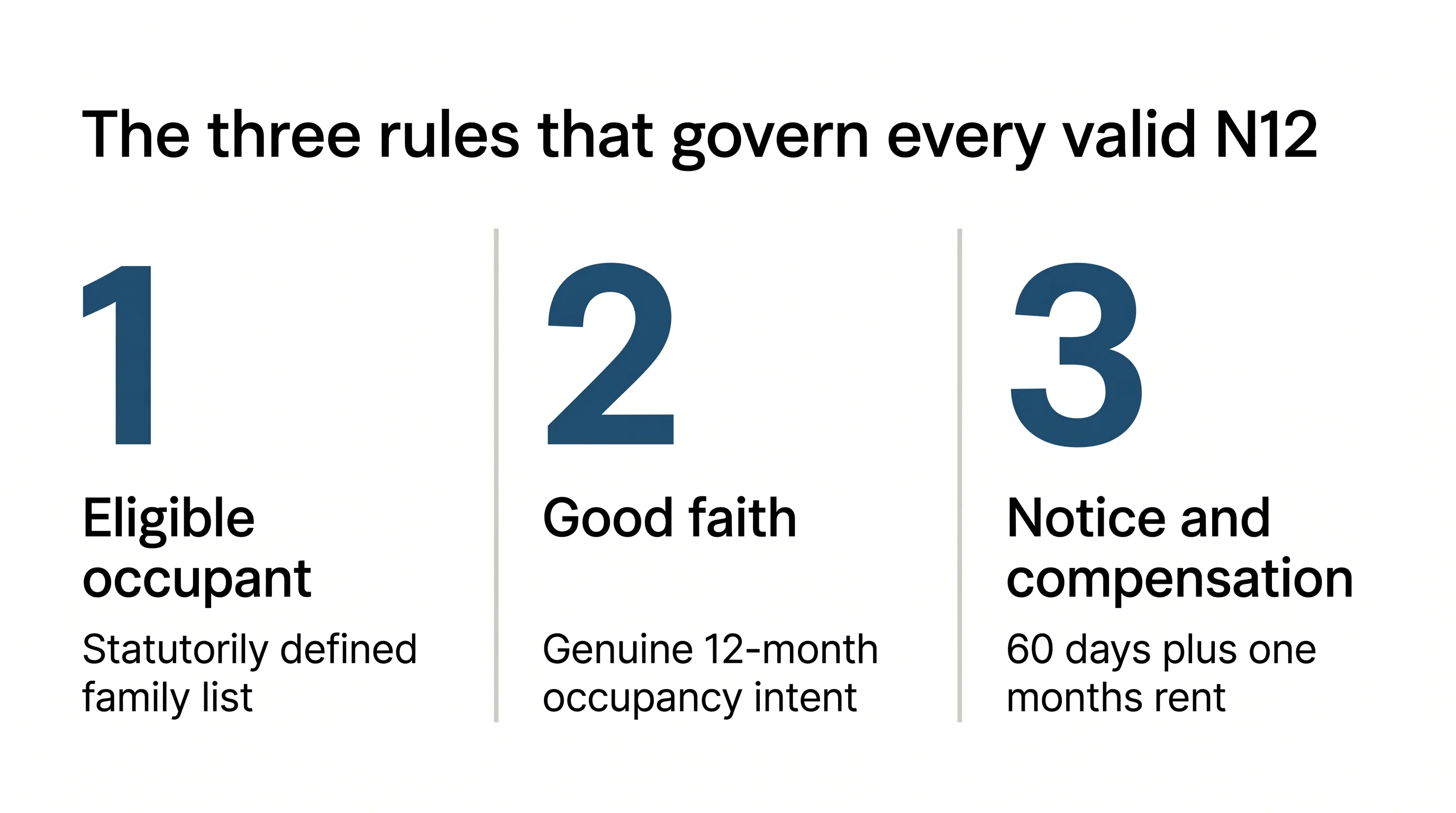
The three rules that govern every valid N12
Three rules sit at the centre of the N12 framework:
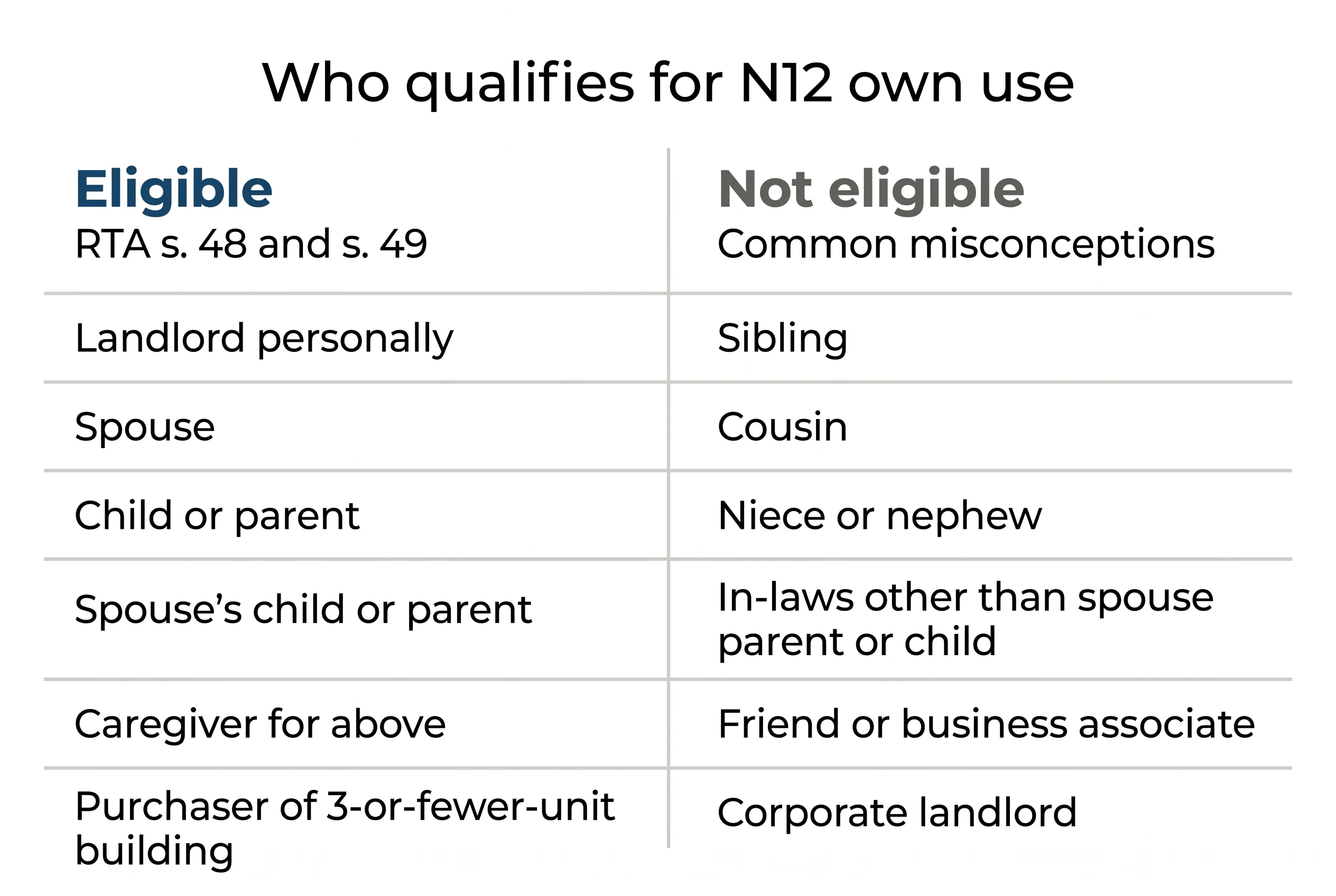
The eligible occupant rule defines who can move in. Under section 48 of the Residential Tenancies Act, the intended occupant must be the landlord personally, the landlord's spouse, the landlord's child or parent, the landlord's spouse's child or parent, or a caregiver for any of those people (where the caregiver will live in the unit). Under section 49, a purchaser can use the N12 if the building has three or fewer rental units. Siblings, cousins, friends, business associates, and corporations don't qualify.
The good faith rule requires that the landlord genuinely intend for the named person to occupy the unit as their primary residence. Since 2020 (Bill 184, RTA s.48(1)), the intended occupancy must be for at least one year — not a brief visit, not a part-time arrangement.
The notice and compensation rule requires at least 60 days of written notice on the official Form N12, with the termination date falling on the last day of a rental period, plus one month's rent in compensation paid before the termination date (or an offer of another rental unit acceptable to the tenant). One exception has applied since September 21, 2026: an N12 served on or after that date for the landlord's own use (the landlord, the landlord's spouse, a child or parent of either, or a caregiver for any of them) that gives at least 120 days' notice requires no compensation and no offer of another unit. It does not apply to an N12 served for a purchaser.
Why this matters depends on which seat you're sitting in. For a landlord, a defective N12 means months of delay and the risk of bad-faith liability if circumstances change after the tenant moves out. For a property manager, the documentation and process compliance fall on you even when the substantive intent comes from your landlord client. For a tenant, knowing the rules means knowing whether to vacate, whether to challenge the notice, and whether the post-vacancy 12-month T5 window applies if circumstances change.
How an N12 actually works
The N12 by itself doesn't end a tenancy. It's a notice — a written communication that triggers a 60-day countdown. If the tenant vacates by the termination date, the tenancy ends and the process is complete. If the tenant doesn't vacate, the landlord's next step is to file an L2 application with the LTB. The L2 process culminates in a hearing where the landlord must file a sworn affidavit confirming the intended occupant's good-faith intent to move in and live in the unit.
This three-step structure — N12, then potential L2, then potential T5 if the move-in doesn't happen — is one of the things that makes N12 unique among Ontario notices. It creates obligations on the landlord that extend well past the termination date.
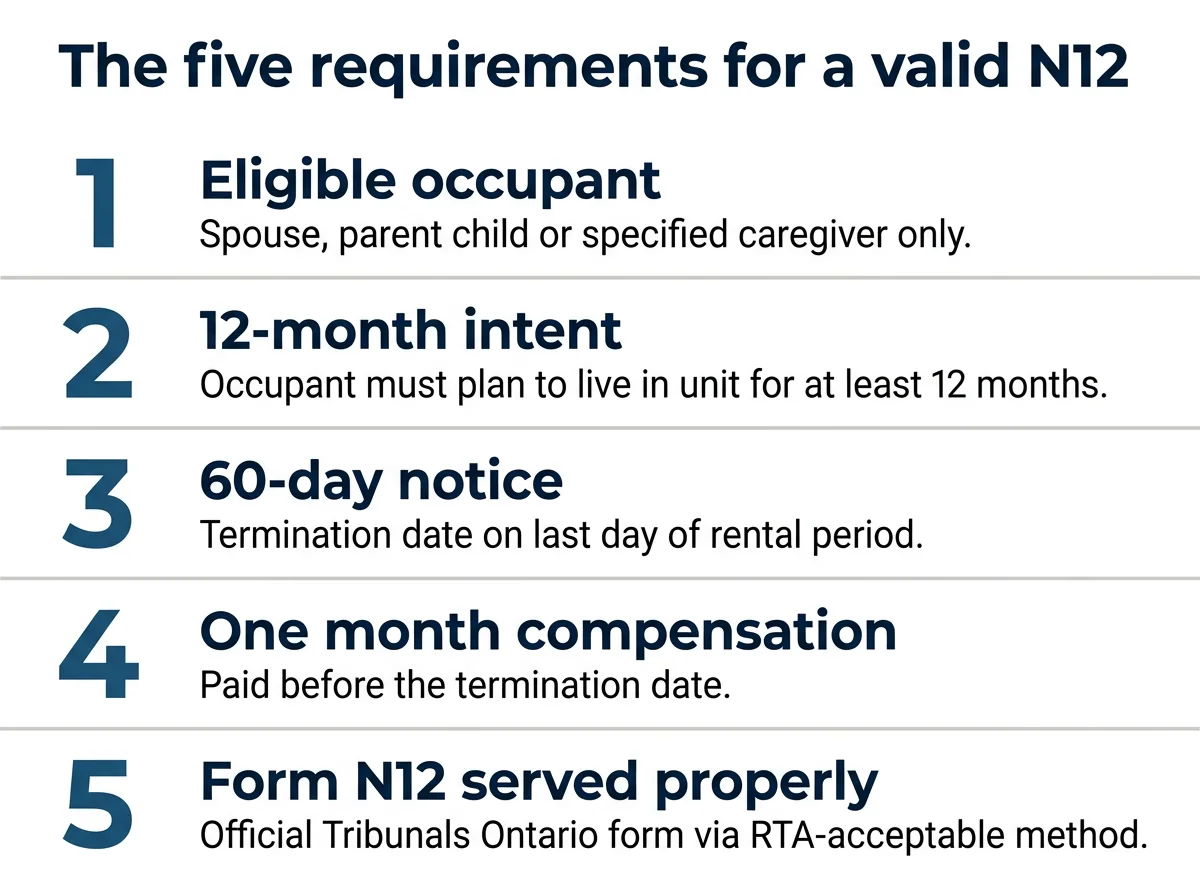
The five requirements for a valid N12
- Eligible occupant. The named occupant must qualify under section 48 (landlord, spouse, child, parent, spouse's child or parent, caregiver) or section 49 (purchaser of a building with three or fewer rental units).
- Intended occupancy of at least 12 months. The named occupant must plan to live in the unit as their primary residence for at least 12 months.
- 60-day minimum notice. The termination date must be at least 60 days after the date the notice is served, and must fall on the last day of a rental period.
- One month's compensation paid before the termination date. Standard compensation is one month's rent. The Bill 60 alternative-accommodation pathway is narrow and rarely the right choice.
- Written notice on Form N12 served properly. The official Tribunals Ontario form, delivered through an RTA-acceptable method.
Who qualifies as an eligible occupant
The eligible-occupant list is narrower than most people assume. Within the immediate family — spouse, child, parent, spouse's child or parent — the relationship qualifies. Outside that, almost nothing does. Siblings don't qualify. Cousins don't qualify. Nieces, nephews, friends, business associates, and employees don't qualify. Corporate landlords can't serve N12 for "own use" at all because corporations don't personally occupy units.
A concrete example: the 60-day timeline
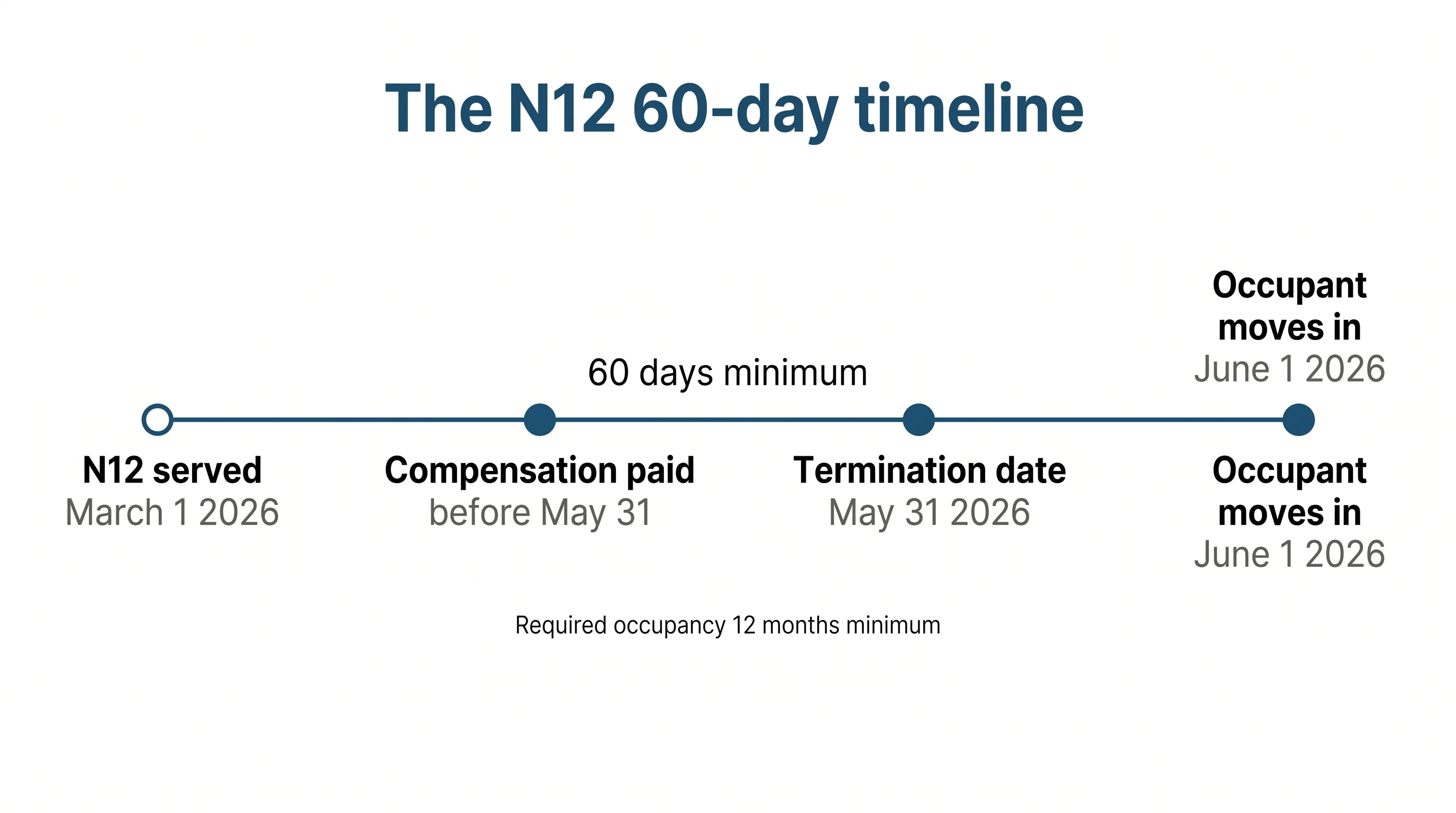
A Toronto condo, tenant since 2022, current rent $2,400/month. The landlord's adult daughter is starting a new job in Toronto and will move in.
- March 1, 2026: Landlord serves N12 with termination date May 31, 2026 (91 days — comfortably above the 60-day minimum, and ending on the last day of the rental period)
- Before May 31: Landlord pays $2,400 compensation to tenant
- May 31, 2026: Termination date — tenant vacates
- June 1, 2026: Daughter moves in
- Required: Daughter lives in the unit for at least 12 months
Calculate your termination date: Use the Ontario Termination Date Calculator to find a valid 60-day-out termination date that lands on the last day of your rental period.
The Bill 60 120-day alternative occupancy exception
Bill 60 introduced a pathway where the landlord can substitute equivalent alternative accommodation for the standard one-month compensation in certain documented circumstances. In practice, this pathway is narrower than it appears at first reading — the documentation requirements are specific, and most landlords and property managers default to the straightforward one-month compensation path. If you're considering the alternative-accommodation route, treat it as the exception that requires careful planning, not the default.
What voids an N12 (and what happens then)
The financial stakes on an N12 cut both ways. A defective N12 — one that fails one of the five requirements — gets dismissed when the L2 application reaches a hearing. The landlord must serve a new compliant notice and start the 60-day clock again, which can delay the process by months. A bad-faith N12 — one where the named occupant never moves in, or where the landlord's intent was not genuine — exposes the landlord to a T5 application from the former tenant. T5 penalties can reach a full year of rent equivalent, plus moving costs, rent differential, and general damages. On a $2,200 unit, that's $26,400 or more in penalties alone.
Common failure modes
- Naming an ineligible person. Sibling, cousin, niece, nephew, friend, business associate. Void on its face.
- Corporate landlord serving N12 for own use. Corporations can't occupy units. Void on its face.
- Compensation not paid before the termination date. Even if it's paid one day late, the notice is defective.
- Less than 60 days' notice or wrong termination date. Mid-month termination dates void the notice.
- Verbal or informal notice. A text message, a voicemail, or an email without prior written consent doesn't count as service.
- Missing affidavit at the L2 hearing. The intended occupant must swear an affidavit confirming intent to move in.
- Re-renting the unit within 12 months of the termination date. Strong evidence of bad faith at any subsequent T5 hearing.
Three real-world scenarios
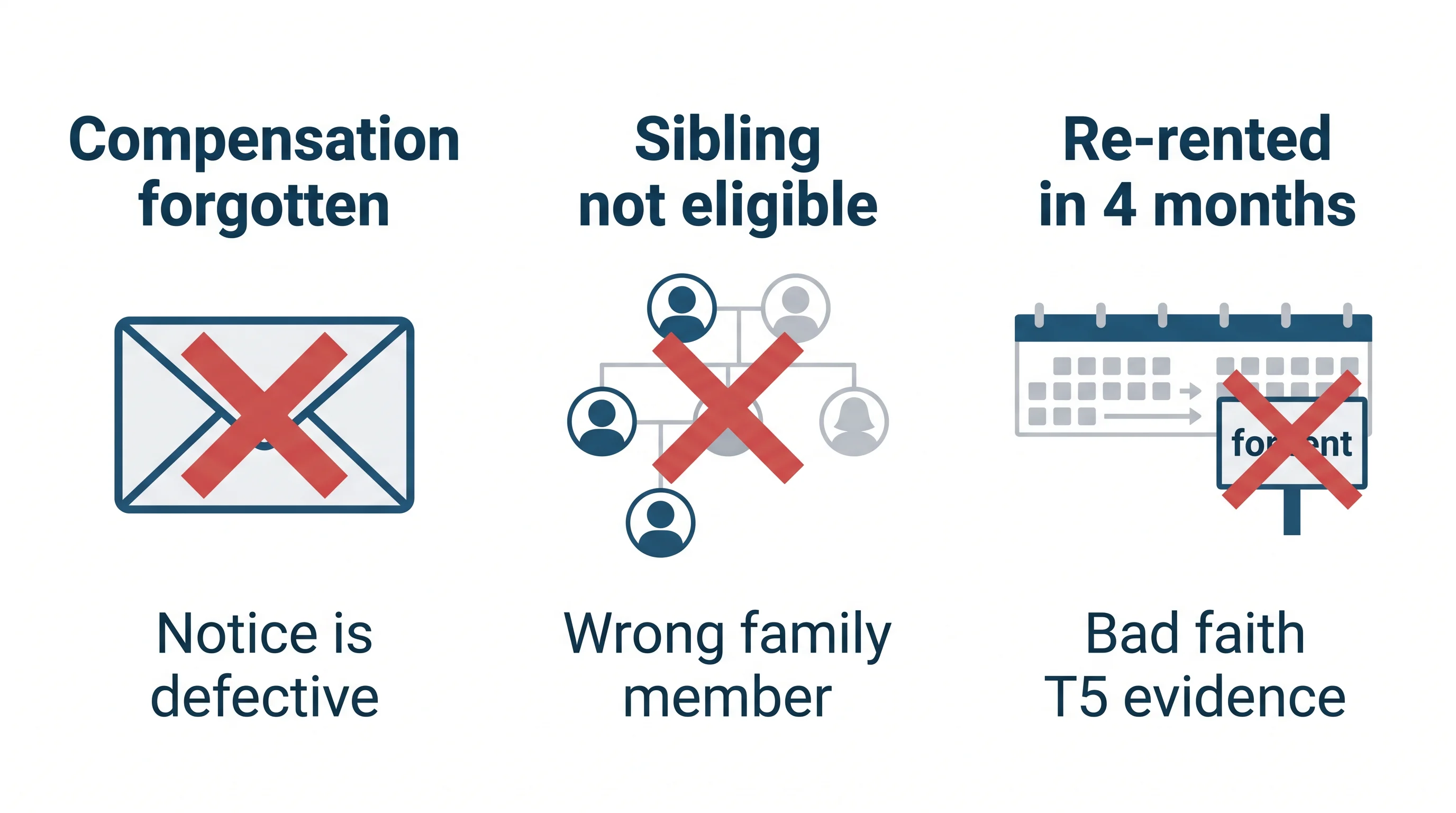
Scenario A — Compensation not paid. Ottawa apartment, $1,900/month. The landlord serves an N12 for their parent's use; the termination date is properly calculated. The landlord forgets to pay the one-month compensation before the termination date. At the L2 hearing, the notice is dismissed as defective. The landlord must serve a new compliant N12 and restart the 60-day clock — and the parent's planned move-in is delayed by months.
Scenario B — Bad faith T5 awarded. Mississauga condo, $2,200/month. The landlord serves an N12 stating their daughter needs the unit; the tenant vacates in June 2025. In October 2025 — within four months — the unit is relisted at $2,900/month and rented to a new tenant. The former tenant files a T5 application within the one-year window. The LTB awards rent differential, moving costs, and general damages up to the one-year cap. The takeaway for landlords: if the intended use changes after an N12, document the change and the reason carefully, and don't re-rent within 12 months without legal advice.
Scenario C — Wrong family member. Toronto apartment. The landlord serves an N12 because their sibling wants to move in. Siblings are not an eligible person under section 48. The notice is void on its face. The landlord must withdraw the L2 application or lose at the hearing.
What happens when an N12 is challenged or void
If the N12 is defective, the tenant continues paying the existing rent and stays in the unit. The landlord cannot evict on a defective notice — they would need to serve a new compliant N12 to start over. If bad faith is later proven through a T5 application, the displaced tenant has 12 months from the termination date to file. The T5 process itself can take six to twelve months at the LTB, with potential for substantial penalties on top of any rent differential, moving costs, and damages.
How this works for different situations
The N12 framework is the same regardless of who's running the process, but the operational reality varies based on your role.
If you're a landlord serving an N12 for your own family
Confirm the intended occupant is statutorily eligible before you do anything else. The family-member list is narrow — spouse, child, parent, spouse's child or parent, plus caregivers for any of those. Document the genuine intent: where is the occupant currently living, what's their reason for moving, when can they actually move in. Pay compensation before the termination date — not on it, before. Be prepared to file a sworn affidavit at any L2 hearing. And understand that the 12-month occupancy requirement is real — not a suggestion. If the occupant moves in for two months and then moves out, the former tenant has T5 grounds.
If you're a property manager handling N12s for clients
Push your landlord client to confirm intent in writing before you serve. Document everything: the eligible-occupant relationship, the intended move-in date, the reason for the move, any documentation that supports the occupant's good-faith plan to live there. Default to the straightforward one-month compensation path; the Bill 60 alternative is narrower than it appears and rarely worth the documentation overhead. Track the 12-month post-termination window — if the landlord's plans change, document the change in writing immediately. Quick re-listing exposes the landlord to T5 liability, and that's a conversation you want to have proactively, not after a former tenant has filed.
If you're a tenant receiving an N12
When an N12 arrives, walk through the checklist:
- Is the person named as the intended occupant statutorily eligible?
- Is the termination date at least 60 days after the notice date and on the last day of a rental period?
- Did the landlord pay one month's compensation before the termination date?
- Is the form actually a Tribunals Ontario Form N12, signed and dated?
If any of these are off, the notice may be defective. Continue paying rent, document everything, and consider seeking advice from Tenant Duty Counsel at the LTB or a community legal clinic. If you do vacate based on the N12 and later discover the unit was re-rented quickly or the named occupant never moved in, you have 12 months from the termination date to file a T5 application for bad-faith eviction. The T5 can recover moving costs, the difference between your old rent and your new rent, and general damages — up to a one-year-equivalent cap.
How Tenon10 handles this
For landlords and property managers, Tenon10 generates a correctly formatted N12 with the eligible-occupant relationship pre-validated, the 60-day termination date calculated automatically against the rental-period rule, and compensation tracking built in. The documentation needed for any L2 hearing — sworn affidavit templates, proof of compensation, occupant intent records — is collected as you work through the form, not assembled in a panic when the hearing is scheduled months later.
For tenants who receive an N12 generated through the platform, the eligibility, timing, and compensation requirements are already verified before the notice reaches you. The technical defects that void notices don't show up. When questions do come up about good faith or the post-termination 12-month window, everyone is starting from the same compliant baseline.
The Ontario N12 Checklist: Know If Your N12 Is Valid
Received an N12 own-use eviction notice? Use this free Ontario tenant checklist to quickly verify whether your N12 is valid under the 2026 Bill 60 rules — and know exactly what to do if it isn't, including your 12-month bad-faith T5 window.
Get Free PDF →Practical takeaways
If you're serving an N12:
- Is the intended occupant statutorily eligible (s. 48 or s. 49)?
- For a purchaser, is there a firm agreement of purchase and sale, and is the building three or fewer units?
- Will the occupant genuinely live in the unit for at least 12 months?
- Is the termination date at least 60 days out and on the last day of a rental period?
- Have I paid one month's compensation before the termination date?
- Did I use the official Form N12 and serve it properly?
- Am I prepared to file a sworn affidavit at the L2 hearing if needed?
If you're receiving an N12:
- Verify the named occupant is on the eligible list
- Count 60 days from the date you actually received the notice
- Confirm one month's compensation was paid before the termination date
- Document everything you receive
- Know you have 12 months to file a T5 for bad faith if circumstances later suggest the move was a pretext
Quick wins: Use the official Tribunals Ontario form, not a recreated version. Pay compensation early, not on the deadline. Keep written records of everything.
Longer term: For PM firms handling multiple N12s annually, software that validates eligibility, calculates termination dates, and tracks the 12-month post-termination window prevents the most expensive failure modes — bad-faith T5 awards.
Conclusion
The N12 is one of the highest-stakes notices in Ontario tenancy law. The rules aren't designed to be punishing — they exist because ending a tenancy for own use is a significant action that affects a real household, and the law requires the landlord to mean what they say.
For landlords, that means confirming eligibility before serving, paying compensation before the deadline, and following through on intended occupancy. For property managers, it means treating the documentation phase as the most important phase of the process. For tenants, it means knowing what a valid N12 looks like and knowing the protections that apply both during the notice period and for 12 months after.
Bill 60 added refinements but didn't change the fundamentals: eligible occupant, good faith, 60-day notice, one month's compensation, written notice on the official form. Get those right and the process works as intended for everyone involved.
Generate a valid Ontario N12 in minutes
Eligibility validation, 60-day termination dates, and compensation tracking — built in for every Ontario rental you manage.
Free • Updated for the Bill 60 changes in force 21 Sep 2026 • Affidavit templates included
Frequently asked questions
Who can a landlord legally serve an N12 for in Ontario?
The landlord personally, the landlord's spouse, the landlord's child or parent, the spouse's child or parent, or a caregiver for any of those people. Siblings, cousins, nieces, nephews, friends, and business associates are not eligible. Purchasers of a building with three or fewer rental units (or their spouse, child, parent, or caregiver) qualify under section 49.
How much compensation is required for an N12 in Ontario? (Updated: none for a landlord's-own-use N12 served on or after September 21, 2026 with at least 120 days' notice; in every other case, one month's rent or an offer of another unit the tenant accepts.)
One month's rent, paid before the termination date specified on the notice. The landlord can instead offer another rental unit the tenant accepts. Since September 21, 2026, none is owed for a landlord's-own-use N12 served on or after that date with at least 120 days' notice; a purchaser's N12 still owes it.
Can a landlord re-rent the unit after an N12?
Not within 12 months of the termination date without serious risk of a bad-faith T5 application from the former tenant. Re-listing the unit publicly within months of the N12 is one of the strongest pieces of bad-faith evidence at an LTB hearing.
What should a tenant do if they receive an N12?
Verify the four basics: eligible occupant, 60-day notice, termination date on the last day of a rental period, compensation paid before that date. If anything is off, the notice may be defective. Document everything, continue paying rent, and consider seeking advice. If you vacate and later discover the unit was re-rented or the named occupant never moved in, you have 12 months to file a T5 application.
What's the difference between an N12 and an N13?
N12 is for own use — landlord, family, purchaser. N13 is for demolition, conversion to non-residential use, or repairs requiring vacant possession. They have different procedures, different compensation rules, and different documentation requirements.