

Ontario has roughly 1.7 million renter households, and the majority of individual landlords in the province own five units or fewer. That means most Ontario landlords started exactly where you are now — with a single property and no prior experience. The good news is that the process is more navigable than it looks from the outside. The less-good news is that the legal framework is genuinely strict, and the mistakes first-timers make in year one often can't be unwound later.
Becoming a landlord in Ontario is a small-business decision dressed up as a real estate decision. The Residential Tenancies Act protects tenants extensively, the paperwork is mandatory in specific ways, and cash flow in year one is usually tighter than first-timers expect. Most new landlords encounter the rules through expensive mistakes rather than through planning — and those mistakes cost money, time, and sometimes the tenancy itself.
This guide walks through the full first-time Ontario landlord path: whether to rent out the property at all, the legal framework you need to know, the financial reality of year one, how to find and onboard your first tenant properly, and how to set up operations that won't collapse the first time something goes wrong.
The First-Time Ontario Landlord Checklist: From Decision to Day One
Thinking about renting out your property in Ontario? This free checklist walks you through every step — from deciding whether to rent at all, to executing your first Standard Lease — so you avoid the mistakes that cost first-time landlords a full year of revenue or peace of mind.
Get Free PDF →Should you rent out the property?
The first decision isn't operational — it's strategic. Not every property should be rented out, and the answer depends on which kind of first-time landlord you are, whether the financial math actually works, and whether you're temperamentally prepared for what the RTA requires.
The three types of first-time Ontario landlord
Most first-time Ontario landlords fall into one of three groups, and each faces different challenges:
- The accidental landlord. You kept a previous home when you moved, inherited a property, or found yourself owning a rental unit without planning to. Roughly 60-70% of first-timers fit this profile. The financial model often wasn't built to be a rental; the decisions are being made after the fact.
- The planned investor. You bought a property specifically to rent out — the condo investor is a recognizable version. You have the advantage of modelling the numbers before committing, but you still need to actually execute the tenancy properly.
- The side-suite landlord. You've added a legal basement apartment or accessory dwelling unit to your primary residence. The rental is a second income stream attached to your home, with different tax implications and operational considerations.
Each path has different cash flow implications, different legal exposures, and different long-term decisions. The RTA treats them all the same once you have a tenant, but the business decisions leading to that moment are very different.
The rent vs. sell decision
If you've inherited a property or kept an old home, the first honest question isn't how to be a landlord — it's whether to be one at all. Rent vs. sell decisions are rarely about maximum possible return; they're about whether renting is a good fit for your situation.
Four questions worth answering honestly before you list the unit:
- Does the projected net cash flow — after all expenses, not just mortgage payment — actually work for your budget?
- Can you absorb 2-3 months of vacancy in year one without financial stress?
- Are you emotionally prepared for the RTA reality: limited control over the unit, long LTB wait times (6-12 months in 2026), and a legal framework that defaults to tenant protection?
- Does holding the property make sense for your broader financial picture, or would selling and investing the equity elsewhere serve you better?
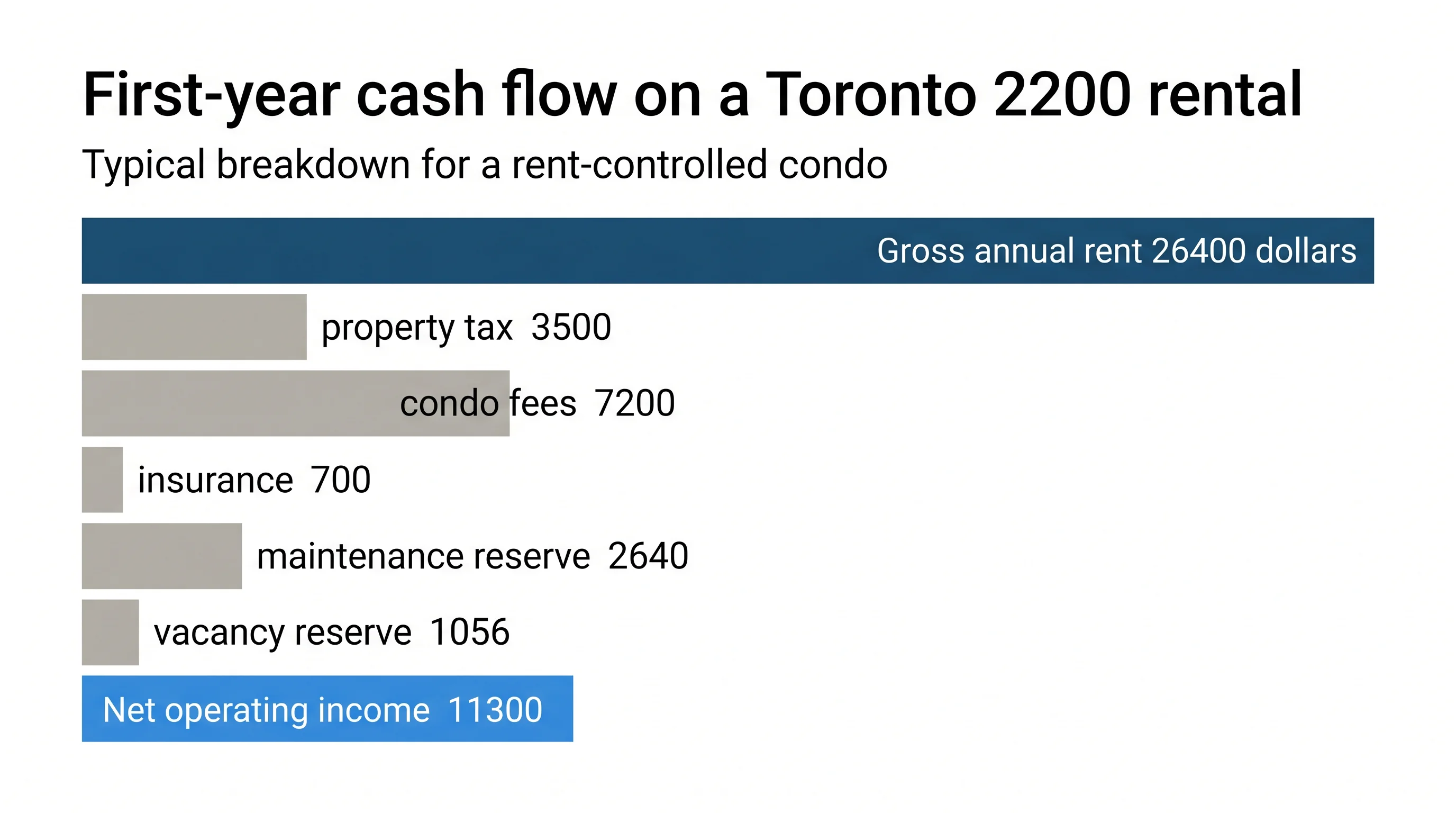
For a typical $2,200/month Toronto condo, the rough annual numbers look like this: gross rent of $26,400, operating costs (property tax, condo fees, insurance, maintenance reserve, vacancy reserve) of roughly $15,000, leaving about $11,300 in net operating income before mortgage payments and tax implications. For many first-time landlords, this is the first time they've seen the real numbers laid out — and the real numbers are usually less exciting than the imagined numbers.
Regional reality check
Ontario isn't a single rental market — it's several. Toronto and the GTA have the tightest vacancy, highest rents, most municipal overlays on top of the provincial RTA, and the most legal complexity. Ottawa has stable government-driven demand and slightly lower rents, with less municipal overhead. Hamilton, Kitchener-Waterloo, and London each have their own dynamics — Hamilton absorbs GTA price pressure, Kitchener-Waterloo follows tech employment and university housing, London leans heavily on post-secondary students. Secondary markets like Windsor, Kingston, Sudbury, and Thunder Bay offer cheaper entry but different operational considerations and slower tenant turnover.
The takeaway for first-timers: your cash flow model, tenant pool, and operating tempo will all look different depending on where the property is. Don't benchmark against Toronto numbers if you're in Kingston, and vice versa.
The legal framework you need to know
The single most important document in your new landlord life is the Residential Tenancies Act, 2006 (the RTA). You don't need to memorize it, but you do need to internalize three things about how it works.
The RTA is the document that runs your business
First, tenant protection is the default. Landlord rights are specific and constrained. If a rule isn't explicitly in your favour, assume it isn't — the RTA isn't hostile, but it's not designed to maximize landlord flexibility either.
Second, the RTA overrides lease terms. Any lease clause that contradicts the RTA is unenforceable. You cannot "contract out" of your obligations by putting different language in the lease. If the lease says one thing and the RTA says another, the RTA wins every time.
Third, it applies to most rentals. Apartments, condos, houses, secondary suites all fall under the RTA. Limited exceptions exist for owner-occupied spaces with shared kitchen or bathroom, commercial tenancies, and care homes — but most first-time landlords are squarely inside RTA territory.
The Ontario Standard Lease
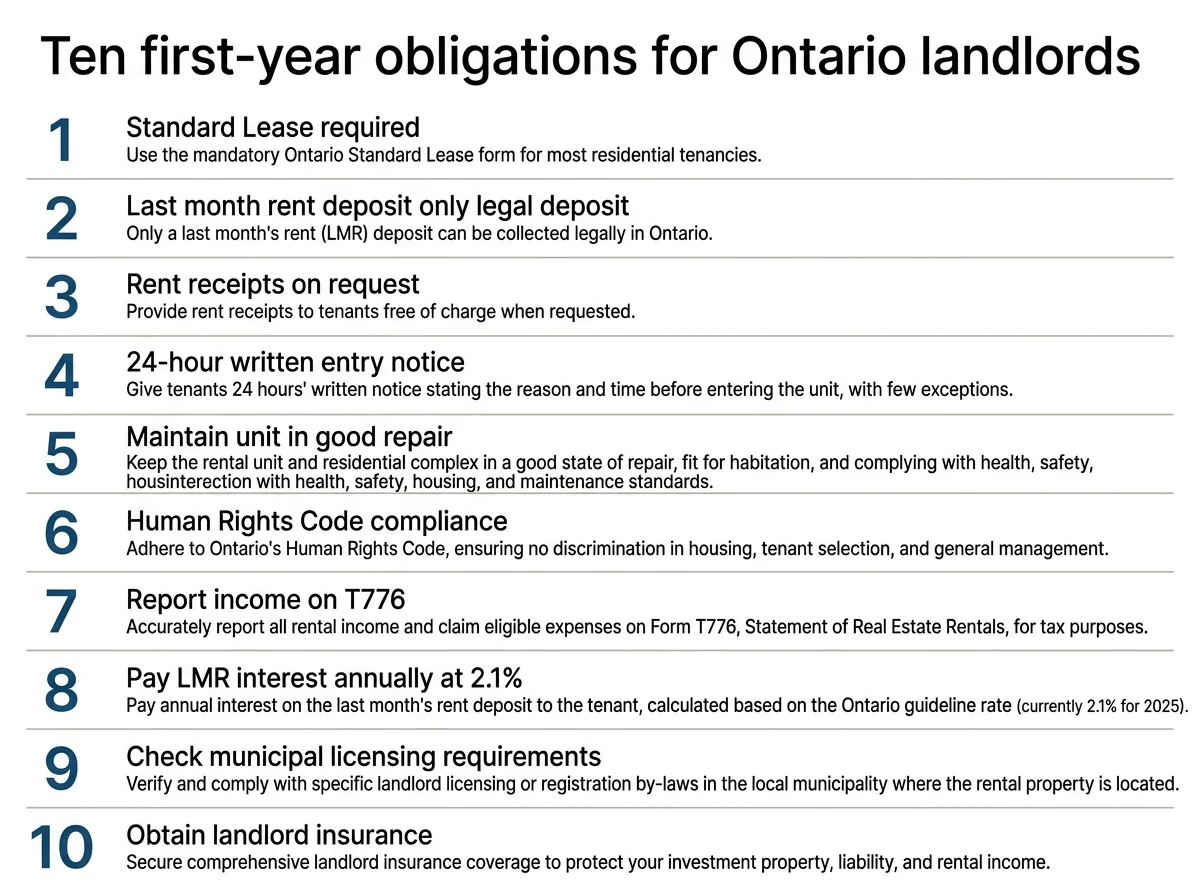
For most new private residential tenancies signed on or after April 30, 2018, Ontario requires the Standard Form of Lease (Form 2229E). This is not optional for the vast majority of first-time landlords. If you don't use the Standard Lease:
- The tenant can request one in writing
- If you don't provide it within 21 days, the tenant can withhold one month's rent
- The tenant can also terminate the tenancy with 60 days' notice
You can add additional terms that don't contradict the RTA, but the base form is mandatory. Trying to use a generic lease template you found online is one of the most common first-timer mistakes — and one of the easiest to avoid.
What you can and cannot collect
Ontario's deposit rules are famously tight. This is one of the places where first-time landlords most often get tripped up, because the rules conflict with common intuitions about how rentals work:
- Legal. Last month's rent deposit (one month's rent, held until the tenancy ends and applied to the final month, with interest paid annually at the guideline rate — 2.1% for 2026). Key deposit at the actual replacement cost of the keys or fobs, refundable when keys are returned.
- Illegal. Damage deposits. Security deposits. Pet deposits. Cleaning deposits. All of these are illegal in Ontario regardless of what the lease calls them. Calling a damage deposit "additional last month's rent" doesn't change its legal status.
Human Rights Code and tenant screening
The Ontario Human Rights Code prohibits discrimination in housing on a list of protected grounds: race, ancestry, place of origin, colour, ethnic origin, citizenship, creed, sex, pregnancy, gender identity or expression, sexual orientation, age (for tenants 16+), marital status, family status, disability, receipt of public assistance, and record of offences (for Criminal Code pardons).
Landlords can screen on:
- Rental history and landlord references
- Income and employment verification with documentation
- Credit reports with the applicant's written consent
The principle is simple: screen on ability to pay and on history of honouring tenancy obligations, not on who the applicant is or on proxies for protected grounds. The Human Rights Tribunal of Ontario has awarded significant damages in discrimination cases, and a single complaint can cost far more than any screening shortcut could ever save.
Bill 60 and the 2026 regulatory environment
Bill 60 (the Fighting Delays, Building Faster Act, 2025) modified several landlord-relevant rules:
- The N4 non-payment notice period dropped from 14 days to 7 days for notices given on or after September 21, 2026
- N12 own-use compensation is no longer owed — and no other unit need be offered — when the N12 is served on or after September 21, 2026 and gives at least 120 days' notice; with less notice, the compensation rules still apply, and the change does not cover an N12 for a purchaser's use
- T5 bad-faith eviction evidence standards were refined
Bill 60 did not change the Standard Lease requirement, the annual rent increase guideline formula, or the fundamental landlord obligations. If you want the full picture of what changed and what didn't, see How Bill 60 Affects Ontario Landlords.
Municipal licensing
Some Ontario municipalities — parts of Toronto, Mississauga, Hamilton, Oshawa, Waterloo, and others — require landlord licensing or registration for certain property types. Check your municipality before listing. Fines for unlicensed rentals typically exceed the licensing fee by many multiples, and municipal enforcement is getting more active, not less.
The first-year financial reality
Most of the financial disappointment first-time landlords experience comes from modelling the property as "rent minus mortgage" when the real equation is significantly more complicated.
Cash flow math, honest version
For a typical Toronto condo rented at $2,200/month, the real annual picture looks like this:
- Gross annual rent: $26,400
- Property tax: approximately $3,500
- Condo fees: approximately $7,200
- Landlord insurance: approximately $700
- Maintenance reserve (10% of rent): approximately $2,640
- Vacancy reserve (4% of rent): approximately $1,056
- Total operating costs: approximately $15,100
- Net operating income: approximately $11,300
This is before mortgage interest, CCA decisions, and income tax. In 2026, most first-time investment properties fall into three buckets: modest positive cash flow after everything, mild negative cash flow offset by principal paydown and long-term appreciation, or — for highly leveraged new purchases — meaningful positive cash flow. The middle bucket is the most common, and it's worth understanding that "investing in real estate" often means accepting short-term cash flow drag in exchange for equity growth.

The tax basics that matter
Four tax concepts every first-time landlord should understand:
- T776. The Statement of Real Estate Rentals — you file this with your personal tax return (or through a T2 if the property is held in a corporation). All rental income is reportable. Deductible expenses include property tax, condo fees, insurance, maintenance, property management fees, mortgage interest (but not principal), and utilities you pay.
- Capital Cost Allowance (CCA). An optional deduction on the building value (not the land). Residential Class 1 is 4% declining balance. Claiming CCA reduces current-year taxable income, but it triggers recapture on sale and can eliminate the principal residence exemption if the property was ever your home. Most first-time accidental landlords are better off not claiming CCA in year one — talk to an accountant before deciding.
- HST/GST. Does not apply to long-term residential rent. Does apply to new construction rebates and to short-term rentals (Airbnb-style). This is a common source of confusion for first-timers renting a newly-built condo.
- Insurance. Landlord insurance is a separate product from homeowner coverage. Your existing policy almost certainly doesn't cover the property as a rental, and the premium difference is usually modest.
The operating reserves most first-timers skip
Three reserves separate landlords who budget realistically from landlords who are perpetually surprised by expenses:
- Maintenance reserve. Budget 8-12% of rent per year. Year one is often under-budget because everything is new; years 3-7 are often above-budget because replacements (fridge, washer, dishwasher, water heater) start coming due.
- Vacancy reserve. Budget 3-5% of rent. Even in tight markets, turnover between tenants usually means at least a few weeks of vacancy plus re-listing costs.
- Legal or dispute reserve. Optional but recommended. First-timers who budget a few hundred dollars annually for eventual LTB applications or legal advice have less stress when they actually need help.
Finding and onboarding your first tenant
If one phase of this whole process deserves more care than any other, it's this one. Experienced landlords, property managers, and legal advisors all converge on the same point: the single highest-leverage decision you make in your first year is who you rent to.
Why tenant selection is the most important decision you'll make
A good tenant makes rent collection automatic, maintenance predictable, and communication respectful. A difficult tenant turns every aspect of landlording into a fight, including issues unrelated to their behaviour. The effort gap between a thorough screening process and a rushed one is small; the outcome gap between them is enormous. Spend disproportionate effort on this phase — it returns more than anything else you'll do in year one.
Setting rent
Rent-setting depends on whether your unit is rent-controlled:
- Exempt units (first occupied as a residential rental after November 15, 2018). You can set the initial rent freely, but once a tenant moves in, you're bound by the guideline going forward for that tenancy.
- Rent-controlled units (pre-November 15, 2018 buildings). You set the initial rent between tenancies but are bound by the annual guideline during the tenancy — 2.1% for 2026.
Research comparable units in your specific building, neighbourhood, and submarket — not just the city average. Consider seasonality: spring and late summer are strongest for showings; winter is slowest. Use the Ontario Rent Increase Calculator to understand the guideline that will apply once you have a tenant.
Screening in a Human Rights Code-compliant way
Screen on ability to pay and tenancy-history indicators. Don't screen on who the applicant is. In practice:
- Credit report with the applicant's written consent
- Employment and income verification through pay stubs, an employment letter, or recent tax assessments
- Landlord references — call them, don't just collect contact information. The conversations matter more than the numbers you'd pull off a credit report.
- Personal references — optional and variable value, but sometimes useful for first-time renters without landlord history
- Written application capturing consistent information from every applicant
What you absolutely don't screen on: presence of children, pregnancy, family structure, source of income (wage vs. pension vs. public assistance), religious or cultural indicators, or anything that proxies for protected grounds.
Executing the Ontario Standard Lease
Once you've selected a tenant, the next step is executing the Standard Lease (Form 2229E). Fill it out completely, include any additional terms that don't contradict the RTA, and sign it before keys change hands.
You can fill out the Standard Lease on paper and collect wet signatures — that works. What doesn't work as well is keeping that paper accessible when you need it six months later for a rent increase, a dispute, or a tax question. Tenon10's Standard Lease flow lets you complete the form digitally, invite your tenant to review and sign via email, and keeps a timestamped copy in both of your accounts. The practical advantage isn't speed — it's evidence. A dispute two years from now is easier to resolve with a signed lease and verifiable timestamps than with a paper copy you're hunting for in a filing cabinet.
For the full breakdown of what you can and can't add to the base form, see What You Can and Can't Add to the Ontario Standard Lease.
If your first tenant is already in place
Not every first-time landlord starts with a blank slate. If you inherited a property with existing tenants, or you've just taken possession of a unit with a paper lease from the seller, the ground rules are:
- The tenancy transfers with ownership — you step into the previous landlord's shoes
- The tenant's existing rent, last-increase date, rent-control status, and all other terms carry over
- You cannot raise rent just because ownership changed
- You cannot terminate the tenancy to reset the rent (N12 is for own-use by landlord or family, not for rent resetting — and misusing an N12 can expose you to T5 bad-faith liability)
The operational challenge is usually documentation. The paper trail from the previous owner is often incomplete, and getting your own records clean from day one is the difference between a smooth tenancy and a constant hunt for old rent receipts.
If you've inherited a signed lease or already have a paper agreement with your first tenant, you can import it into Tenon10 using the lease uploader. The platform picks up the lease terms, start date, rent amount, and tenant details from the document, so you're tracking the tenancy cleanly from day one without retyping anything or re-signing. For inherited tenancies especially, this is the fastest way to move from a stack of paper you didn't create to a searchable tenancy record.
The onboarding handover
A clean move-in day establishes the tone for the whole tenancy. Minimum list:
- Unit condition documented with photos and a written checklist signed by both parties
- Keys and fobs handed over against signature
- Last month's rent collected and held (interest-bearing account recommended)
- Utility transfer confirmed
- First communication channel established — email works best for documentation
- First rent payment method set up before move-in, electronic wherever possible
Setting up operations for year one
Once the tenancy is live, your job changes from "get the first tenant in" to "run this like a small business." Three decisions matter more than the rest.
Self-manage or hire a property manager?
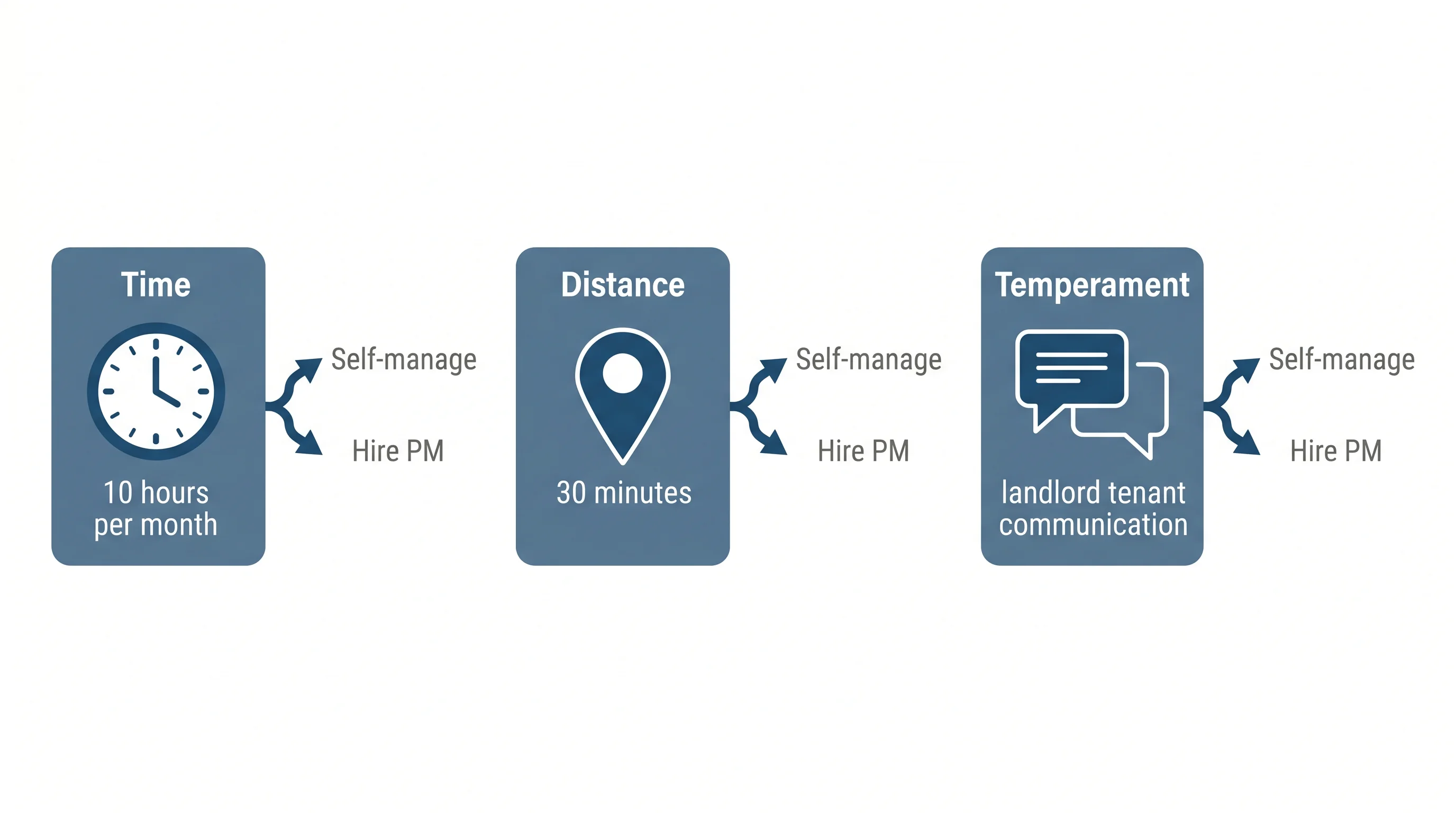
First-time landlords should honestly assess three factors:
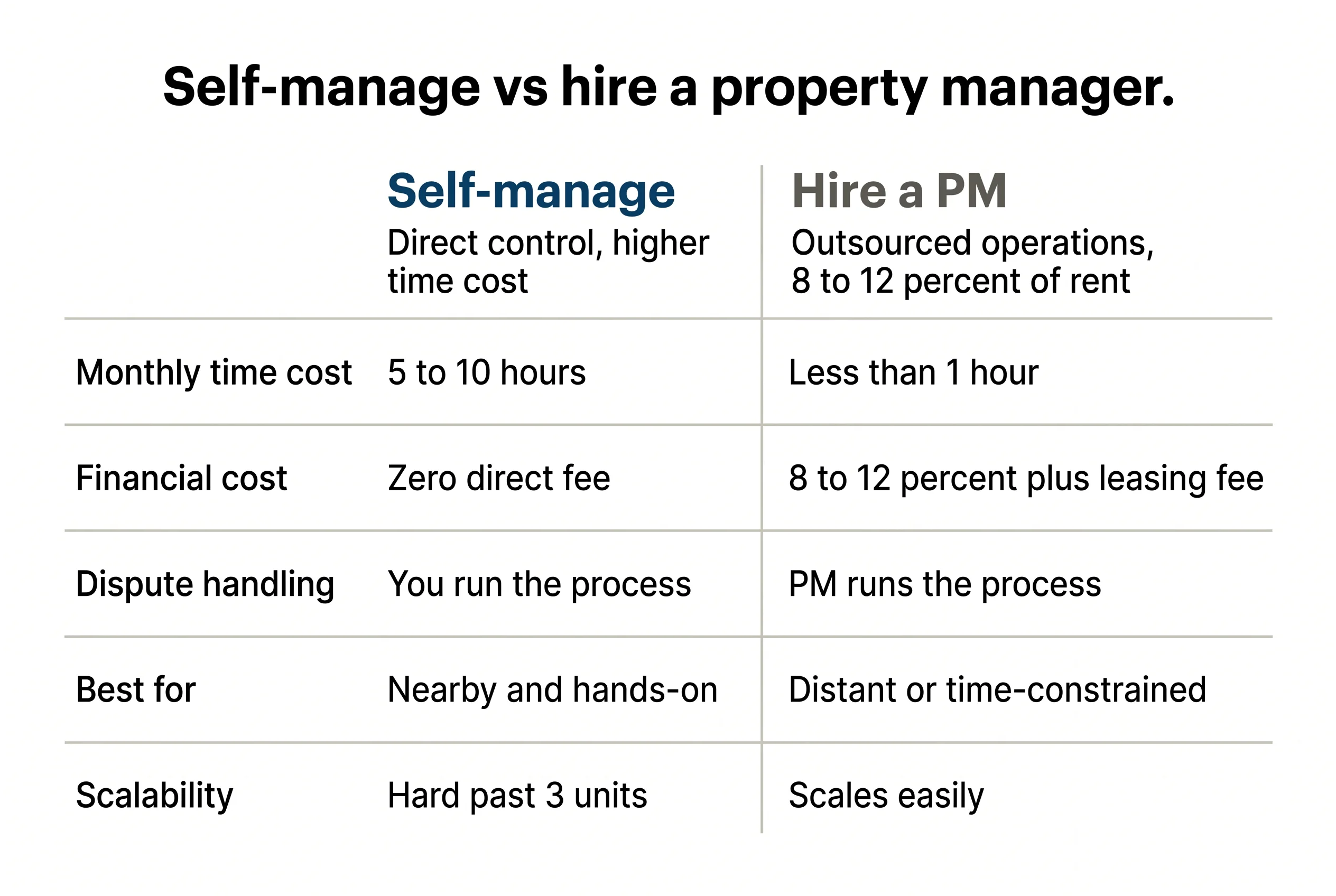
- Time. Self-managing one unit is typically 5-10 hours per month in a normal year, 20+ hours during a dispute or turnover month.
- Distance. If you live more than a 30-minute drive from the property, self-managing gets significantly harder.
- Temperament. Some people find tenant communication easy; others find it exhausting. Neither is wrong, but it affects the math.
Property managers typically charge 8-12% of collected rent, sometimes with an additional leasing fee of half a month to one month's rent per new tenancy. On a $2,200/month unit, that's $176-$264/month. Whether that's worth it depends on your time, temperament, and distance — not on any universal answer.
The documentation discipline that pays off
Experienced landlords all say the same thing about first-year operations: document everything. That includes things that feel minor now, because they matter later. Minimum documentation:
- Signed Standard Lease stored digitally and on paper
- All rent payments logged with date, amount, and method
- All maintenance requests — date received, action taken, completion date
- All communication with the tenant (email is ideal because it's automatically timestamped)
- Annual move-through inspection with photos
- Any amendments, notices, or significant incidents in writing
This becomes your record if anything ever goes to the LTB. It's also what separates landlords who win disputes from landlords who lose them on evidence gaps.
The monthly rhythm
Year-one operations settle into a monthly rhythm: rent collection (automate this if possible), record-keeping for tax purposes, a monthly quick-check on the property, responding to any maintenance requests within 48 hours even if the fix takes longer, and a quarterly documentation review. Call a lawyer or an experienced property manager for advice before you need them — an hour of upfront advice costs far less than months of frustration during a dispute.
How Tenon10 fits in
For first-time landlords, Tenon10 handles the operational setup that usually falls through the cracks: digital Standard Lease execution with timestamped e-signatures, lease import for inherited tenancies, electronic rent collection, and the document and communication trail you'll want if anything ever needs to be proven later. Everything is tied to Ontario's RTA specifically — not a generic US-first template retrofitted for Canada — so the rent increase math, the notice periods, and the form generation all match what the LTB actually expects.
For the broader question of whether to self-manage or hire help, Tenon10 also serves property management firms managing multiple landlord clients. If you reach a point where self-managing no longer makes sense, your tenant records, lease history, and payment logs are already structured for handoff.
The First-Time Ontario Landlord Checklist: From Decision to Day One
Thinking about renting out your property in Ontario? This free checklist walks you through every step — from deciding whether to rent at all, to executing your first Standard Lease — so you avoid the mistakes that cost first-time landlords a full year of revenue or peace of mind.
Get Free PDF →Key takeaways
Before you list the unit:
- Decide rent vs. sell on honest cash-flow math, not optimistic math
- Research municipal licensing requirements for your property
- Obtain landlord insurance (not just homeowner coverage)
- Understand RTA basics and your obligations as a landlord
- Set up a system for lease execution, rent collection, maintenance, and documentation
- Set a rent number based on real market comparables
- Understand how to report rental income on your tax return via T776
When you find your first tenant:
- Screen in a Human Rights Code-compliant way
- Verify income, references, and credit — with consent
- Use the Ontario Standard Lease (Form 2229E)
- Collect only legal deposits: last month's rent and actual-cost key deposit
- Document unit condition at move-in with photos and a signed written checklist
First 12 months:
- Pay interest on the last month's rent deposit annually
- Keep records detailed enough for T776 and any future LTB application
- Respond to maintenance requests within a reasonable timeframe
- Keep communication in writing wherever possible
- Know what to do if rent is late — the N4 process with Bill 60's 7-day notice
Conclusion
Becoming a landlord in Ontario is neither the easy passive income it's sometimes portrayed as nor the nightmare it's occasionally described as. It's a small business with a specific and tenant-protective legal framework, real financial discipline required, and a clear separation between landlords who build systems from day one and those who don't.
The path from "I own a property I could rent" to "I'm a capable Ontario landlord" is navigable. The RTA isn't hostile — it's specific. The financial math works when you budget honestly. Tenant selection done carefully makes almost everything else easier.
What makes the difference in year one is whether you treat the lease execution, documentation, and operational setup as the foundation of a small business, or as paperwork to rush through.
Set up your first tenancy properly from day one
Generate an Ontario Standard Lease, collect rent electronically, and keep every document in one place — free to start.
Free • Ontario-specific • Updated for the Bill 60 changes in force 21 Sep 2026
Frequently asked questions
What does it cost to become a landlord in Ontario?
The direct startup costs are modest — landlord insurance ($700-1,200/year), possible municipal licensing ($50-500 depending on city), and initial preparation of the unit. The less-visible costs are operating reserves for maintenance (8-12% of rent) and vacancy (3-5%), plus the opportunity cost of capital tied up in the property. Most first-time landlord purchases in 2026 don't produce significant positive cash flow in year one; they produce modest positive cash flow with principal paydown and potential appreciation.
Do I need a property manager?
Not necessarily — many first-time Ontario landlords self-manage their first unit successfully. Hire a PM if you're more than 30 minutes from the property, if you have a demanding full-time job that leaves no margin for tenant calls, or if you're uncomfortable with direct tenant communication. PMs typically charge 8-12% of collected rent plus a leasing fee per new tenancy.
What's the most common first-time landlord mistake?
Rushing the first tenant. Every experienced landlord and PM makes the same point: spending an extra two weeks to find a better tenant pays off more than any other single decision in year one. A good tenant makes everything easier; a difficult one makes everything harder.
Can I screen out applicants with kids, pets, or who receive assistance?
Children: no. Family status is a protected ground under the Ontario Human Rights Code. Assistance: no. Receipt of public assistance is protected. Pets: "no pets" clauses are permitted in the lease but are unenforceable under the RTA — meaning you can decline applicants with pets at the application stage, but you cannot evict them for having pets once they're in. Pet deposits are illegal regardless. Most experienced landlords rely on thorough landlord references to evaluate pet history.
What happens if my tenant doesn't pay rent?
The standard process: serve an N4 notice after rent is late. Under Bill 60, an N4 given on or after September 21, 2026 gives the tenant 7 days to pay or vacate (reduced from the previous 14 days). If they don't pay or move within that window, you file an L1 application with the LTB. Wait times for L1 hearings in 2026 are typically several months, so the process is not fast. Documentation — late-payment history, communications, the N4 itself — matters enormously at the hearing. For the step-by-step, see How to Use the N4 Notice in Ontario: A Landlord's Complete Guide.


