

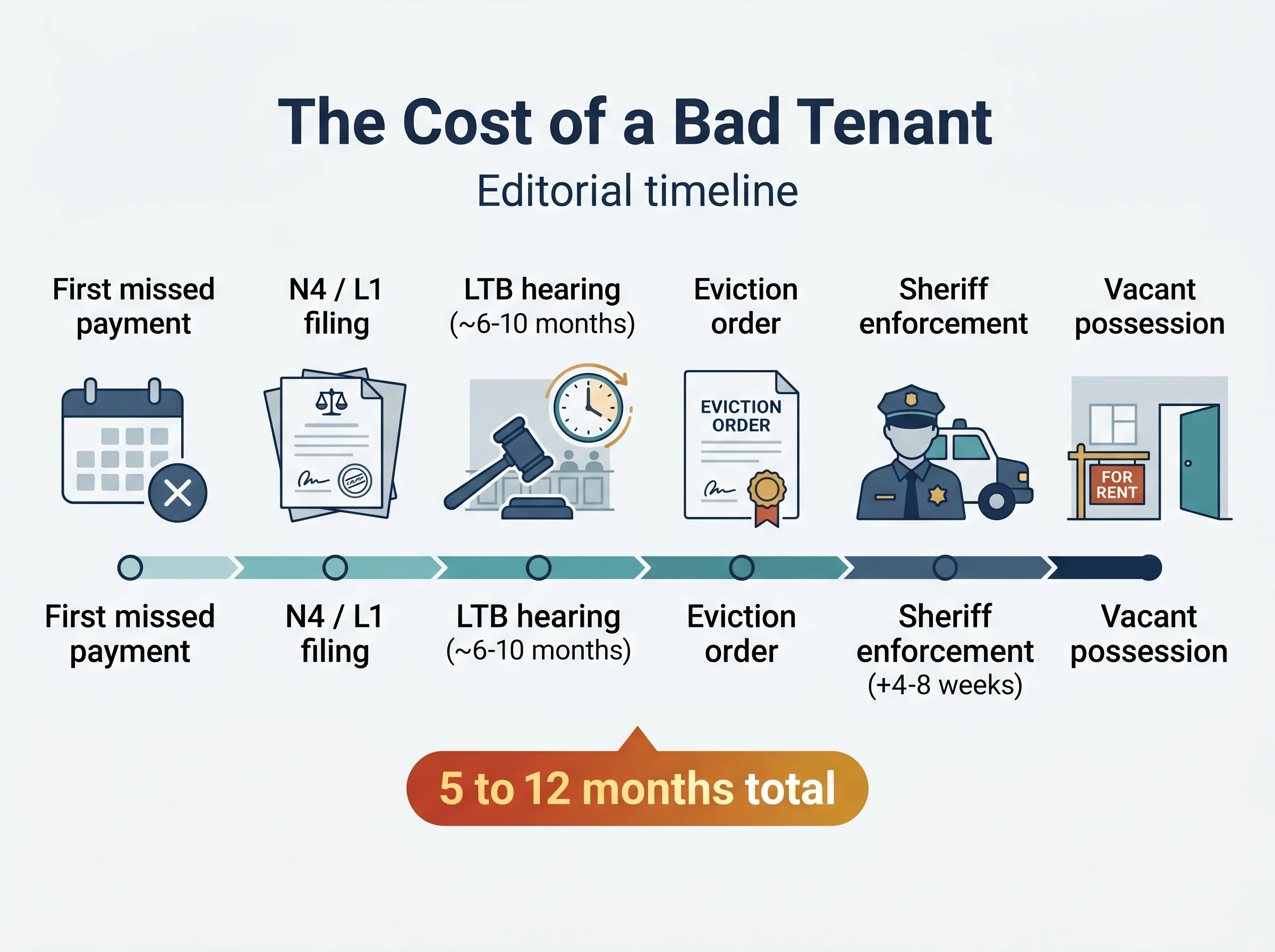
The most expensive mistake an Ontario landlord can make isn't a bad furnace — it's a bad tenant approved in a hurry. From a first missed rent payment to vacant possession can run five to twelve months, and the second most expensive mistake is screening that tenant the wrong way and ending up at the Human Rights Tribunal instead. Knowing how to screen tenants in Ontario well — and lawfully — is the highest-leverage skill a landlord or property manager has.
Here's the catch: tenant screening in Ontario sits in a narrow lane. You're allowed to be selective; you're not allowed to be discriminatory. Most landlords don't know exactly where that line is, so they either screen too little and get burned, or screen on the wrong criteria and expose themselves to a complaint. This guide does both halves at once — the legal rules (the Human Rights Code and Regulation 290/98) and a practical, repeatable six-step process — so you can screen effectively and stay onside. We'll cover what you can and can't ask, how to verify income without breaking the law, the red flags that actually matter, and the 2026 rules on deposits and credit checks.
This is general information, not legal advice. For a specific situation, consult a licensed paralegal or lawyer, or the Ontario Human Rights Commission.
The Ontario Tenant Screening Checklist for Landlords
A free, Human Rights Code–compliant checklist: what you can and can't ask, the 6-step process, and the deposit rules — keep it by your desk while you screen.
Get Free PDF →Why Screening Matters, and the Legal Lane It Sits In
Tenant screening is simply evaluating applicants to judge whether they'll meet their lease obligations — through a standard application, income and employment verification, a credit check (with consent), and references. Done well, it's the cheapest insurance a landlord can buy.
And in 2026, the cost of doing it badly has gone up. Evicting for non-payment now runs roughly five to twelve months, with non-payment (L1) hearings scheduled six to ten months out in some regions and another four to eight weeks for Sheriff enforcement after an order. At the same time, vacancy has loosened — forecast around 3 to 5%, with one property manager citing about 3.6% locally — so units sit longer and the pressure to approve someone fast rises. That pressure is exactly when corners get cut.
Screening is governed by two things working together: the Ontario Human Rights Code (which prohibits discrimination) and Ontario Regulation 290/98 under the Code (which sets out the limited business practices you may use). Federal privacy law — the consent you need before a credit check — applies too. The one-line principle to keep in your head: you're allowed to be selective, you're not allowed to be discriminatory.
That means you can't choose or refuse a tenant based on race, ancestry, place of origin, colour, ethnic origin, citizenship, creed, sex, sexual orientation, gender identity, gender expression, age, marital status, family status, disability, or the receipt of public assistance — and that protection extends to someone's friends or relatives. These grounds are off the table at every stage: the listing, the application, the decision, and everything after. The same Code shapes the broader list of what landlords cannot do in ontario.
What You Can and Can't Ask
Regulation 290/98 is refreshingly specific. It permits only five categories of screening information: income information, credit checks, credit references, rental history, and guarantees. The regulation allows "no other inquiries." That's the whole permitted toolkit.
The most-misapplied rule in Ontario is the income one, so be precise about it. You may ask about income — but only if you also ask for credit references, rental history, and a credit check, and only if you weigh income together with all of that other information. Income on its own can be considered only when nothing else is available, and even then only to confirm the applicant earns enough to pay the rent.
Which leads to the single biggest mistake landlords make: rent-to-income ratios are illegal. You cannot apply a "30% rule," a 25–35% guideline, or a "must earn three times the rent" cut-off in the private market. Being allowed to see income does not let you apply a ratio to it. The only exception is subsidized, rent-geared-to-income housing. This isn't a grey area — the ratio approach was struck down as indirect discrimination because it has no real value in predicting whether someone will default, and it disproportionately screens out people protected by the Code; cease-and-desist orders have followed against landlords who kept using it.
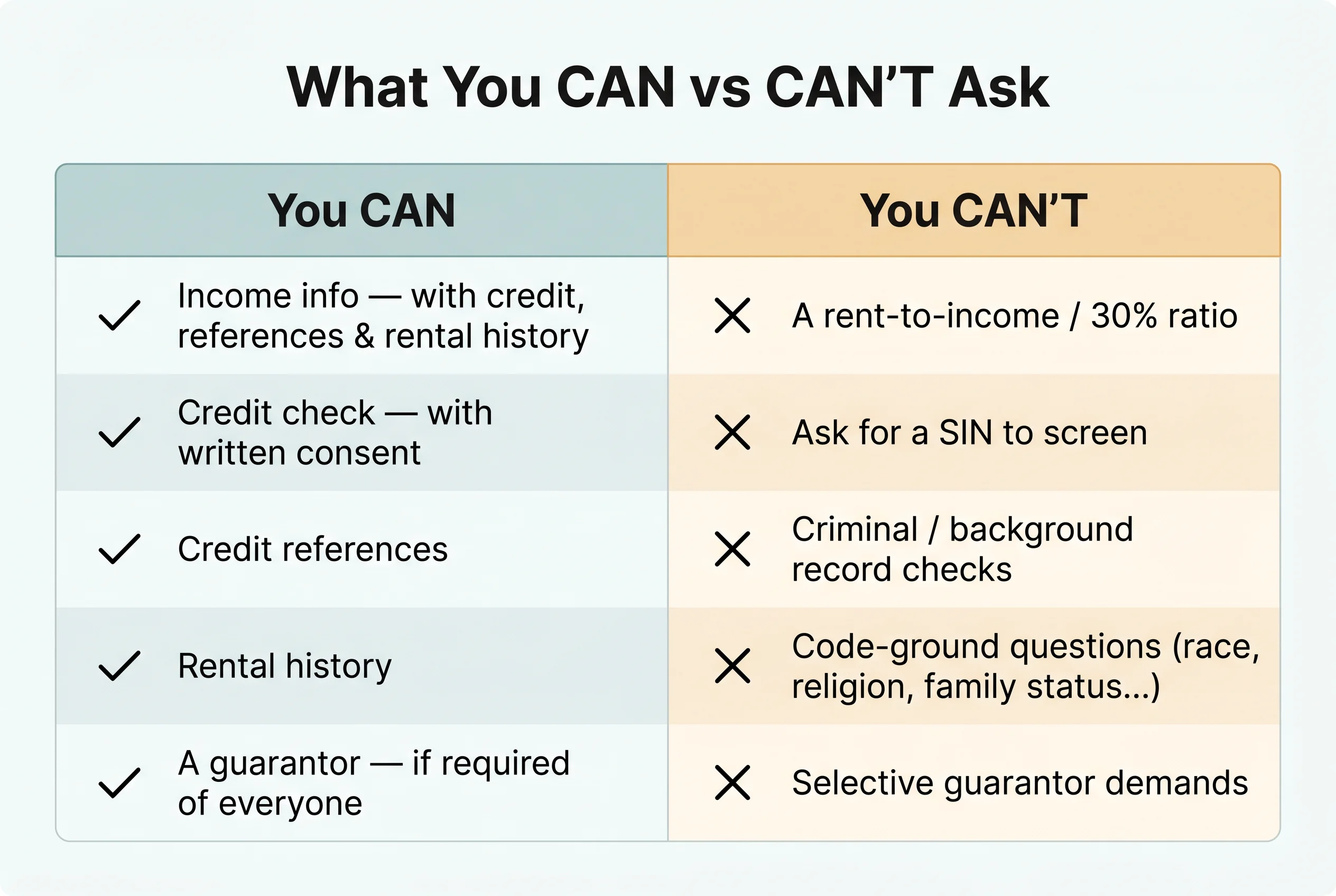
A few more lines that trip people up. You may require a guarantor — but only if you require one of every applicant, never selectively for newcomers or social-assistance recipients. You can't reject a newcomer simply for lacking Canadian credit or rental history; that can be adverse-effect discrimination, so accept references and proof of past rent or bill payments instead. And avoid asking for a SIN to screen, or running a criminal or background "record" check as a selection tool — neither is authorized by Regulation 290/98, and both carry real discrimination risk.
The 6-Step Screening Process
Here's the thing that makes screening both effective and defensible: one consistent, documented process applied identically to every applicant. Consistency is simultaneously your best screen and your best legal defence — if a decision is ever questioned, you can show it rested on conduct and finances, not on anything protected.
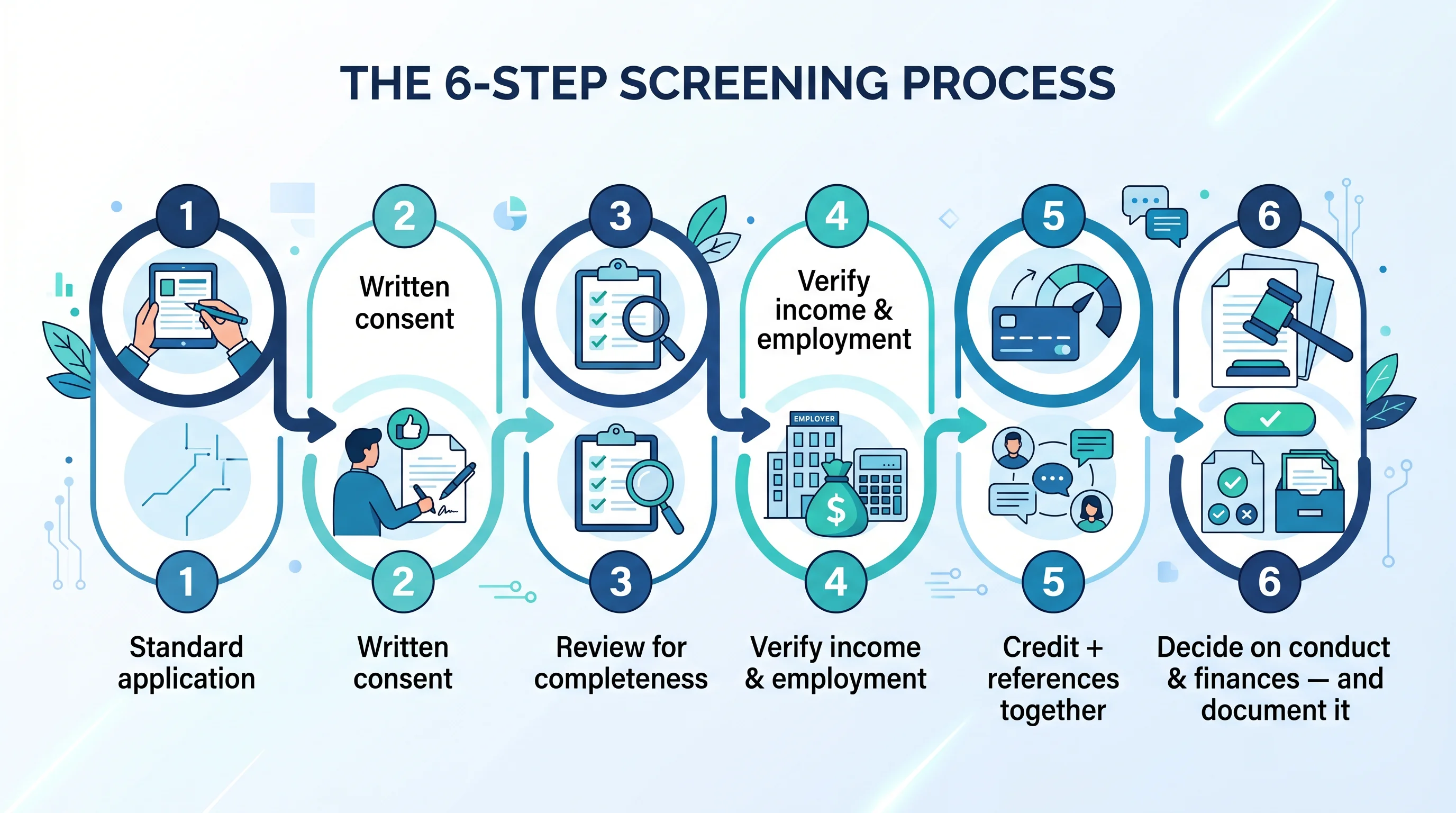
- Standard application. Use one identical form for everyone — basic info, employment, income, and rental history.
- Written consent. Get it before any credit or reference check, and explain what you collect and why. No consent, no check.
- Review for completeness. Confirm everything's there; flag anything missing or inconsistent for follow-up.
- Verify income and employment. Ask for pay stubs, a letter of employment, or — for the self-employed — a Notice of Assessment. You're confirming the income exists and is steady, not ranking people by how far above the rent they earn.
- Credit and references, together. Run the credit check (with consent) through Equifax or TransUnion, and call previous landlords, not just the current one — the current landlord may be happy to give a glowing reference to move a problem tenant along. Ask: did they pay on time, give proper notice, leave the unit in good shape, and would you rent to them again?
- Decide on conduct and finances — and document it. Write down the basis of the decision and keep it with the application.
Red Flags and How to Read Them
The red flags worth weighting are about conduct and finances, never identity: a refusal to consent to a credit check, inconsistent employment details, references that don't check out or feel suspiciously polished, unexplained gaps in rental history, or pressure to skip steps and rush the decision. A refusal to consent, in particular, is one of the clearest warning signs there is.
Read them fairly, though. A single late payment or a short employment gap may not tell the whole story — look for patterns across payment history, stability, and references rather than over-weighting one data point. The trap to avoid is letting a genuine red flag get tangled up with a protected characteristic. Decide and document on the conduct and the finances, every single time.
Consider a real example. A Hamilton fourplex was bought from an owner who'd screened entirely on gut feel — he picked tenants he "had a good feeling about," skipped credit and reference checks, and at one point chose an applicant over a single mother who was, on paper, the stronger candidate. Three of the four units were in arrears at takeover, and that single-mother decision is exactly the kind that becomes a human-rights complaint. The fix was a documented process: one standard application, written consent, verified income, and two landlord references per applicant. The cost-benefit is stark — a consistent screen costs an hour or two up front; a bad tenancy costs five to twelve months and thousands in lost rent, and a discriminatory one costs a Tribunal application on top.
The 2026 Rules: Deposits, Soft Credit Checks, and Clean Listings
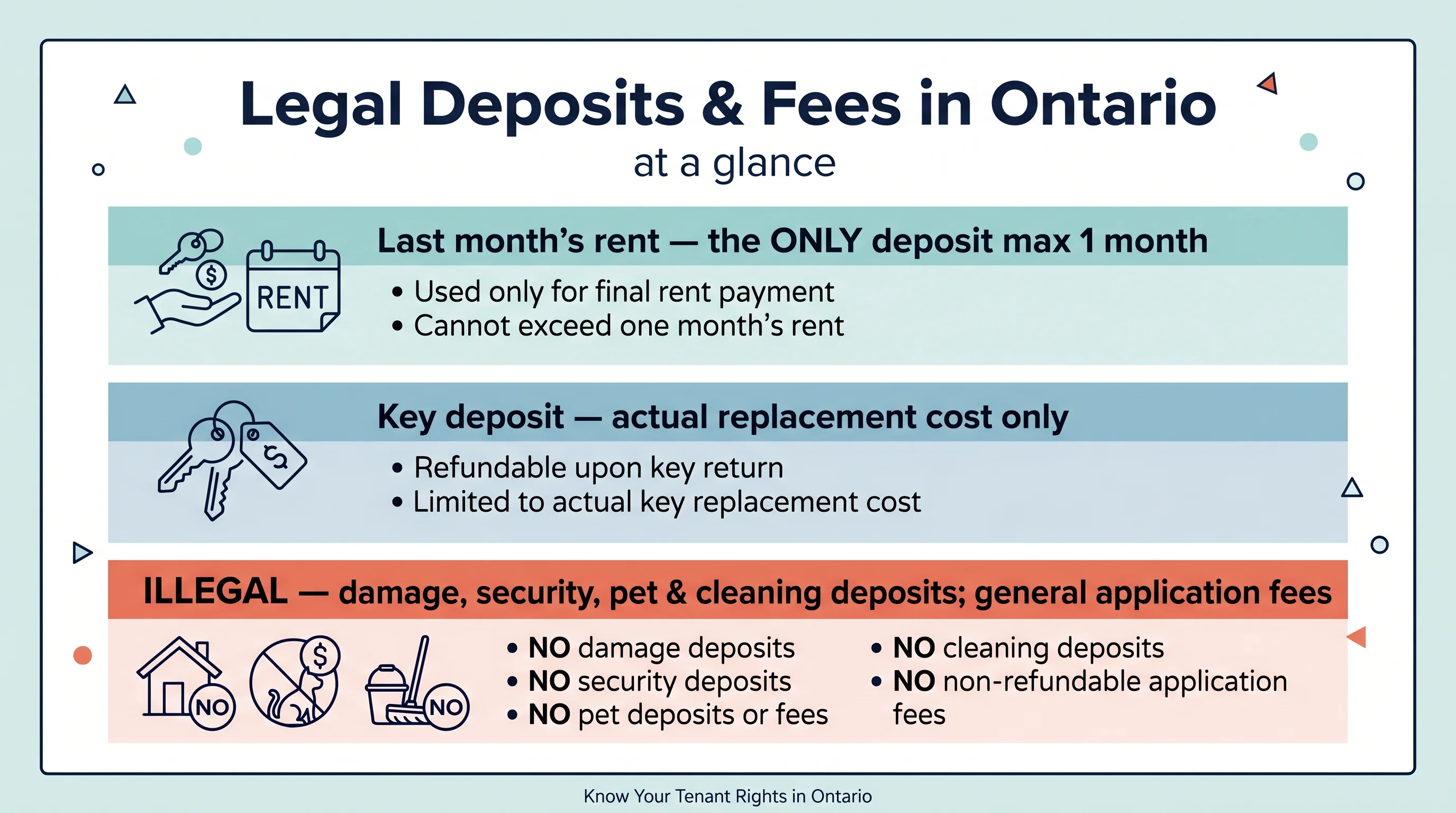
Screening is also where deposit compliance starts, so get it right before move-in. The only legal deposit in Ontario is last month's rent (a maximum of one month, or one rental period for non-monthly tenancies), and it must be applied to the final month — never to damage or cleaning. Damage deposits, security deposits, pet deposits, and cleaning deposits are all illegal. A key deposit is allowed only at the actual replacement cost of the keys. And you owe annual interest on the last month's rent at the guideline rate — 2.1% in 2026. On fees: you can't charge anything beyond the actual cost of a credit check, and while you can request post-dated cheques, you can't require them.
One 2026 change is worth knowing: since November 2024, rental credit checks are classified as soft inquiries — they don't lower the applicant's score, even across multiple applications. You still need written consent, and applicants can supply their own report if they prefer. It's a small point that removes a common applicant objection.
Finally, clean up your listings, because the ad itself can be evidence. Cut "professionals only," "no students," "30% rule," and "damage deposit" — each one signals (or simply is) a discriminatory or non-compliant screen. And build the ontario standard lease into your onboarding: it's required for most tenancies, and if you don't provide it within 21 days of a written request, the tenant can withhold one month's rent.
Key Takeaways
A screening process that's both effective and lawful comes down to a handful of habits:
- Use one standard application for every applicant, and get written consent before any check.
- Ask for income only alongside credit, references, and rental history — and never apply a rent-to-income ratio.
- Verify income by documents; confirm it's steady, not a multiple of rent.
- Call previous landlords and ask conduct questions; weigh patterns, not single data points.
- Apply guarantor requirements to everyone, never selectively.
- Keep listings clean — no "30% rule," "professionals only," or "damage deposit."
- Collect only last month's rent (plus a key deposit at real cost), pay 2.1% interest, and document every decision.
The quick win is fixing your listing wording and adding a consent line today. The long game is a documented, identical process across every unit that holds up if a decision is ever questioned. For the next layer, the Ontario Human Rights Commission's rental-housing policy and our guide to the Ontario Standard Lease are the references to keep handy.
The Ontario Tenant Screening Checklist for Landlords
A free, Human Rights Code–compliant checklist: what you can and can't ask, the 6-step process, and the deposit rules — keep it by your desk while you screen.
Get Free PDF →Conclusion
Good screening in Ontario is selective and lawful at the same time. Use the five permitted categories of information, ask about income the right way, never apply a rent-to-income ratio, run a consistent and documented six-step process, read red flags on conduct rather than identity, and follow the 2026 rules on deposits, soft credit checks, and clean listings. None of this is about being less careful — it's about being careful on the right things.
A documented, identical process is both the strongest screen and the best defence if a decision is ever challenged. Standardize your application and consent form, clean up your listings, and you've removed most of your exposure while improving the quality of every tenancy you sign.
Reminder: this is general information, not legal advice. For your situation, consult a licensed paralegal or lawyer, or the Ontario Human Rights Commission.
Screen every applicant the same way
Tenon10 standardizes your applications, consent, income verification, reference notes, and decision records — so every unit and every decision-maker screens the same, compliant way.
Free to start • Built for Ontario landlords and property managers
Frequently Asked Questions
Can a landlord ask for income information in Ontario?
Yes, but only alongside credit references, rental history, and a credit check — and weighed together with them. Income can be considered on its own only when no other information is available, and only to confirm the applicant earns enough to pay the rent.
Is the "30% rent-to-income rule" legal in Ontario?
No. Applying a rent-to-income ratio such as a 30% cut-off (or "must earn three times the rent") is illegal in the private market. The only exception is subsidized, rent-geared-to-income housing.
Do I need consent to run a tenant credit check?
Yes — written consent is required before pulling a credit report. Since November 2024, rental credit checks are soft inquiries that don't affect the applicant's score, and applicants can also provide their own report.
What deposits can a landlord collect in Ontario?
Only last month's rent (a maximum of one month, applied to the final month), plus a key deposit at the actual replacement cost. Damage, security, pet, and cleaning deposits are all illegal, and you owe 2.1% annual interest on the last month's rent in 2026.
Can I require a guarantor or reject a newcomer with no Canadian credit history?
You can require a guarantor only if you require one from every applicant. Rejecting a newcomer for lacking Canadian credit or rental history can be discrimination — consider references and proof of past rent or bill payments instead.


