

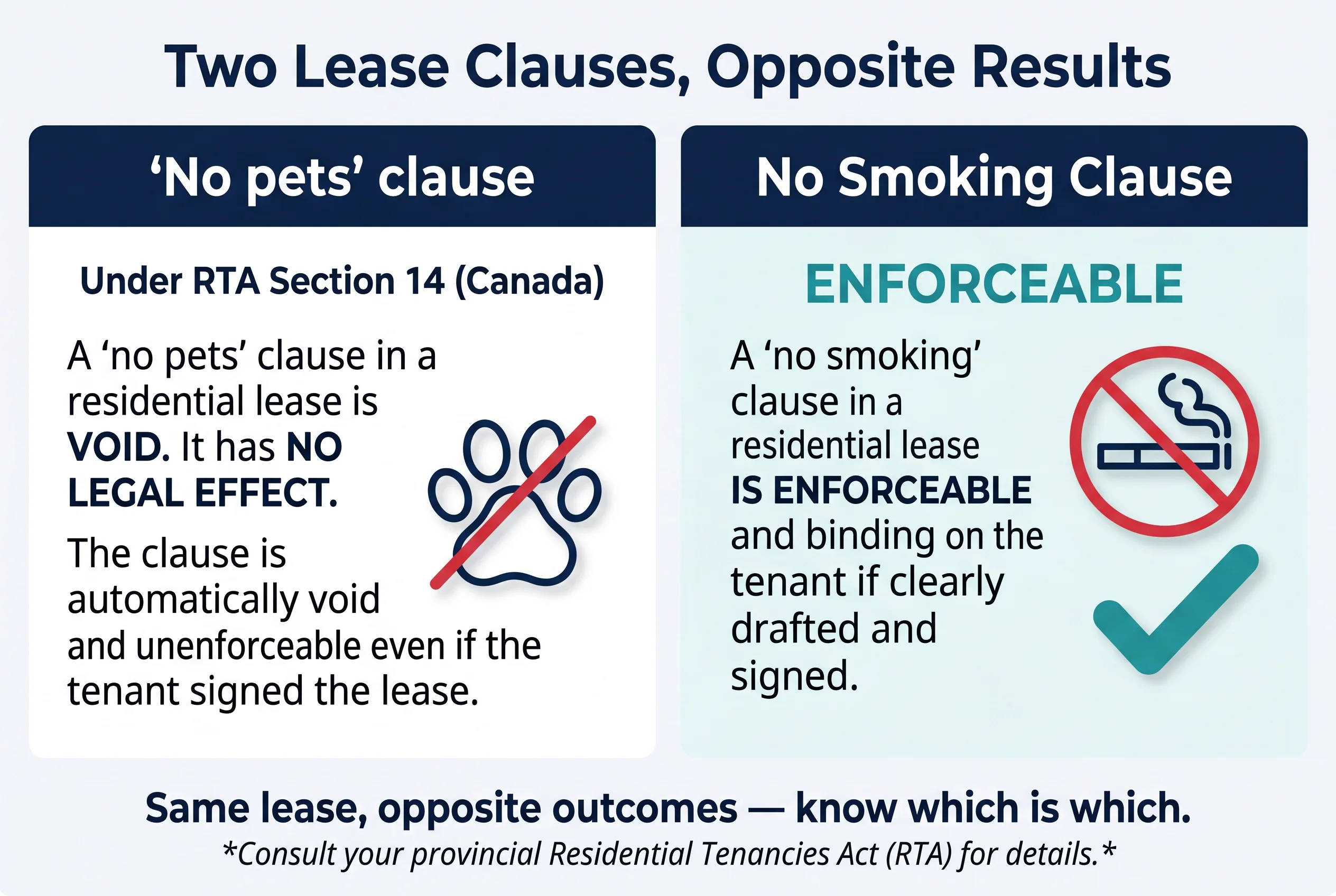
If you've just learned that a "no pets" clause in Ontario is void, you might assume a "no smoking" clause is too. It isn't — it's the opposite. A clearly written no smoking clause in Ontario is fully enforceable, and signing a lease with one means you're bound by it.
But "enforceable" doesn't mean "automatic." Landlords lose these cases all the time — by trying to add the rule mid-tenancy, by banning "tobacco" and assuming it covers cannabis, or by forgetting vaping entirely. And tenants get caught out assuming that legal cannabis means they can light up wherever they like.
This guide explains exactly what a landlord can ban and how: the clause that holds, the grandfathering rule, why cannabis and vaping have to be named, the common-area law that applies no matter what your lease says, and how medical accommodation and smoke-drift disputes actually play out. It's general information, not legal advice; for a specific situation, confirm at ontario.ca or with the Landlord and Tenant Board (LTB).
Smoking & Cannabis Rules in Ontario Rentals
When a clause holds, where you can't smoke, and what a landlord can actually ban — both sides on one page.
Get Free PDF →The Clause That Holds (the Opposite of Pets)
Start with the rule itself. The Residential Tenancies Act gives a tenant no automatic right to smoke inside a unit — so a clearly drafted "no smoking" clause in a signed lease is valid and enforceable. That's the single most useful thing to understand here, because it's the exact reverse of the pet situation: a "no pets" clause is void, while a "no smoking" clause holds.
If a tenant (or their guest) smokes in breach of the clause, the landlord can serve an N5 and pursue eviction through the LTB. In practice, these cases are heavily evidence-dependent — a landlord has to clearly connect the smell or residue to the specific tenant, which is harder than it sounds. And the clause only reaches as far as it's written: it has to define what is prohibited (tobacco, cannabis, vaping) and where (the unit, balconies, common areas, or the whole property). A clause that only mentions common areas can't be stretched to ban smoking inside a private unit.
Grandfathering and the Naming Traps
Here's where landlords trip up — three ways an otherwise-valid ban falls apart.
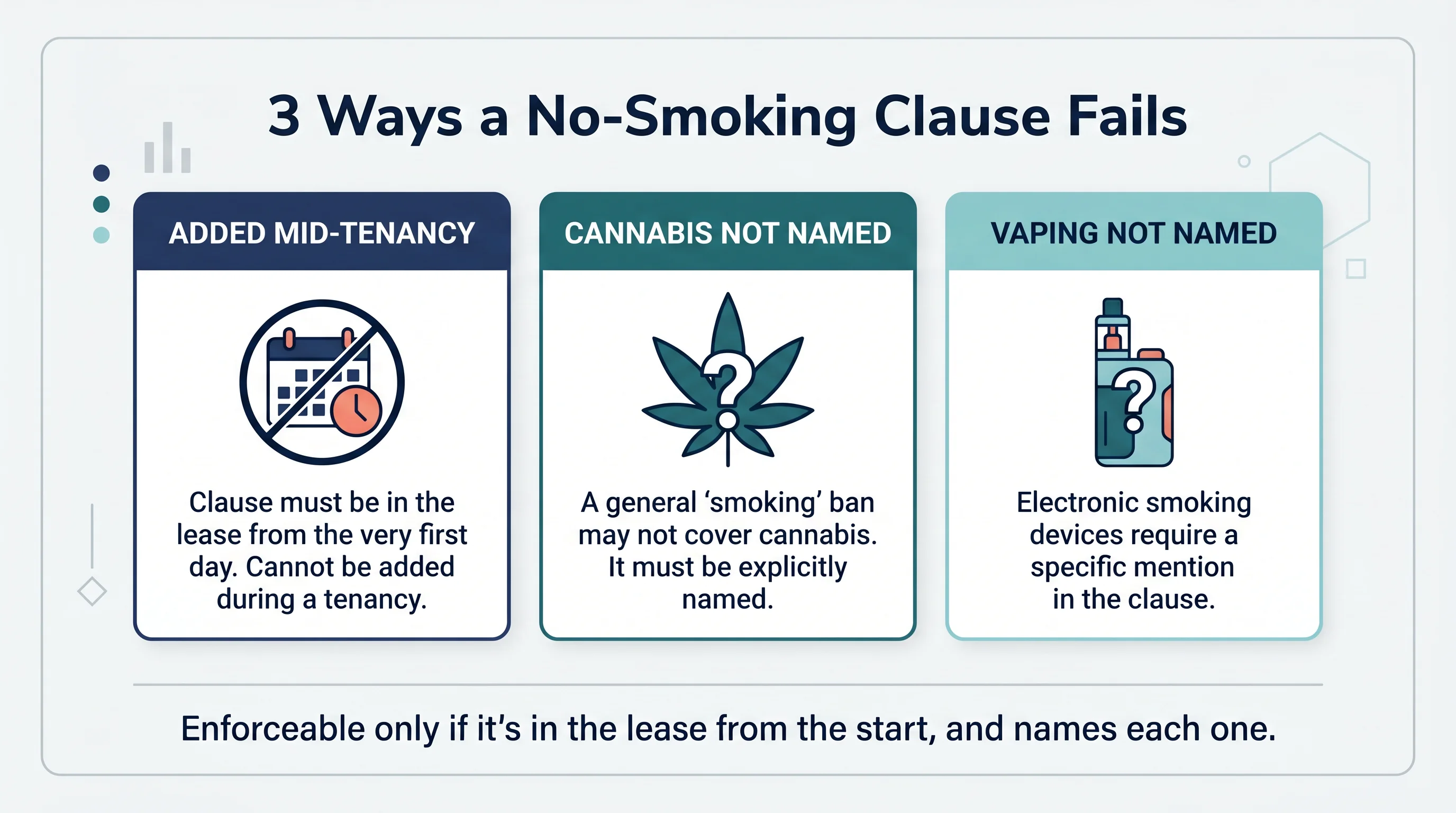
1. Added mid-tenancy. A landlord can't add a no-smoking rule to an active tenancy without the tenant's written agreement. If your original lease was silent on smoking, you're grandfathered — you can keep smoking inside your unit, and the new rule only binds new tenants (or a renewal you agree to amend). This mirrors the "before versus after" gap in the pet rules: the terms are set when the tenancy is formed.
2. Cannabis not named. A lease can prohibit cannabis smoking, vaping, and even cultivation just like tobacco — but a clause that says "tobacco" doesn't automatically reach cannabis. It has to be named. This is where the 2018 legalization myth bites: legalization created no right to smoke cannabis in a rental, but a tobacco-only clause won't stop it either.
3. Vaping not named. Because e-cigarettes are non-combustible, the LTB may treat them differently from smoke — so to ban vaping, the clause has to explicitly include electronic and vaping devices. A clause covering tobacco and cannabis but silent on vaping leaves a gap.
Common Areas, Drift, and the Smoke-Free Ontario Act
One layer applies no matter what your lease says. The Smoke-Free Ontario Act, 2017 bans smoking and vaping — tobacco or cannabis — in the enclosed common areas of any multi-unit building: lobbies, hallways, stairwells, elevators, laundry rooms, and parking garages. No lease clause is needed, and landlords have their own duties under the Act: post no-smoking and no-vaping signage, remove ashtrays, and keep common areas clear. It's an offence to knowingly permit prohibited smoking, and smoking or vaping where it's banned carries a fine of $1,000 for a first offence and $5,000 after — enforced by local public health units.
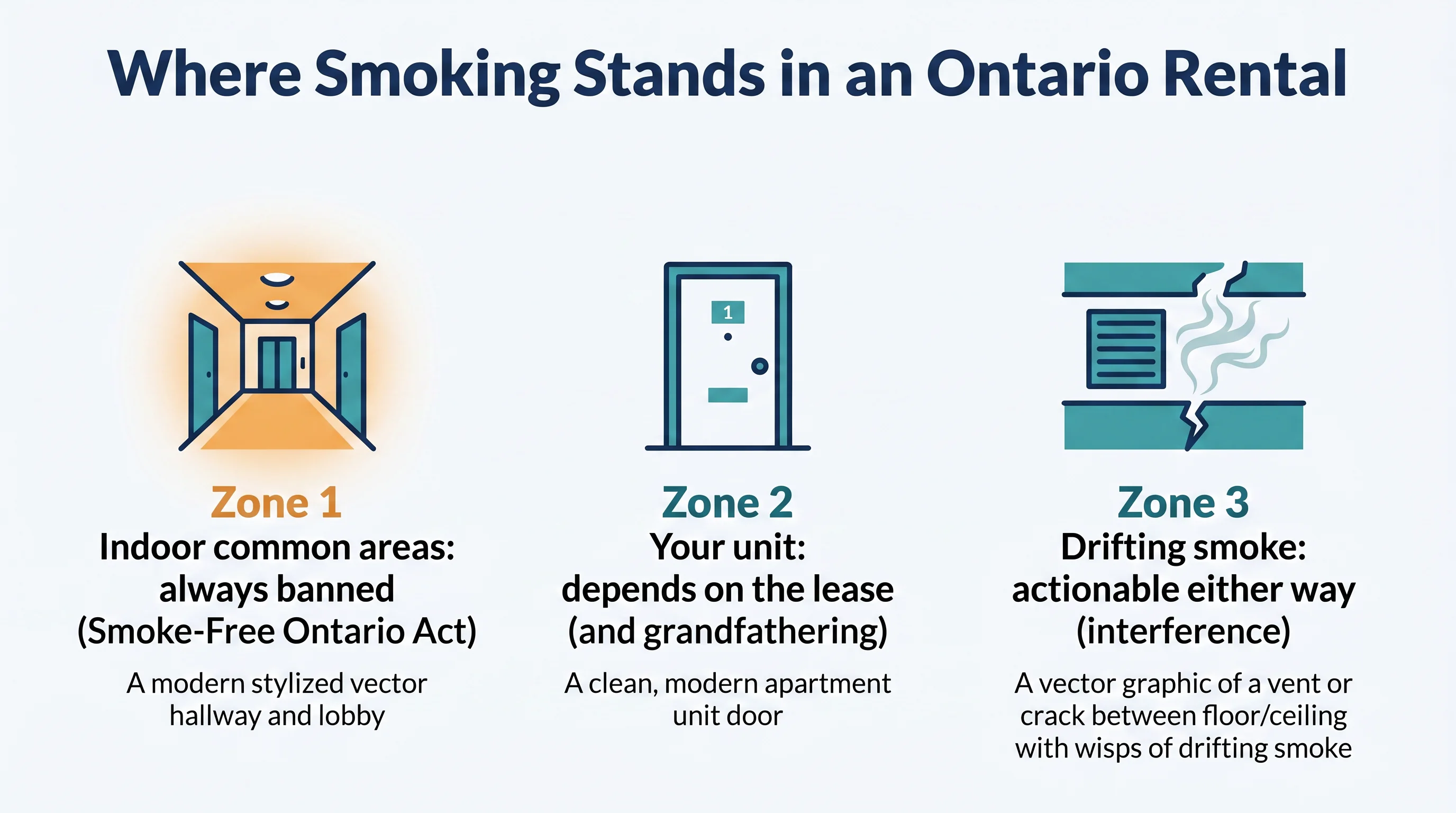
Then there's drift — and this is the part that surprises grandfathered smokers. Even without a no-smoking clause, a tenant can face eviction if their smoke substantially interferes with other tenants' reasonable enjoyment (say, drifting through shared ventilation) or causes damage. That runs through the same s.64 → N5 → L2 route, decided case by case. And smoke damage — staining, odour, burns — isn't normal wear and tear; it's recoverable, which is exactly why a documented move-in and move-out inspection matters.
The flip side protects the non-smoker. If a neighbour's smoke is drifting into your unit, you have the right to reasonable enjoyment: document the incidents, notify your landlord in writing, and the landlord may owe remedies — air filters, sealing and repairs, distance rules, or notice to the offending tenant. If it isn't resolved, you can apply to the LTB (for reasonable enjoyment or maintenance) or complain to public health about common-area breaches.
Medical Cannabis, and the Drafting Playbook
Medical cannabis is an accommodation, not a free pass. A tenant with a disability may be entitled to accommodation under the Human Rights Code — but it's assessed case by case, and it's usually satisfied by non-smoking methods (edibles, oils, tinctures, vaping) rather than indoor combustion. A nicotine addiction isn't automatically a disability, and no one has an absolute right to smoke regardless of the people around them. Where accommodating one tenant would harm another — a neighbour with documented asthma, for instance — the landlord has to balance the competing rights and address the degree of harm, not automatically favour either side.
For landlords and property managers, the playbook is about drafting and enforcing cleanly. Put the clause in the lease from the start — as an additional term or addendum — because you can't add it mid-tenancy without written consent. Name everything: tobacco, cannabis, vaping, and cultivation, and specify the places it applies. Meet your Smoke-Free Ontario Act duties on signage and common areas. And when a real problem arises, enforce through the s.64/N5 route with evidence — dated complaints, photos, residue linked to the unit — rather than any form of self-help. What you can and can't put in the lease is covered in our guide to what you can and can't add to the Ontario standard lease.
Smoking & Cannabis Rules in Ontario Rentals
The naming traps, the common-area law, drift, and medical cannabis — everything both sides need on one page.
Get Free PDF →Key Takeaways
For tenants:
- A clear no-smoking clause in a signed lease is enforceable — unlike a void "no pets" clause.
- You can never smoke or vape in indoor common areas, whatever your lease says.
- If your lease is silent on smoking, you're grandfathered and can smoke in your unit; a landlord can't add a ban mid-tenancy without your written consent.
- Cannabis and vaping are only banned if the lease names them.
- Even a grandfathered smoker can be actioned for drift or damage — and medical cannabis is an accommodation, usually via non-smoking methods.
For landlords and property managers:
- Put the clause in the lease from the start, and name tobacco, cannabis, vaping, and cultivation.
- Meet your Smoke-Free Ontario Act signage and common-area duties.
- Enforce via s.64/N5 with evidence, treat smoke damage as recoverable, and handle medical cannabis as a case-by-case accommodation.
Conclusion
In Ontario, a no-smoking clause is enforceable — the mirror image of the void "no pets" clause. But it only works if it's in the lease from the start, names cannabis and vaping specifically, and is enforced through the LTB with evidence. Regardless of any lease, the Smoke-Free Ontario Act keeps indoor common areas smoke-free, drifting smoke can be actioned either way, and medical cannabis is an accommodation — usually met by non-smoking methods — not a blanket right to smoke.
Clarity serves both sides here: a well-drafted clause and honest expectations at signing prevent almost every smoking dispute before it starts. This is general information, not legal advice — confirm the current details and your situation at ontario.ca or with the Landlord and Tenant Board.
Build a lease that actually holds
From a clear, fully-named no-smoking clause to the signed lease and the tenancy record, Tenon10 keeps your paperwork organized and enforceable.
Free • No signup required • Built for Ontario
Frequently Asked Questions
Is a "no smoking" clause enforceable in Ontario?
Yes. Unlike a "no pets" clause (which is void), the RTA gives no automatic right to smoke, so a clearly drafted no-smoking clause in a signed lease is valid and enforceable — and breaching it can ground an eviction through the LTB.
Can my landlord make my unit non-smoking after I've moved in?
Not without your written agreement. A landlord can't change the tenancy terms mid-lease; if your original lease was silent on smoking, you're grandfathered and can keep smoking inside your unit. New rules only bind new tenancies or an agreed renewal.
Can a landlord ban cannabis in a rental?
Yes — a lease can prohibit cannabis smoking, vaping, and cultivation just like tobacco. But it must be named: a clause banning only "tobacco" doesn't automatically cover cannabis, and vaping has to be listed explicitly.
Can I smoke in common areas like the lobby or stairwell?
No. The Smoke-Free Ontario Act, 2017 bans smoking and vaping (tobacco and cannabis) in enclosed common areas of multi-unit buildings, regardless of your lease — with fines of $1,000 for a first offence and $5,000 after.
What can I do about second-hand smoke from a neighbour?
You have the right to reasonable enjoyment. Document the incidents, tell your landlord in writing, and if it isn't resolved you can apply to the LTB (reasonable enjoyment or maintenance) or complain to your local public health unit for common-area breaches.


