

Ontario landlords waited an average of 8-10 months for LTB hearings in 2023—now Bill 60 promises to cut your timeline by a full week before you even file. But is 7 days really the game-changer everyone claims?
The Residential Tenancies Act has long frustrated landlords dealing with non-paying tenants. Between lengthy notice periods, LTB backlogs, and last-minute tenant defences, recovering your property felt like running a marathon through molasses. Bill 60, the Fighting Delays, Building Faster Act, 2025, directly targets these pain points.
This guide breaks down exactly how Bill 60 affects Ontario landlords—from the new 7-day N4 rule to the 50% arrears requirement for tenant counter-claims. You'll learn what's changed, what hasn't, and precisely how to update your processes.
We'll cover the seven key legislative changes, walk through real-world timelines, debunk common misconceptions, and provide an actionable compliance checklist you can implement immediately.
What Bill 60 Actually Changes: The 7 Key Reforms Every Ontario Landlord Must Know
Bill 60 received Royal Assent in late November 2025, making it the most significant update to landlord-tenant procedures since the RTA's introduction. While specific provisions await proclamation dates, understanding these changes now positions you ahead of less-prepared landlords.
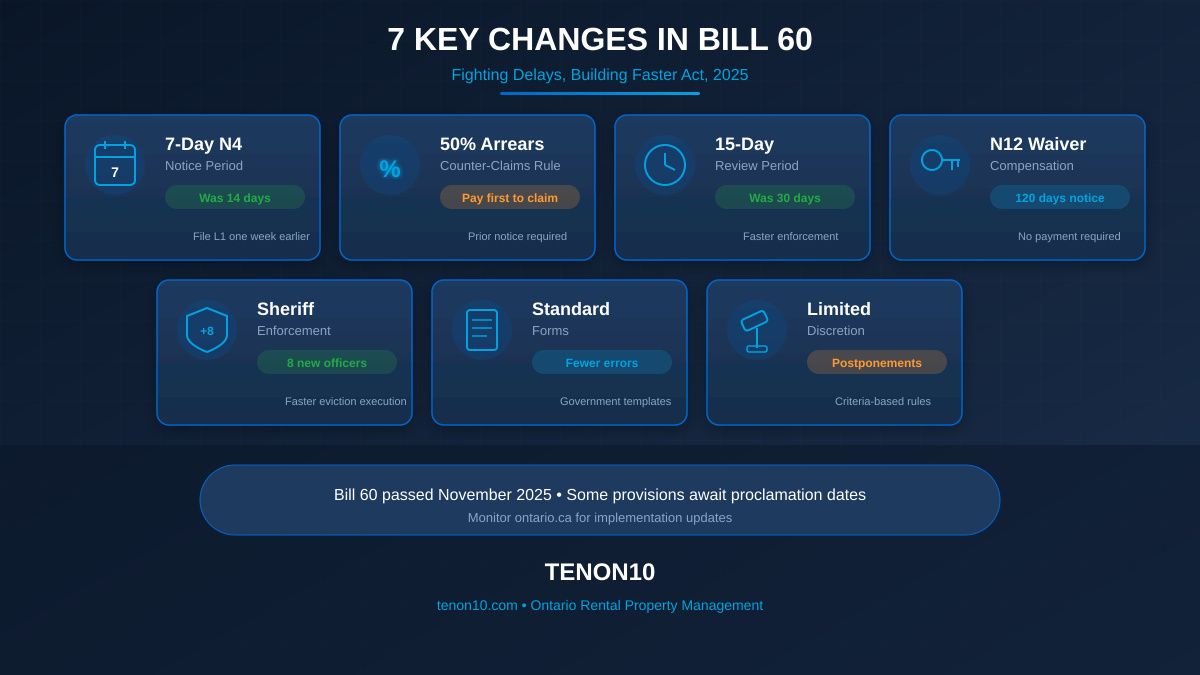
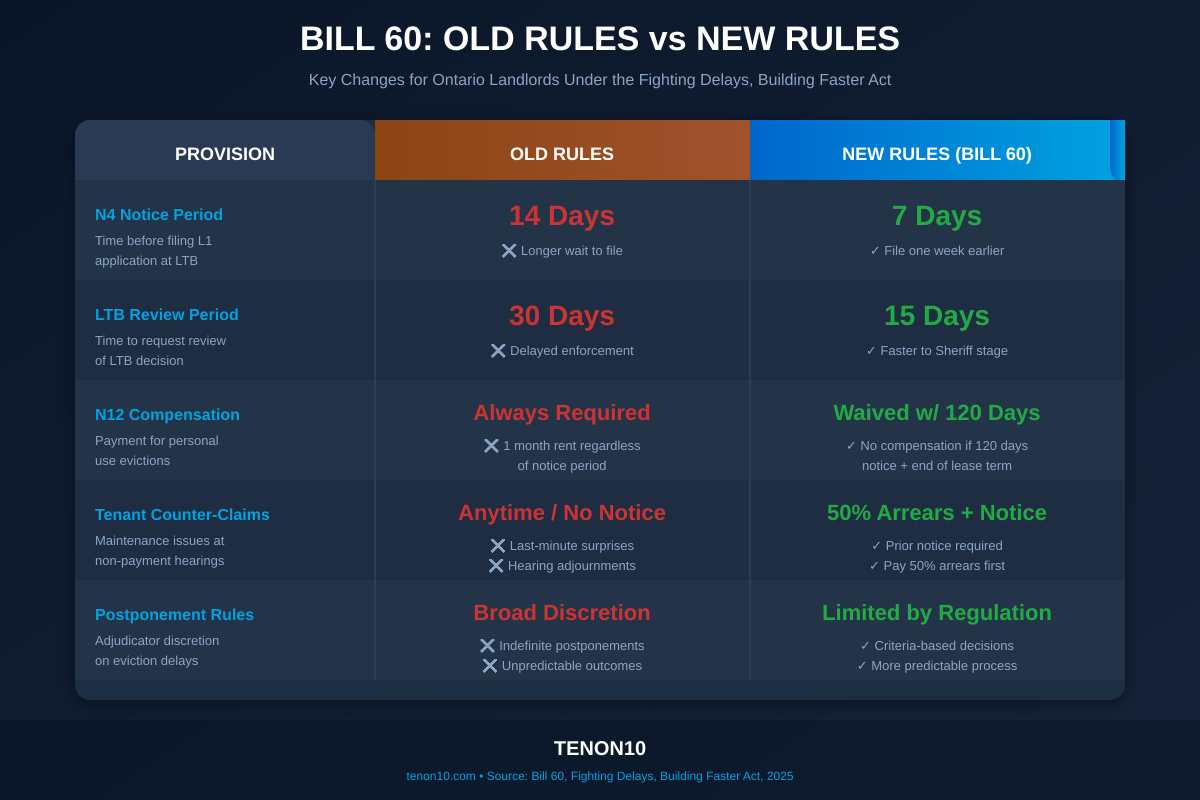
Change #1: N4 Notice Period Reduced (14 → 7 Days)
Previous Rule: Landlords had to wait 14 days after serving an N4 notice before filing an L1 application with the LTB.
New Rule: The notice/waiting period is cut to just 7 days.
Practical Impact: If rent is due December 1st and unpaid, you can begin eviction proceedings by approximately December 8th instead of December 16th. This is one of the most significant ways Bill 60 Ontario impacts daily operations for property owners.
Change #2: 50% Arrears Rule for Counter-Claims
Under the new rules, tenants who wish to raise maintenance or harassment issues (Section 82 claims) at a non-payment hearing must now:
- Provide prior notice to both the LTB and landlord before the hearing
- Pay at least 50% of claimed arrears before raising maintenance/repair counter-claims
This change reduces strategic withholding of rent, minimizes last-minute hearing delays and adjournments, and keeps hearings focused on rent payment issues.
Change #3: LTB Review Period Halved (30 → 15 Days)
Previous Rule: Parties had 30 days to request a review of an LTB decision.
New Rule: Only 15 days to request a review, with extensions only in "exceptional circumstances."
This means faster enforcement of eviction orders once issued. After the 15-day review period ends, landlords can move forward with the Sheriff—a meaningful improvement to the Ontario eviction timeline 2025.
Change #4: N12 Compensation Waiver with 120-Day Notice
Previous Rule: Landlords evicting for personal/family use (N12) had to pay one month's rent compensation regardless of notice period.
New Rule: If you provide 120 days' notice AND the termination date aligns with the end of the lease term or rental period, no compensation is required.
Standard 60-day N12 notices still require one month's compensation. Plan ahead to take advantage of this change.
Change #5: Enhanced Sheriff Enforcement Resources
The province will add up to 8 additional enforcement officers to address delays in executing eviction orders, particularly in high-volume regions like the GTA.
Change #6: Standardized Termination Forms
Bill 60 authorizes the government to prescribe contents of standardized termination forms, including the N4. This aims to improve clarity, reduce errors, and limit administrative dismissals caused by form defects.
Change #7: Restricted Adjudicator Discretion on Postponements
New regulations will set criteria adjudicators must follow when considering whether to postpone an eviction. This limits discretion that previously allowed indefinite delays—a key component of the Landlord and Tenant Board reforms.
What Bill 60 Did NOT Change
The government withdrew proposals to end automatic month-to-month lease renewals or consult on ending rent control. Important points:
- Rent control remains for units first occupied before November 15, 2018
- Month-to-month lease protections preserved
- 2026 rent increase guideline set at 2.1%
The Real Timeline: From N4 Notice to Sheriff Enforcement
The 7-day rule sounds revolutionary—until you understand where delays actually occur. Let's trace a complete non-payment case to see how Bill 60 affects your real-world timeline.
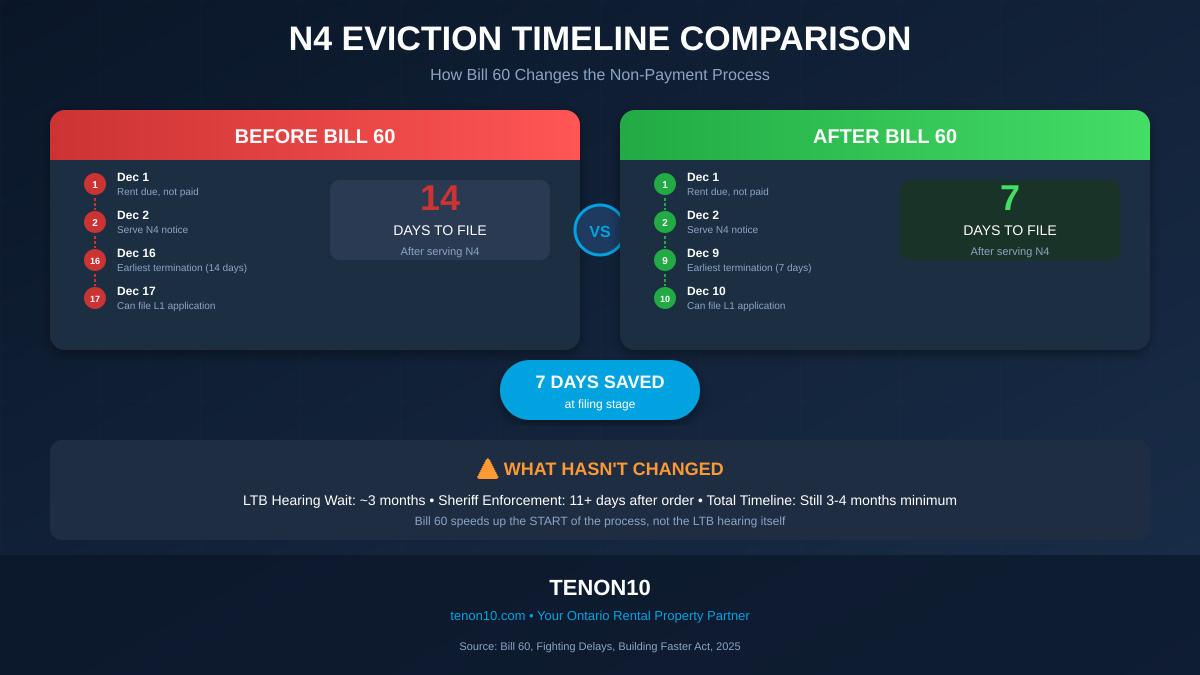
Case Study: Rent Arrears Scenario
Tenant misses December 1st rent payment
| Stage | Before Bill 60 | After Bill 60 |
|---|---|---|
| Rent due (unpaid) | Dec 1 | Dec 1 |
| Serve N4 notice | Dec 2 | Dec 2 |
| Earliest termination date | Dec 16 (14 days) | Dec 9 (7 days) |
| File L1 application | Dec 17 | Dec 10 |
| LTB hearing scheduled | ~March 17 | ~March 10 |
| Order enforcement (if granted) | ~March 28 | ~March 21 |
Net Effect: Process starts 7 days earlier, but overall timeline remains 3+ months.
Where Delays Actually Occur
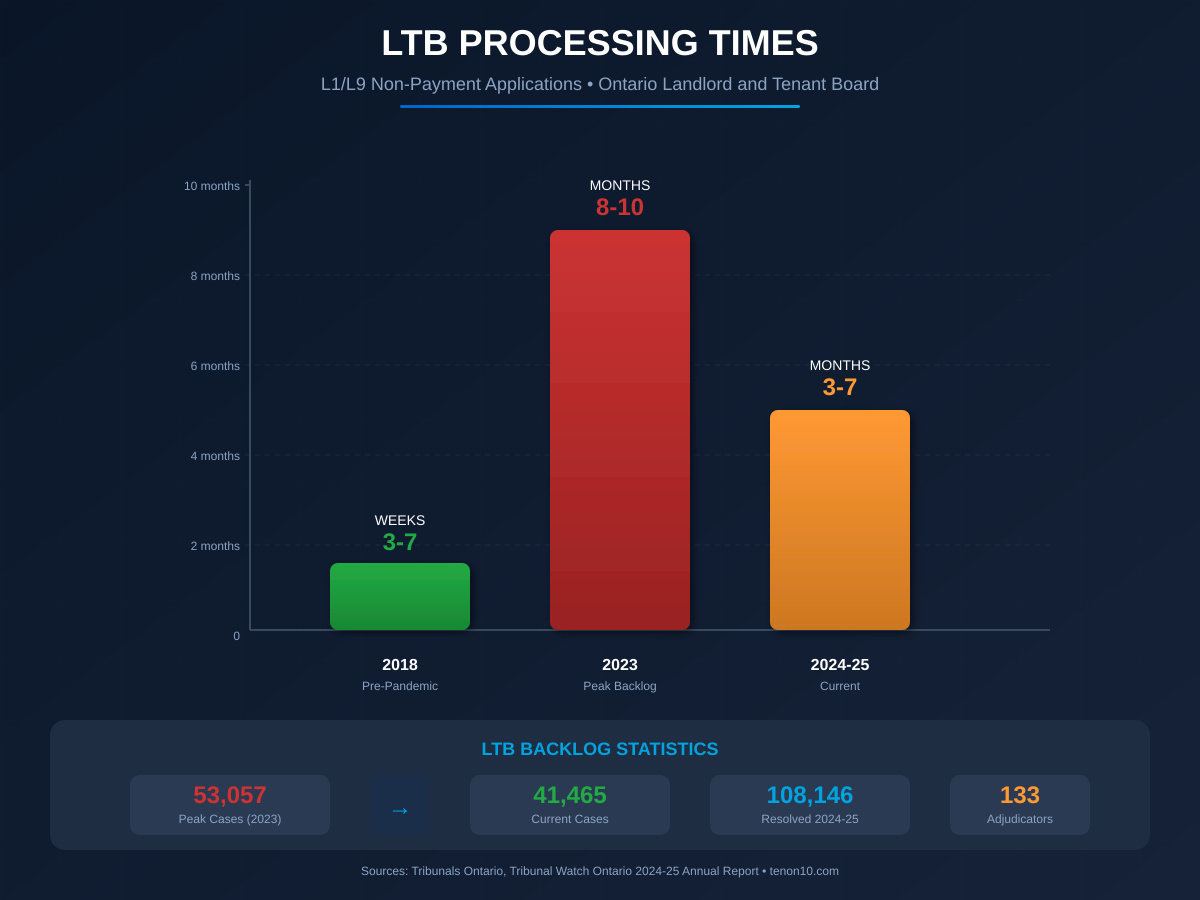
LTB Hearing Backlog (Still ~3 Months): The current backlog sits at 41,465 cases, down from 53,057. L1/L9 processing takes approximately 3 months, improved from 10 months in 2023. Other applications take 5-7 months.
Review Period (Now 15 Days): Previously 30 days—this is meaningful time savings and faster progression to Sheriff enforcement.
Sheriff Enforcement: Historically a bottleneck in high-volume regions. The new Sheriff resources target this specific stage.
Real Case Example: Singh v. Rafle (August 2024)
In this case, a tenant accumulated $41,000 in rent arrears. Even after the LTB ordered the tenant to vacate, the landlord needed Sheriff involvement for enforcement. The landlord considered selling the property after the experience—illustrating why understanding how Bill 60 affects Ontario landlords matters for long-term planning.
The Honest Assessment
Bill 60 shaves approximately 7 days off the front end and potentially 15 days off the back end through the shortened review period. For a process that still takes 3-4 months minimum, this represents incremental improvement—not transformation.
"Though practically speaking, even if an application is filed, it will be months before a hearing is scheduled, during which time arrears can be paid off, and parties can still negotiate a resolution."
— Green Economy Law Professional Corporation
The 50% Arrears Rule: Your New Advantage
This overlooked change may help landlords more than the 7-day rule.
The Previous Problem
Landlords have long complained about "strategic withholding"—tenants refusing to pay rent, then raising maintenance issues at the eleventh hour to delay eviction proceedings. This created last-minute adjournments, unprepared landlords scrambling to respond, and extended non-payment periods.
What's Changed
Under Bill 60, tenants who wish to raise maintenance or harassment issues at a non-payment hearing must now:
- Provide prior notice to both the LTB and landlord
- Pay at least 50% of claimed arrears before raising counter-claims
Practical Impact for Landlords
- Fewer hearing surprises: You'll know in advance what issues tenants plan to raise
- Better preparation: Time to gather maintenance records before hearings
- Reduced strategic withholding: 50% payment requirement changes the calculus for tenants considering this approach
What This Doesn't Mean
Tenants can still raise legitimate maintenance issues. Valid concerns still get heard—just with earlier notice. This isn't a "tenant silencing" measure.
How to Prepare
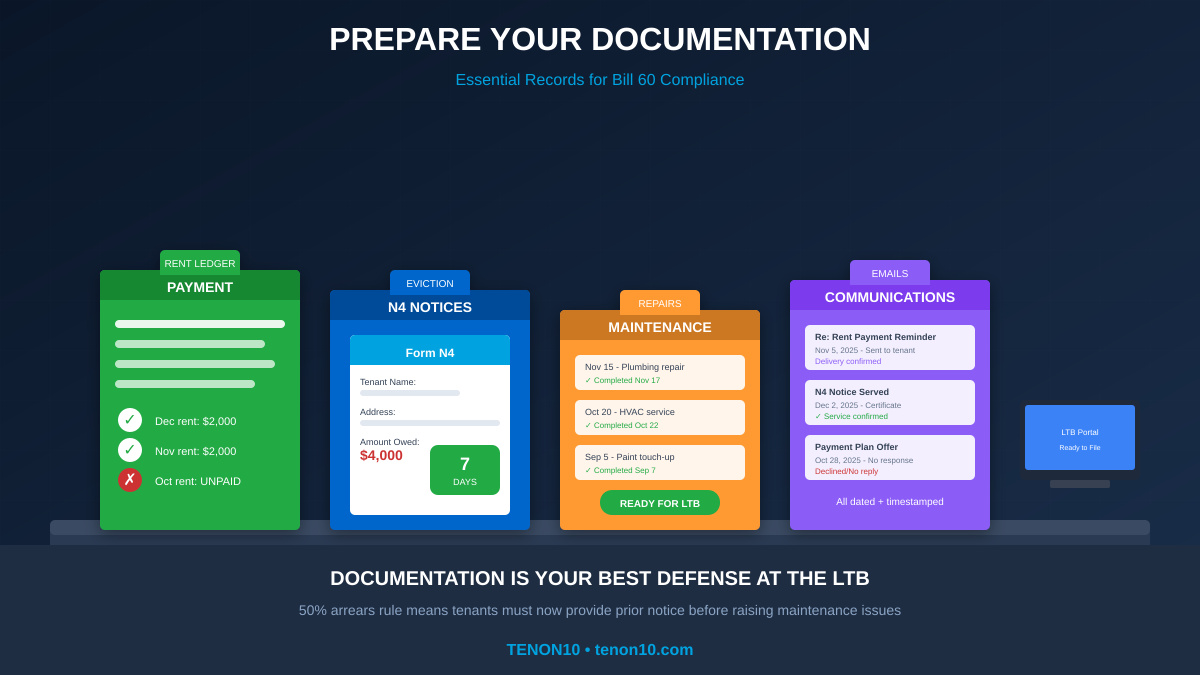
- Document everything: Dated maintenance requests, repairs completed, communications
- Respond promptly: Address maintenance issues in writing
- Keep payment ledgers: Clear records of what's owed vs. paid
- Organize chronologically: Prepare a timeline for potential hearings
"Landlords may benefit from faster non-payment hearings and fewer last-minute surprises. Tenants, on the other hand, need to act earlier, document problems in writing, and be ready to pay half of any claimed arrears if they want to challenge them at the LTB."
— Found Spaces Property Management
Common Misconceptions Debunked: What Bill 60 Does NOT Do
Despite what you may have heard, several misconceptions about Bill 60 Ontario are circulating. Here's the reality:
Misconception #1: "Bill 60 Means Instant Evictions"
Reality: The 7-day N4 notice period Ontario change only affects when you can FILE. LTB hearings still take approximately 3 months. Tenants can pay arrears anytime before the hearing to void the notice.
Misconception #2: "Tenants Can No Longer Raise Maintenance Issues"
Reality: Tenants CAN still raise maintenance issues—they just need to provide prior notice and pay 50% of arrears first. This requires earlier preparation, not silence.
Misconception #3: "No More N12 Compensation Ever"
Reality: Compensation waiver only applies with exactly 120 days' notice aligned with lease end. Standard 60-day N12 notices still require one month's rent compensation.
Misconception #4: "Bill 60 Ends Rent Control"
Reality: The government withdrew proposals to consult on ending month-to-month leases. Rent control remains for pre-November 2018 units. The 2026 guideline is 2.1%.
Misconception #5: "The LTB Backlog Is Eliminated"
Reality: Backlog reduced from 53,000 to approximately 41,000 cases. Processing times are 3-7 months—still roughly 3× longer than pre-2020 levels when cases were heard in 3-7 weeks.
Misconception #6: "Procedural Errors Don't Matter Anymore"
Reality: While Bill 60 allows overlooking "small mistakes," substantive errors (wrong dates, incorrect amounts, improper service) will still result in dismissals.
Misconception #7: "All Parts of Bill 60 Are In Effect Now"
Reality: Many provisions await proclamation dates and supporting regulations. Confirm which provisions are actually in force before relying on them.
Preparing for What's Next: Market Conditions and Strategic Positioning
Ontario's rental market is shifting, and understanding these changes helps contextualize how Bill 60 affects Ontario landlords in practical terms.
Current Market Context
- Downtown Toronto 1-BR: $2,090/month (down 11.6% YoY)
- GTA vacancy rate: 3.0% for purpose-built rentals
- National trend: Canadian rents declined 3.1% YoY
What This Means for Bill 60 Implementation
Rising vacancies = more tenant choice: Tenants may be quicker to pay or move rather than fight eviction. Market conditions may naturally reduce arrears disputes.
Softening rents = margin pressure: Faster resolution of non-payment cases becomes more critical. Every month of lost rent hurts more in a flat market.
Immigration slowdown = demand reduction: Lower international migration targets and student enrollment caps are affecting key markets.
Upcoming Regulatory Developments
- Proclamation dates: Watch for when specific Bill 60 provisions take effect
- Updated LTB forms: New government-prescribed templates expected
- "Persistent late payment" definition: Regulations forthcoming on N8 notice criteria
Strategic Positioning
Immediate (Now):
- Update N4 templates for 7-day timeline
- Review all current tenancies for compliance
- Establish documentation systems
Short-term (1-3 months):
- Monitor proclamation announcements
- Update lease templates as needed
- Train any staff on new procedures
Medium-term (3-6 months):
- Evaluate effectiveness of new processes
- Adjust based on early LTB decisions under Bill 60
- Build relationships with paralegals familiar with new rules
"We need to restore the confidence in the rental environment because right now, it's starting to wane."
— John DiMichele, CEO, Toronto Regional Real Estate Board
Your Bill 60 Compliance Checklist
Immediate Actions
- ☐ Update all N4 notice templates with 7-day timeline
- ☐ Implement clear payment ledger system for all tenants
- ☐ Maintain written records of all landlord-tenant communications
- ☐ Subscribe to LTB updates for proclamation announcements
- ☐ Consult with paralegal or lawyer on updated procedures
N4 Best Practices (7-Day Rule)
- ☐ Serve N4 on day after rent is due if unpaid
- ☐ Ensure termination date is at least 7 days after service
- ☐ Complete all fields accurately—errors still cause dismissals
- ☐ Keep Certificate of Service records
- ☐ Calculate termination date correctly (count 7 full days)
N12 Strategy (120-Day Notice)
- ☐ Provide full 120 days' notice to avoid compensation
- ☐ Align termination date with end of lease term
- ☐ Document genuine good faith intention to occupy
- ☐ Keep evidence (moving plans, address change documentation)
Quick Wins vs. Long-Term Strategies
| Quick Wins (This Week) | Long-Term (Next 6 Months) |
|---|---|
| Download updated N4 template | Build comprehensive documentation system |
| Set calendar reminders for 7-day timelines | Develop relationships with LTB-experienced paralegals |
| Review current tenancies for arrears | Monitor Bill 60 proclamation dates |
Essential Resources
- Tribunals Ontario Portal: tribunalsontario.ca
- Ontario N4 Form: ontario.ca/page/landlord-and-tenant-board-forms
- Rent increase guidelines: ontario.ca/page/residential-rent-increases
Conclusion: Evolution, Not Revolution
Bill 60 represents meaningful progress for Ontario landlords—but it's evolution, not revolution. The 7-day N4 rule, 50% arrears requirement, and shortened review periods create genuine operational advantages, particularly for landlords prepared to use them correctly.
The landlords who benefit most won't be those waiting for the LTB to get faster. They'll be the ones implementing airtight documentation systems, serving perfect notices, and staying ahead of proclamation announcements.
Key Takeaways:
- 7 days saved at filing + 15 days saved at review = approximately 3 weeks off total timeline
- 50% arrears rule may prove more valuable than the N4 change
- Procedural precision remains critical—sloppy notices still get dismissed
Your Next Step: Review your current tenant documentation today. Are your payment records clear? Your communications dated? Your notices compliant? These fundamentals determine whether Bill 60 helps you or becomes another frustration.
Frequently Asked Questions
When does the 7-day N4 rule actually take effect?
Bill 60 received Royal Assent in November 2025, but specific provisions await proclamation dates. Monitor the Ontario Legislative Assembly website and LTB announcements for implementation timelines. Do not rely on the 7-day rule until officially proclaimed.
Can tenants still void an N4 notice by paying rent?
Yes. Tenants can still pay the full arrears amount owed at any time before the eviction order is issued, voiding the N4 notice. This hasn't changed under Bill 60.
Do I need to pay compensation for N12 notices now?
It depends. Compensation is waived ONLY if you provide exactly 120 days' notice AND the termination date aligns with the end of the lease term or rental period. Standard 60-day notices still require one month's rent compensation.
How long will LTB hearings actually take under Bill 60?
Current L1/L9 (non-payment) processing is approximately 3 months, down from 8-10 months in 2023. Bill 60 doesn't directly speed up hearing scheduling—it affects notice periods and post-hearing reviews.
What happens if I make an error on my N4 notice?
While Bill 60 allows LTB staff to overlook "small mistakes," substantive errors (wrong termination dates, incorrect arrears amounts, improper service) will still result in dismissal. Procedural accuracy remains essential.
Disclaimer: This article is for informational purposes only and does not constitute legal advice. Landlords should consult with a licensed paralegal or lawyer for guidance specific to their situation.


